
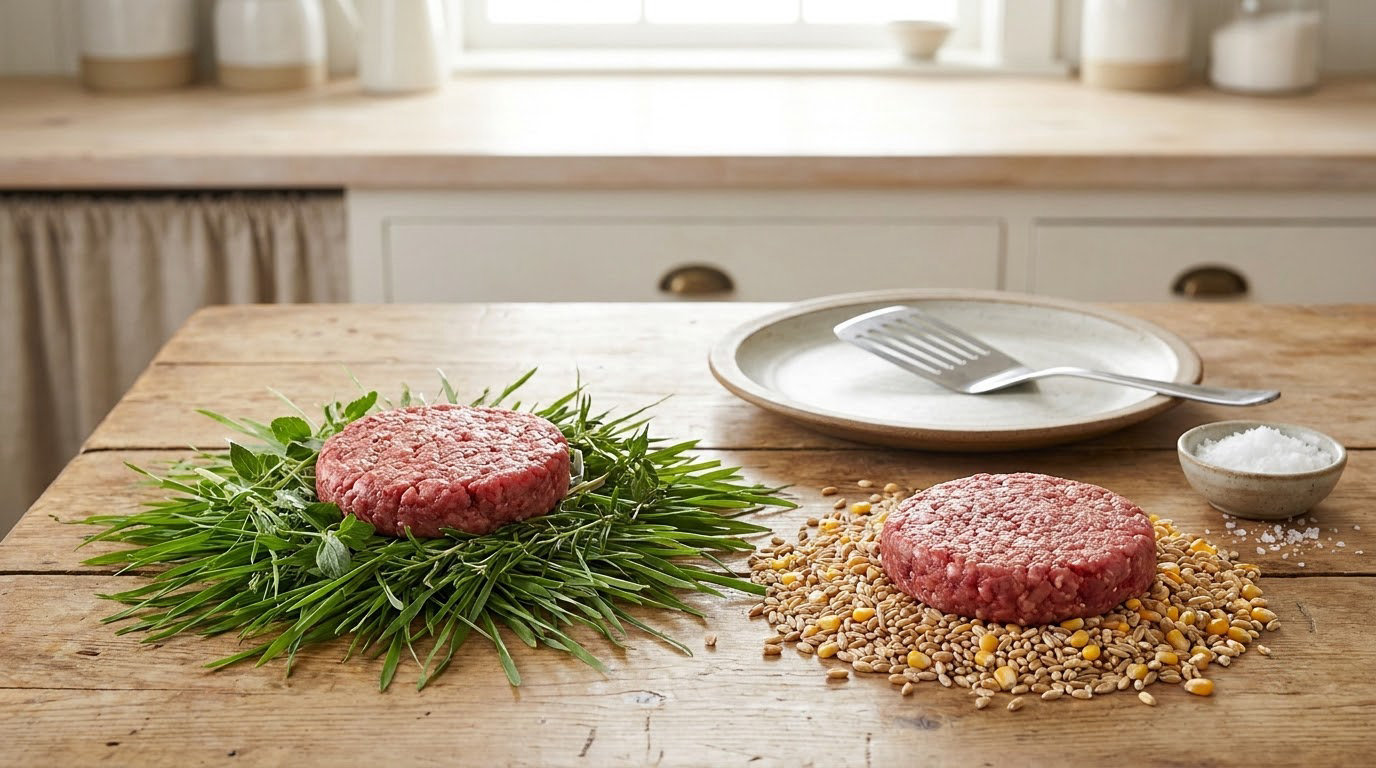
Grass fed vs grain fed beef for burgers comes down to one trade: grain-finished beef gives you a fatter, milder, juicier patty, while grass-fed beef gives you a leaner, more intensely flavored one that needs a little help. For most home cooks an 80/20 grain-fed blend is the easiest burger to make well. Grass-fed wins when you want a beefier flavor and are willing to blend in extra fat.
Here is how the two compare on the things that actually change dinner: flavor, fat and juiciness, nutrition, cost, and how each behaves on the grill.
Table of Contents
- Grass Fed vs Grain Fed Beef for Burgers at a Glance
- How Does Grass Fed Beef Taste in Burgers?
- How Does Grain Fed Beef Taste in Burgers?
- Texture and Fat: Which Beef Makes a Better Burger?
- Nutrition: Is Grass Fed Beef Healthier?
- Price, Availability, and Best Burger Uses
- Which Should You Choose?
- Frequently Asked Questions
- Bottom Line
Grass Fed vs Grain Fed Beef for Burgers at a Glance
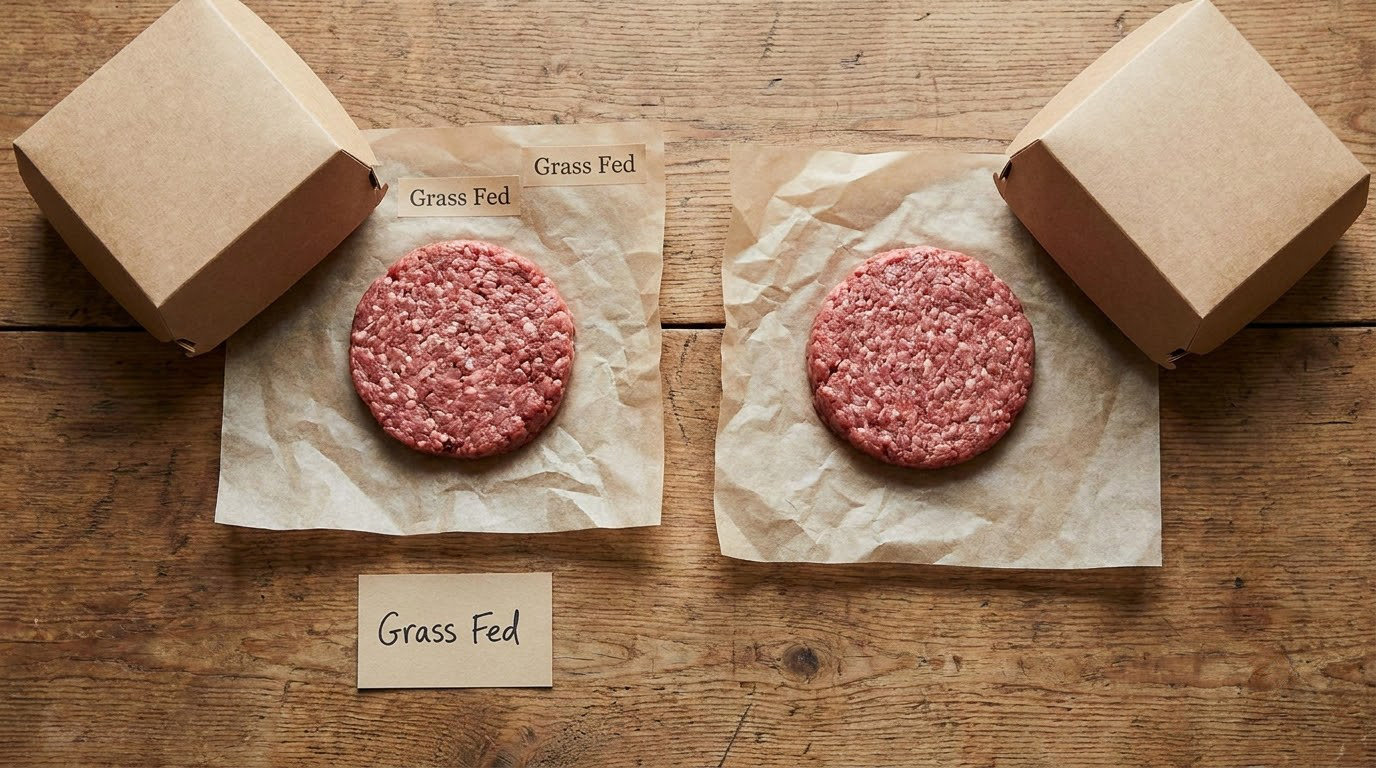
| What changes | Grass fed beef | Grain fed beef |
|---|---|---|
| Flavor | Intensely beefy, earthy, grassy or mineral notes | Mild, slightly sweet, buttery |
| Fat and marbling | Lean, little intramuscular fat | More marbling, visibly fatter |
| Juiciness | Drier unless blended or cooked gently | Juicier straight from the packer |
| Color | Darker red lean, yellowish fat | Bright red lean, white fat |
| Omega-3s | Noticeably higher | Lower, but not zero |
| Price per pound | Clear premium over conventional | Baseline |
| Forgiving on the grill | No, it punishes high heat and long cooks | Yes, hard to overcook badly |
| Best for | Flavor-forward burgers, lean blends, meal prep | Classic juicy burgers, smash burgers, feeding a crowd |
One important note on labels: grass-fed, grass-finished and grain-finished are not synonyms. A cow can be raised on pasture its whole life and still be finished on grain for the last few months before slaughter, and the label may still say grass-fed. The finishing diet is what changes the meat, so that last stage is the part to ask a butcher about.
How Does Grass Fed Beef Taste in Burgers?
Grass-fed beef tastes more concentrated, not milder. A cow that spends its whole life on pasture does a lot more walking, and the muscle develops more of the flavor compounds and a darker, leaner color. You will notice it before the toppings go on.
Three notes come up again and again:
- Grassy or green — a hay or clover note, most noticeable in raw ground beef.
- Mineral or iron-like — some people describe it as almost metallic.
- Gamey — a deeper, almost venison-adjacent taste that strong cheese and caramelized onions partly cover.
None of that is a flaw, but it is a different flavor than most burger patties people grew up on, and that gap is why some first-timers call it bad beef. Cooked through with salt, pepper and a hot sear, the grassy edge usually settles down and what remains is a deep, almost roasted beefiness that grain-fed ground rarely reaches.
How those flavor notes work with toppings
Strong, salty, sharp toppings suit grass-fed beef because they give it something to push against. Aged cheddar, blue cheese, bacon, caramelized onion and a smoky sauce all work. A plain bun with ketchup and nothing else will not do the grassy notes any favors. If you buy grass-fed and then reach for a mild cheddar and a sweet pickle, the contrast makes the meat taste more like an accident.
How Does Grain Fed Beef Taste in Burgers?
Grain-finished beef tastes sweeter and rounder, and that is mostly a fat effect. Corn and other grains in a feedlot diet create more intramuscular fat, and more intramuscular fat means more buttery flavor in every bite.
It is why restaurant burgers taste the way they do. A grain-fed 80/20 patty has enough fat to stay juicy on a screaming-hot flat top, enough fat to brown into a proper crust, and enough fat to make the burger taste richer than its own seasoning. The flavor is less about depth and more about comfort.
There is also a consistency argument. Steers on the same feed program arrive at the butcher with a predictable fat ratio, so an 80/20 blend performs the same way in March and in August. That predictability is a big part of why burger joints use it, and why most people never think about it.
Texture and Fat: Which Beef Makes a Better Burger?
Fat is the whole story here. Fat gives a burger juiciness, flavor, browning and structural hold. Take it away and you get a patty that is dry on the outside, tough in the middle and prone to falling through the grill grate.
The persistent complaint on burger and grilling forums is that grass-fed meat labeled 80/20 often cooks like a 90/10. Less connective and intramuscular fat means less rendered fat in the pan, so the patty seizes, contracts and dries out faster. Grass-fed fat also renders at a different rate than grain-fed fat, which is why users report seeing noticeably less grease in the skillet even when the printed ratio is identical.
Blending fat back in
If you love grass-fed flavor and keep hitting dry patties, add fat rather than lowering the heat and hoping. A few formulas that work:
- 85/15 grass-fed ground mixed with 15% rendered beef tallow for a firm, grill-friendly patty.
- 90/10 grass-fed with a tablespoon of grated cold butter worked in with a pinch of salt.
- 80/20 grass-fed plus a small splash of the rendered drippings from the previous batch.
Tallow adds beefy flavor with almost no change to the profile. Butter adds richness and a slightly lighter note. Both bind water that lean meat would otherwise lose. Aim for 20% added fat in total and pat out any excess grease before the patty hits the pan.
Matching the beef to the cooking method
Smash burgers need fat that stays on the surface, which favors grain-fed. A thin, dry grass-fed patty smashed on a hot flat top will stick and tear. Thick, slow-cooked or low-and-slow patties favor grass-fed, because the gentle heat gives lean meat time to cook without scorching the outside. Reverse-seared patties on a grill also suit grass-fed: indirect heat first, a fast sear at the end.
Nutrition: Is Grass Fed Beef Healthier?
Grass-fed beef is leaner and carries more omega-3s, but that does not make it automatically the healthier burger. A 20% fat grain-fed patty can have more total fat and calories than an 85% lean grass-fed patty, and the burger you build around it changes the nutrition more than the finishing diet does.
| Per 4 oz cooked patty, typical | Grass fed (lean blend) | Grain fed (80/20) |
|---|---|---|
| Calories | Roughly 240-280 | Roughly 300-340 |
| Total fat | About 15-18 g | About 24-28 g |
| Protein | About 22-25 g | About 20-22 g |
| Omega-3 (ALA) | Higher, often several times the grain-fed level | Lower but measurable |
| Vitamin E | Higher | Lower |
| Saturated fat | Lower in a lean blend | Higher in an 80/20 blend |
For the record, that is a finishing-diet difference, not a quality difference. Grass fed vs grain fed beef for burgers is mostly a question of which trade you want, not which beef is better beef. Read those numbers as ranges, not facts about a specific package. Composition varies with breed, diet length, season and cut, and only the label tells you what is actually in the ground. If you are tracking fat, sodium or omega-3 intake for a medical reason, a registered dietitian can help you build a plan around labels rather than categories, and your doctor is the right person for anything specific to your health.
Two questions come up that have a factual answer. On antibiotics and hormones, the main difference is that grass-fed and organic programs generally restrict routine antibiotic use, while conventional beef in the US is also subject to national rules on antibiotic overuse, so the gap is narrower than marketing implies. On bacterial risk, grain-finished cattle spend more time in high-density lots, and the guidance for ground beef does not change: cook it thoroughly.
Price, Availability, and Best Burger Uses
Grass-fed ground beef carries a real per-pound premium, and for large-batch cooking it adds up quickly. Eight quarter-pound patties is a lot of beef to buy at a premium, and that is why so many people buy grass-fed for flavor-forward weekend burgers and conventional for weeknight meal prep.
Availability is the other half of the equation. Conventional 80/20 is in every supermarket and most butchers. Grass-fed ground beef is patchier, quality varies a lot between producers, and a package labeled grass-fed is not a guarantee of grass-finished. If you care about how the cow was raised, the American Grassfed Association certification is the label that actually means grass-fed for the animal’s life, and a butcher shop or direct-from-rancher route gives you the most consistent quality.
Which type fits which burger
- Everyday dinner burgers for a family — grain-fed 80/20. Cheaper, forgiving, consistent.
- Flavor-forward weekend burgers — grass-fed 85/15 with a spoonful of tallow, served with sharp toppings.
- Smash burgers — grain-fed. Fat on the surface is what gives you the lace.
- Meal prep on a budget — grain-fed, formed into patties and frozen individually.
- Lean and high-protein burgers — grass-fed 90/10 with butter grated in, cooked gently.
- Freezer storage — either, if you portion it into patties before freezing.
Which Should You Choose?
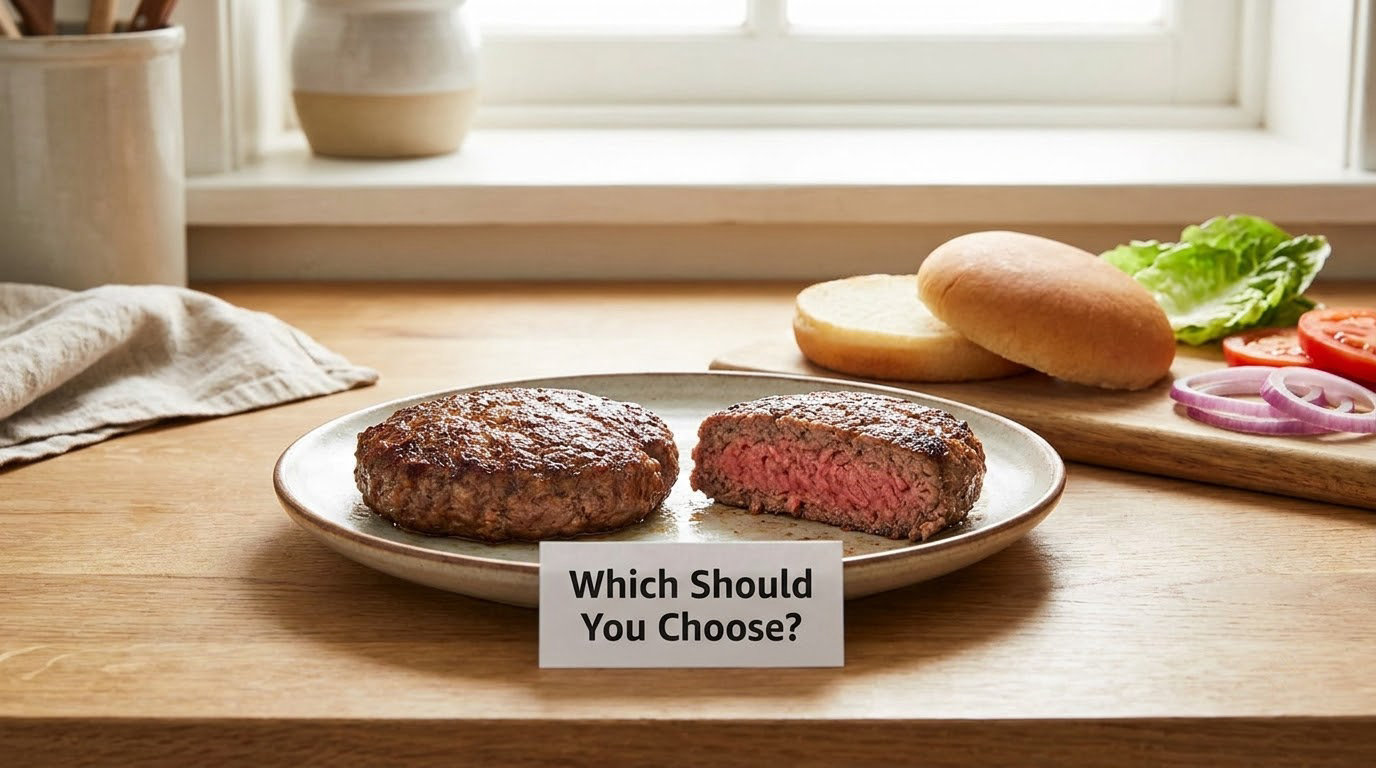
Buy grain-fed 80/20 if you want the easiest, juiciest, most consistent burger and you are cooking for more than two people. Buy grass-fed if you want a deeper, more distinctly beefy flavor, you are cooking a small batch, and you are willing to add fat and keep the heat moderate.
If you want the honest middle path, buy grain-fed and treat it well: 80/20, coarse ground if your butcher can do it, salted at least 15 minutes before it hits the heat, and a hard sear on one side only. Careful treatment of an 80/20 gets you most of what people are chasing when they spend extra on grass-fed.
How to cook grass-fed patties without drying them out
- Add fat first. Blend in tallow or grated butter to land near 20% total fat.
- Salt ahead. Season 15 to 30 minutes before cooking. Salt early draws a thin protein gel onto the surface that holds moisture and gives you a better crust.
- Do not work the meat. Handle the ground as little as possible. Mixing kneads in myosin and makes the patty springy and tight.
- Keep heat moderate. Lean beef has no fat buffer to survive a screaming-hot sear. Medium heat, or a two-zone fire with most of the time on the cool side.
- Stop early. Pull the patty well before you think it is done. It carries residual heat and continues cooking on the bun.
- Rest it. Three to five minutes before serving lets the juices redistribute instead of running out on the first cut.
Whatever the beef type, cook ground beef to a safe internal temperature of 160°F (71°C) and use a thermometer. It is the one step in burger cooking you should never eyeball.
Frequently Asked Questions
Is grass fed beef better for burgers?
It depends on what you want from the burger. Grass-fed beef has a deeper, earthier flavor and is leaner, but it is drier and easier to overcook. Grain-fed 80/20 is fatter, milder and more forgiving, which is why most burger joints use it. Cooks who add fat and use moderate heat are usually happy with grass-fed; cooks who want a juicy, consistent patty on the first try are usually happier with grain-fed.
Which type of beef is juicier for hamburgers?
Grain-fed beef is juicier out of the packer. It carries more intramuscular fat, so it stays moist through a hot sear and keeps rendering fat during cooking. Grass-fed beef can be made very juicy by blending in tallow or grated butter to around 20% total fat, salting the patty ahead of time, and using moderate heat instead of a screaming-hot grill.
Is grass fed beef less fatty than grain fed beef?
Grass-fed beef is usually leaner, with less intramuscular fat and fewer calories per patty. Grain-finished cattle generally show more marbling because a grain diet encourages fat deposition, so an 80/20 grain-fed blend typically has more total fat than a comparable grass-fed blend. Note that the printed fat ratio on grass-fed packages often overstates how the meat behaves in practice, because grass-fed fat renders out of the patty faster.
Does grass fed beef taste grassy or gamey?
Sometimes, and it is the reason a lot of people decide grass-fed is not for them. Cattle raised on pasture develop a more intense beefy profile with grassy, mineral or gamey notes that grain-finished beef rarely shows. The grassy edge is strongest in raw ground beef and settles down once the patty is salted, seared and served with strong toppings like aged cheddar, blue cheese or caramelized onion.
How should I cook lean grass fed burger patties?
Add fat before you add heat. Blend tallow or grated butter into lean grass-fed ground to reach roughly 20% total fat, season 15 to 30 minutes ahead, and cook over medium heat rather than a very hot grill. Handle the meat gently, pull the patty before it looks done, and rest it three to five minutes. Always verify 160°F (71°C) with a thermometer.
Can I freeze ground beef made from grass fed or grain fed cattle?
Yes, and freezing works the same way for both. Press the ground into quarter-pound or half-pound patties, separate them with parchment paper, and freeze them in a single layer before bagging so they do not stick together. Thaw in the refrigerator rather than on the counter. Grass-fed patties benefit most from this because forming them ahead of time lets you thaw a portion without handling the whole block.
Bottom Line
Grain-fed 80/20 is the better burger for most people on most nights, and grass-fed is the better burger for cooks chasing a deeper flavor and willing to add fat. That is the whole of grass fed vs grain fed beef for burgers: pick the trade, not the label. Start at the butcher counter this week, ask whether the beef is grass-finished, buy the smallest package of each, and cook both the same way with a thermometer. Two packages and one dinner will tell you more than any label does.