
How to write a food review that people trust comes down to method, not enthusiasm. Go deep enough to form a real opinion, describe the food in concrete detail, separate your taste from the kitchen’s execution, and disclose anything you were handed for free. Those four habits do most of the work.
A trusted food review is a specific, evidence-based account of what a restaurant actually served: what you ordered, what it tasted and felt like, what you paid, and what you were given, written so a reader can decide for themselves whether it suits them.
Reviews that fail tend to fail one of two ways. They’re unverifiable enthusiasm — amazing food, must visit, everyone will love it — or they’re vague complaints that leave the next diner with nothing to act on. On a Google Maps thread about writing fair negative reviews, the repeated complaint was blunt: if you state that the food is bad, you are not saying much.
Both problems are fixable with the same six steps below. Most people can do the whole thing in about twenty minutes of writing once the notes exist.
What You Need
Five things make a review possible, and four of them you gather before the first bite rather than after it.
- A recent dining experience. Same day is best. Yesterday is fine. A memory from three months ago is where details start going soft, and readers can hear it.
- Note access. Your phone’s notes app is genuinely enough. A paper notebook works better than you’d think, because writing the note takes thirty seconds more than typing a three-word impression.
- The menu, read before you order. Not just to pick dishes. Reading first tells you what the place claims to be, which you will want later when you compare the promise to the plate.
- Restaurant basics. Name, address, neighborhood, the kind of place it is, and roughly what you spent per person. Readers need these to decide if it’s even their kind of place.
- A clear opinion you can defend. If you can’t explain why something was good or bad, you don’t have an opinion yet. You have a mood.
Time matters more than people expect. Rushing the write-up is how unfair reviews happen — the annoyance from two weeks ago gets mixed into a plate you actually liked.
Step-by-Step: How to Write a Food Review That People Trust
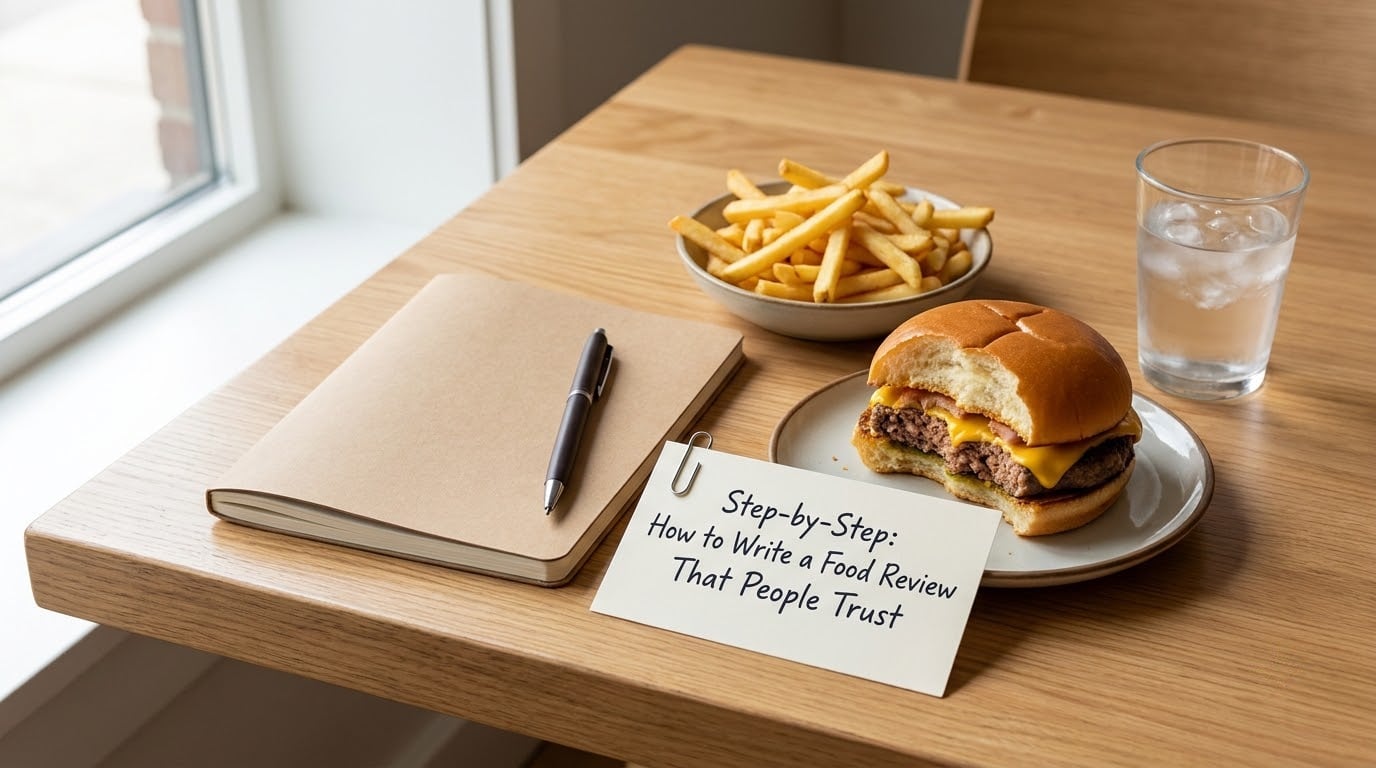
Six steps in order. Each one adds something a reader can check for themselves, and each step below includes a quick way to tell whether it worked.
Define the experience and its context
Open by stating what you reviewed, where and when, and who the review is for. Day and time matter more than most writers admit: a weekday lunch and a Friday dinner are two different restaurants.
Then set expectations honestly. In a r/Yelp discussion, readers argued that a rating should reflect whether the restaurant delivered what it advertised, not whether the reviewer personally likes that style of food. That is a good test to write against.
You also need to admit the shape of your visit. One visit with two dishes is a normal person’s review and you can say so. A headline verdict for a place you visited once and ordered the server’s favorite is not something you can support yet. It worked if a reader could tell in one sentence how much of the place you actually saw.
Take useful notes while the meal is fresh
Write notes as you eat, not after you leave the parking lot. Memory smooths edges: the sauce that tasted sharp at the table becomes just good in a recap.
Run each dish through a short sensory grid:
- Flavor — what dominates, and what balances it. Not “good flavor,” but smoky and sweet with a sour cut at the end.
- Texture — crisp, rubbery, dry, creamy, flaky, dense.
- Temperature — arrived hot, went cold fast, lukewarm in the middle.
- Aroma — what you smelled before the first bite.
- Balance — was anything fighting anything else?
- Presentation — and how well it survived the trip from kitchen to table.
Add logistics while they’re still knowable: what you ordered, roughly what it cost, how long the wait was, portion size against the people you were feeding.
Buns deserve their own note. A burger that falls apart in your hands is a fact about the plate, not a complaint, and there’s a useful guide on choosing burger buns that hold up if you want to know whether the culprit was the bread or the cooking.
It worked if, reading your notes cold a week later, you could still describe each dish without inventing anything.
Separate description from judgment in a food review
Describe what is on the plate first. Only then say what you think of it. Blending the two is why reviews read as rants.
Weak: the burger was amazing and the fries were soggy.
Stronger: the patty had a dark, crisp crust and stayed juicy all the way through, while the fries sat about ten minutes before arriving and had gone soft in the middle.
The first sentence asks the reader to trust your enthusiasm. The second gives them two things they can picture, which is the whole job. It worked if someone could disagree with your sentence on the evidence.
Support opinions with specific evidence
Every broad reaction needs a cause attached. Delicious, overpriced, and not worth it are verdicts; the ingredients, preparation, portion, and value behind them are the argument.
- Delicious becomes: the braising was seasoned properly and the meat fell apart at a glance, not just on the second chew.
- Overpriced becomes: the plate was generous but nothing about it was difficult, so you could have assembled something similar at home for a fraction of the bill.
- Not worth the wait becomes: forty minutes for a burger that came out lukewarm, and the fries were the only thing that needed the hot hold.
Skip foodie shorthand nobody outside your circle can parse. If a word would need a follow-up question, use a plainer one. It worked if your strongest claim could be traced back to something a reader could go and order.
Give a fair, balanced verdict
A review with nothing but praise reads as an advertisement, and readers discount the whole thing. Name at least one thing that fell short, and be honest about whether it was the kitchen’s fault or the menu’s fault.
Also separate two different things: whether you liked it, and whether they did it well. Someone who dislikes a whole category of cuisine can still give an accurate account of a technically excellent plate, and saying both at once is more useful than picking one.
Finish by naming who should order here — the smash-burger people, the weekday-lunch crowd, the vegetarian looking for a real entree. Calibrate your stars to what you actually say: if your single complaint is that the fries cooled too fast, that is not a four-star meal you wish you’d had, it is a good meal with one flaw. It worked if your rating and your description say the same thing.
Edit for clarity, honesty, and usefulness
Read the draft once with fresh eyes and cut in a specific order:
- Strike vague adjectives — excellent, amazing, incredible — that carry no information on their own.
- Strike superlatives you can’t back up, especially anything about the whole city.
- Remove identifying details about individual staff. A manager in a small room is a person, not a character, and businesses can and do respond.
- Separate what you observed from what you inferred. You observed a 20-minute wait; you inferred they were understaffed.
- Leave out accusations about hygiene, staff conduct, or an owner’s motives unless they are firsthand and factual.
- Confirm your disclosure line is still there, and that nothing reads as hostile. Firm is useful. Personal costs you readers.
It worked if a stranger could act on it: order this, skip that, go on a Tuesday, bring cash.
Common Mistakes
Most lost-trust reviews share one of a handful of fixable problems.
Writing the verdict instead of the evidence. The food was bad tells the next diner nothing. Say what arrived, what was wrong with it, and what you would order instead.
Reviewing one dish as if it were the restaurant. You picked a single item from a menu of thirty. Either order a cross-section on your next visit and say you did, or state plainly that you only tried the one thing.
Blurring the food with the room. A slow server and a great burger are two different ratings. Score food, service, room, and value on their own lines so a reader can disagree with one and keep the rest.
Praising instead of assessing. If every sentence is a compliment, you have written an ad. Name the dish you’d come back for and the one you wouldn’t.
Skipping the disclosure. A free meal, a discount, a friend’s kitchen, or a comped dessert changes what the reader should expect from your opinion. Saying so up front costs you nothing and buys you a lot of credibility.
Writing it while still angry. Bad experiences lodge. Draft notes immediately, then write the review the next day.
When you genuinely dislike a place, the same rules apply with more force. Be exact, be calm, and skip anything you would not say to the person’s face.
When you are unsure, say unsure. “The menu changes often and this version was heavier than I expected” is a sentence readers respect far more than a confident guess.
And when two visits told you different stories, publish both. Contradictions are the most credible material a reviewer can offer — most confident food writing online has never seen a contradiction at all.
For anyone cooking their way through a review, keeping the prep honest matters as much as the writing does. Getting the protein right in the first place, as in how to make burger patties that hold together, removes a whole category of complaint before you sit down.
Frequently Asked Questions
How long should a food review be?
Short enough that people finish it, long enough to carry the evidence. For a public rating, three or four specific sentences is plenty. For a blog review or round-up entry, 300 to 500 words with a dish-by-dish section works well. Length is not what earns trust; concrete detail is. If your review is running past 800 words, ask whether the extra paragraphs are adding evidence or just heat.
How do I write a negative food review fairly?
Describe what happened before you deliver a verdict. Name the dish, the problem, and the moment it happened, then say what you would have expected instead. Write it calm and assume the reader wants to know how to order around the issue. Politeness does not cost you honesty, and a specific complaint helps the next person far more than a blunt verdict.
Should a food review mention the price?
Yes, briefly and usefully. Readers use price to decide whether a place suits an occasion, not just whether the food is good, so give a rough figure per person or per dish. Pair it with what you got for it, because value is a comparison rather than a number. If the restaurant is expensive, say whether the portion, the service, or the setting earns it.
How do I know whether my opinion is trustworthy?
Test it three ways. Can you explain what specifically made it good or bad, can someone else picture the dish from your words, and would a person with different tastes still understand your reasoning? If all three hold, your opinion is defensible even when a reader disagrees with it. Trust comes from having a defensible opinion, not from being right about everything.
Can I review a restaurant if I worked there?
You can, but say so in the first line. Former staff carry real knowledge of a kitchen, and readers value that, but they also assume access and bias. State that you worked there, give the dates, and describe your assessment in the same concrete terms you would use as a customer. Most platforms let you mark a connection to the business, and using that option is the straightforward move.
How should I disclose a free meal or sponsored visit?
Put it in the first two sentences, in plain words, rather than in a footnote. Something like the kitchen treated us to dinner and I paid for my own drinks is enough. Then write the rest of the review exactly as you would otherwise, including the criticism. Disclosure usually increases trust rather than reducing it, because readers are deciding whether to believe you, not whether you were invited.
Start tonight: write down what you ate while you still remember the temperature of it. Everything else on this list follows from those notes, and readers can tell the difference between a review built on them and one built on mood.