
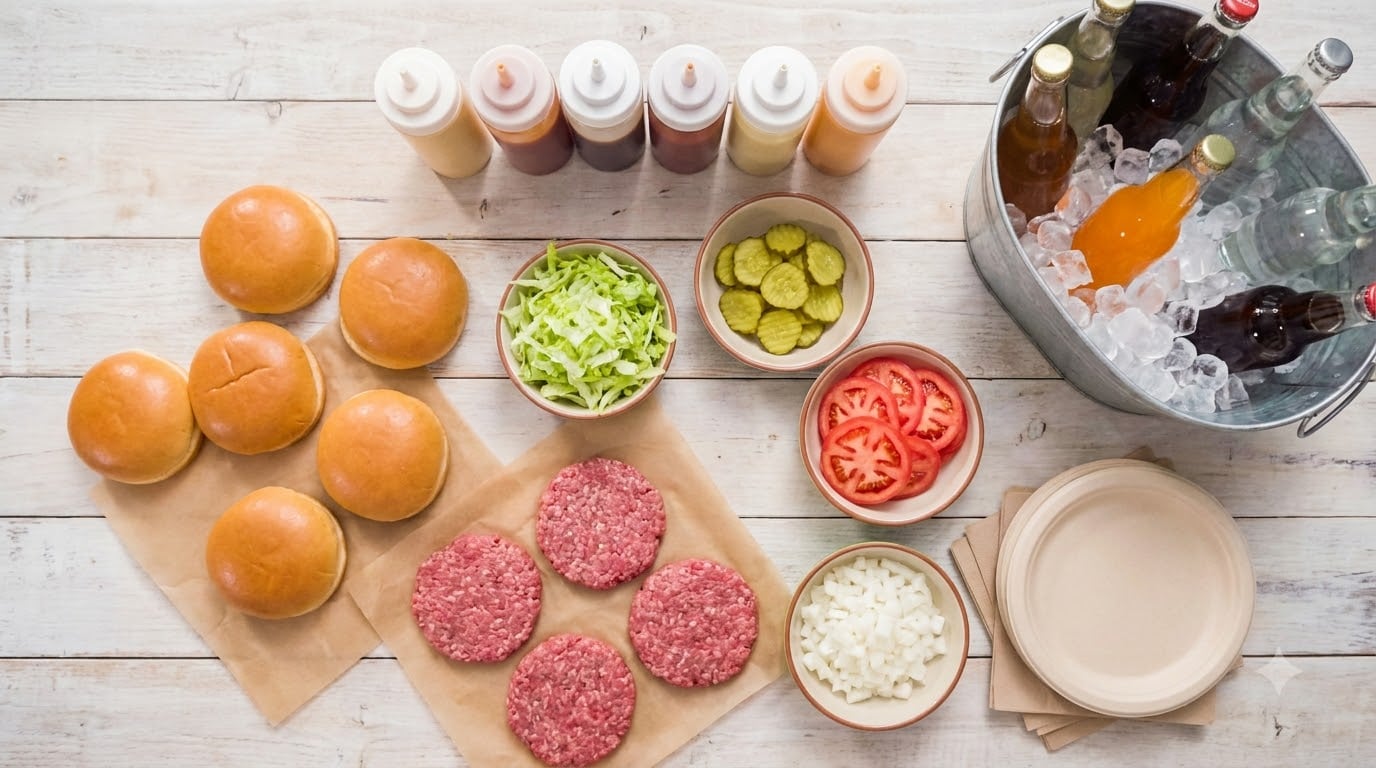
To plan a burger themed party menu, settle the format first, count your guests, then scale everything off one number: 1.5 to 2 quarter-pound patties and about 1.5 buns per adult, plus a topping bar, two or three sides and a drink station. The planning itself takes an afternoon of thinking and about twenty minutes of shopping math. The cooking fits into a single grill session if you keep the menu to two or three proteins.
The reason a burger spread works so well for parties is that one lineup feeds meat eaters, vegetarians, kids and the pickiest person in the room. Guests assemble their own plate, so you cook once and nobody stands in a serving line waiting on a platter to be passed around.
What You Need
Most of the work happens before the grill ever heats up. Gather the planning pieces and the serving gear first, then decide what to buy.
- A final guest count, with a separate note for children, since kids eat smaller portions and often prefer sliders.
- Dietary notes listing vegetarian, vegan, gluten-free and any religious restrictions among your guests, with numbers rather than vague guesses.
- Cooking equipment sized to the crowd: a grill or griddle that holds 12 to 16 patties per batch, plus a sheet pan for holding cooked burgers.
- Cooling and holding gear, including an insulated drink tub, a bowl of ice, and a chafing dish or a low-s burner for keeping patties hot without drying them out.
- Trays and shallow containers for every topping, each with its own serving spoon or tongs so nothing gets double-dipped.
- Paper or metal plates, napkins, and one drink cup per guest plus a spare round for refills.
- Labels or tent cards for anything that is not an obvious ingredient, especially gluten-free buns, plant-based patties and any nut-based sauce.
- A timer and a written timeline so the sides, the burgers and the dessert come to the table in the right order instead of all at once.
Step-by-Step: How to Plan a Burger Themed Party Menu
1. Choose the burger-party format
A burger bar puts every component out in labeled bowls so guests build their own. It suits a crowd, a mixed-age group and anyone who wants variety, and it scales cleanly past 25 people.
A family-style spread works better for smaller groups, roughly 10 to 15, where you plate a few signature burgers onto a board and bring it to the table. A grilled menu suits hosts who want to control quality: you cook a set of three named burgers and hand them out. A build-your-own station is the middle ground, with patties and toppings but no cheese, for a simpler line.
Pick the format before you write the shopping list, because it changes your quantities. A full burger bar needs roughly twice the topping variety of a plated menu, since guests will spread the same patties across more options. Whatever the format, the bun matters more than most hosts expect; picking the wrong one turns a great patty into a mess, and there is a solid guide on how to choose burger buns that do not fall apart.
2. Calculate how much food to make
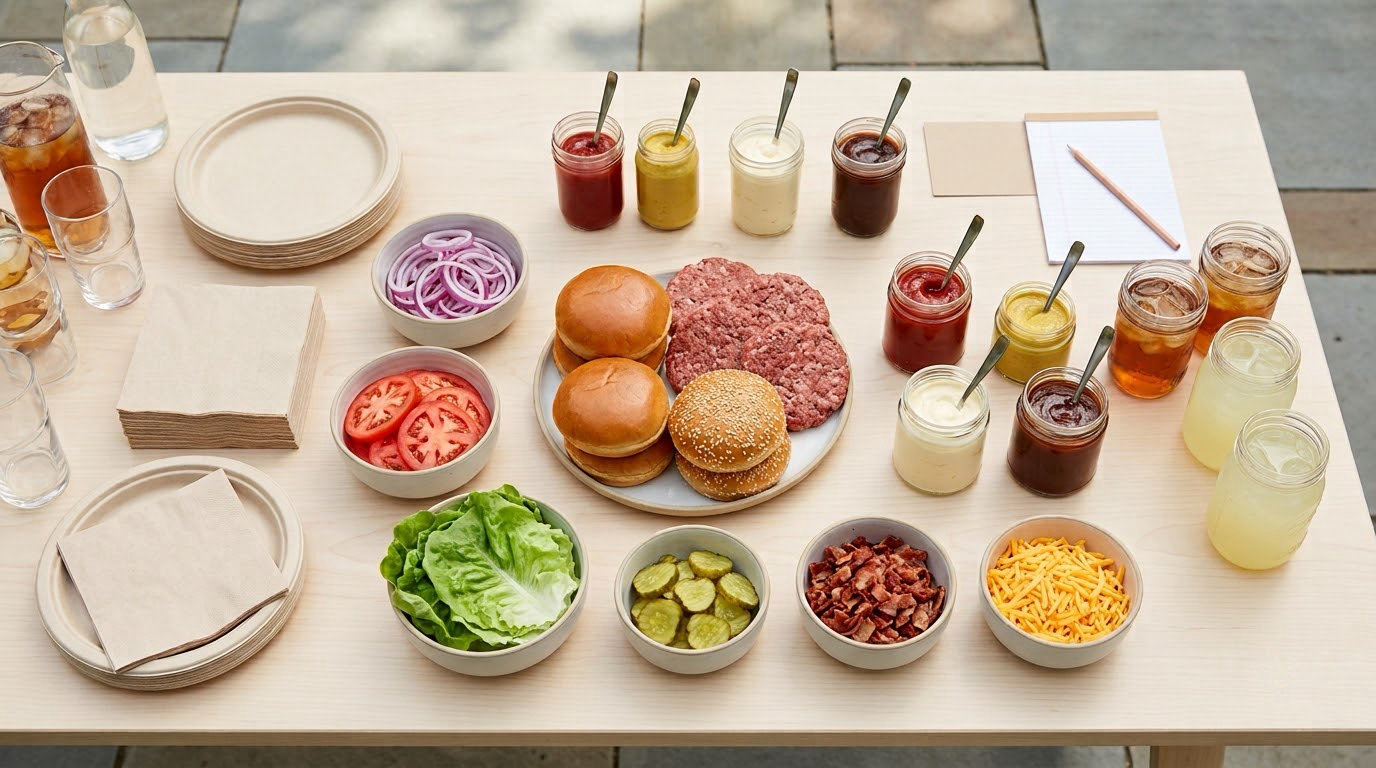
Start with 1.5 to 2 quarter-pound patties per adult, and use 2 for a hungry crowd or a summer cookout where people are active. Children under about eight usually count as half an adult, and many of them eat more happily from a slider than from a full-size burger. Buns follow a similar pattern: about 1.5 per adult, and buy one in ten more than you think you need, because the spare stays useful as a backup for anyone who tears a bun mid-build.
For sides, plan on about 1 cup of fried or potato-based sides per adult and slightly less for guests who are known to load up on burgers. Salads and slaws go a little heavier, around 1.25 cups, since they are lighter. For toppings, roughly a quarter of a chopped onion and half a tomato per adult keeps waste low; pickles and sliced cheese work out to about two slices per person.
Sauces are the item most hosts underbuy. Put out about 2 tablespoons per adult per sauce, which means a 16-ounce bottle covers roughly 24 people at a single sauce station. Drinks usually need one per person, with roughly 20 percent more if you are planning an afternoon cookout rather than an evening meal.
Scale that up for larger parties. For 20 guests, buy 35 to 40 patties and 30 buns. For 50 people, most hosts land on 90 to 100 patties, 80 buns, and 6 to 8 side trays, and the cooking job needs two grill stations or staggered batches to keep the line moving.
3. Pick a balanced main menu
Two to three burger styles is the sweet spot. More than that and you are buying, prepping and storing ingredients for a menu nobody finishes.
- Classic cheeseburgers are the safe anchor: one beef style, one cheese, lettuce, tomato, onion. They sell out first at almost every party.
- A signature burger adds the theme, such as a bacon burger with smoky cheese, a blue cheese and caramelized onion burger, or a southwestern burger with pepper jack and charred corn.
- A plant-based or mushroom option keeps vegetarian guests genuinely included rather than served an afterthought. Portobello caps and shredded cheese mushrooms both work on a grill, and a plant-based patty handles the same bun queue.
- Sliders solve two problems at once: they suit kids, and they let you offer a different flavor without running a second grill.
When you form the patties yourself, freeze or chill them at least an hour ahead. Cold patties hold their shape on the grill instead of falling apart at the flip, and there is a straightforward method in how to make burger patties that hold together.
4. Add sides that complement the burgers
Two or three sides is plenty. Four or more turns the table into a buffet nobody finishes and leaves you with leftovers to pack.
Fries are the obvious pairing, and a large batch serves roughly 10 adults. Loaded fries turn the same tray into a destination by you add cheese sauce, bacon and scallions after it comes out of the oven. Potato salad and slaw are the best make-ahead choices since they hold for hours at room temperature, and neither competes with the burger for attention. Grilled corn on the cob, a simple green salad with a vinegar dressing, or a tray of roasted vegetables all work for a summer party.
Logistics matter more than the recipe here. Anything fried should go out last so it stays crisp, anything dressed should be kept cold until close to serving, and anything that has to sit in the oven is best started before the burgers hit the grill. Plan a serving utensil for every side and place the busiest side closest to the end of the table.
5. Set up toppings, sauces, and drinks
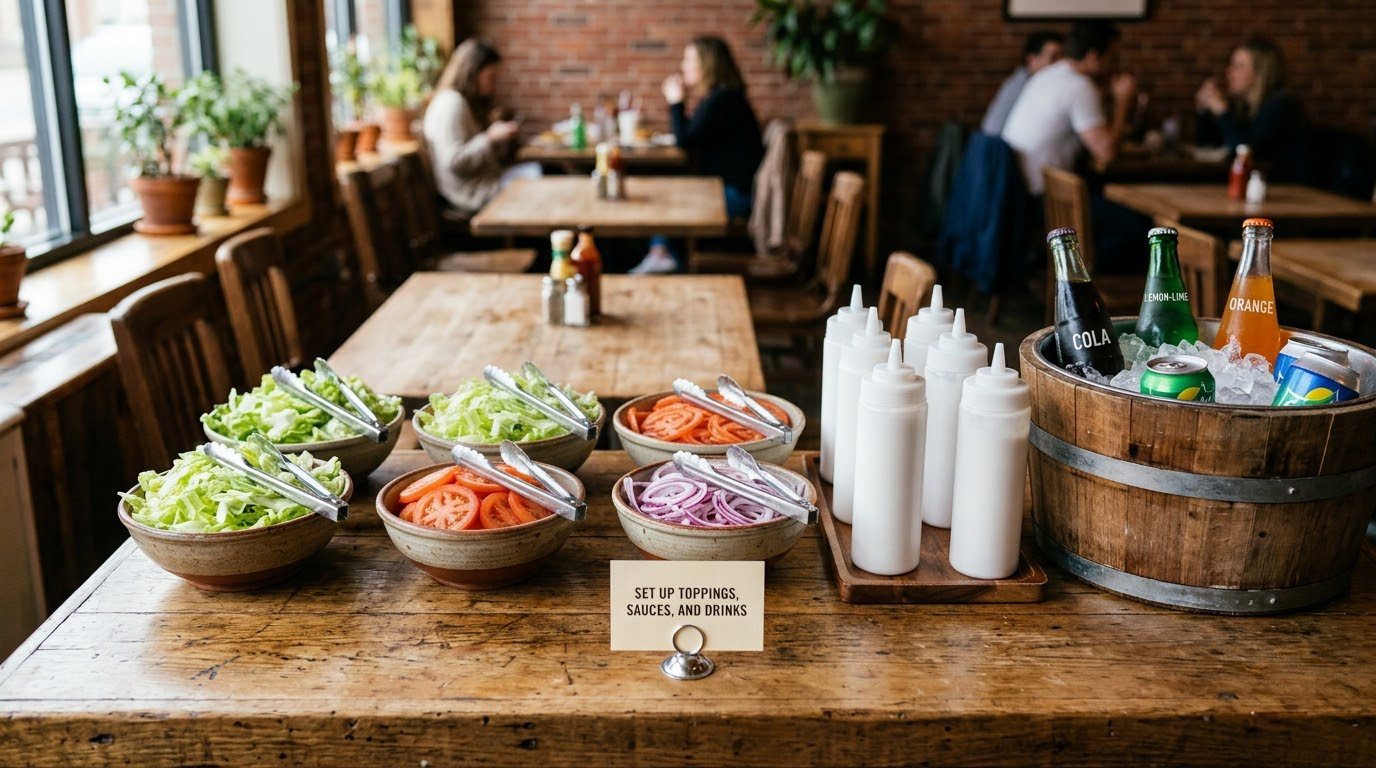
Arrange toppings so they read in the order a burger is built: lettuce and onion first, then tomato, then cheese, then pickles and condiments. Put the essentials within reach and the fancier items at the far end, which quietly nudges guests to try them.
A good lineup mixes the familiar with something worth discovering. Chopped lettuce, diced tomato, sliced onion and dill pickles cover most builds. Then add one or two of these: caramelized onions, crispy bacon, roasted peppers, crumbled blue cheese, avocado slices, or grilled mushrooms. For sauces, offer ketchup and mustard, then two that are not in a bottle, such as a house burger sauce, a chipotle mayo, or a sharp mustard. If you make your own, a five-minute blender recipe is easier than it sounds.
For drinks, keep it short: beer and a hard seltzer if the crowd is adult, a couple of sodas in a tub with ice, iced tea, and plenty of water. Fill a separate drink table away from the food so people stop at the burgers with wet hands and nobody walks the length of the table mid-build.
Label anything unusual. A tent card on a plant-based patty tray and one on a gluten-free bun basket takes two minutes and prevents the awkward mid-party conversation.
6. Prepare, serve, and clean up efficiently
Two days out, buy everything except the buns and the salad greens, and make the sauces, the potato salad and the slaw. The night before, shape the patties, cover them and put them in the fridge. Buy the buns in the morning so they are not stale or squashed by anything heavy placed on top.
On the day, light the grill well before guests arrive, since a cold-start grill eats fifteen minutes you wanted for seating people. Cook in batches, and move finished patties to a sheet pan in a single layer. Holding cooked patties in a single layer on a warm pan, loosely covered with foil, keeps them from steaming themselves soggy. If you need longer holding, a low burner or chafing dish set to keep food at 140°F or hotter is the safer option than leaving the grill on high.
For food safety, keep raw patties under 40°F until they hit the grill and cook ground beef to 160°F. Any ground meat, including chicken and turkey patties, should reach 160°F, while any beef kept whole cooks to 145°F. Keep cold toppings and sauces on ice and swap the trays rather than topping them up, so nothing sits out for more than two hours, or one hour if the day is above 90°F.
Assign one person to restock. Watching for trays that drop below a quarter full and swapping them for full ones keeps the line moving without anyone waiting for a refill. For cleanup, box the leftover buns and the last patties before guests leave, and send cold leftovers home within two hours. Leftover patties reheat fine in a skillet for a couple of minutes per side, or in a low oven until they come to a safe temperature.
Common Mistakes
Buying too many different dishes. Five burger styles means five sets of toppings and a week of leftovers. Fix it by cutting to two or three mains and putting the energy into one excellent topping bar.
Forgetting dietary options. Treating a single veggie patty as the plan for a group with six vegetarians guarantees a line at the counter. Ask about restrictions when you set the headcount, then order for roughly a quarter of guests to eat plant-based and keep buns separate for anyone avoiding gluten.
Overcrowding one table. Twenty-five or more guests queuing at a single station turns a party into a waiting room. Fix it by splitting the build into two identical stations, one at each end of the table, and putting a topping set at each.
Underestimating sauces and sides. Burgers arrive first and sides follow, so sides that run out leave people eating plain. Set out more sauce than feels reasonable and refill the side trays once before you bring dessert out.
Leaving food out too long. A warm afternoon drains a shallow tray of potato salad in a hurry. Keep trays over ice, use smaller dishes and swap them often rather than refilling a big one.
Cooking everything at once. Burgers, fries and grilled corn all want the grill or oven at the same time, and something always burns. Cook in order of how long it takes, start the slow side first, and hold the finished items.
Frequently Asked Questions
How many burgers should I make per guest?
Plan 1.5 to 2 quarter-pound patties per adult, and go to 2 for a hungry crowd or an all-day cookout. Count children under about eight as half an adult, and buy roughly 1.5 buns per adult. Adding one extra bun for every ten guests covers the one that always gets torn or dropped.
What are easy sides to serve with a burger party?
Pick two or three, not five. Large batches of fries, potato salad, slaw and a simple green salad cover most parties and most of them can be made a day ahead. Loaded fries make the same tray feel special, while grilled corn or roasted vegetables suit a summer cookout without adding work.
How can I plan a burger menu for mixed diets?
Ask about restrictions when you confirm the headcount instead of guessing, then plan for about a quarter of guests to eat plant-based. That means 20 to 25 percent extra patties or portobello caps, buns kept separate and covered for anyone avoiding gluten, and clear labels on every tray so nobody has to ask mid-build.
Should I cook burgers ahead of time for a party?
You can, but plain reheated patties lose their crust. The better plan is to shape them a day ahead, keep them chilled, and cook in batches during the party so the last guest gets a burger as good as the first. For large crowds, holding finished patties on a warm pan under loose foil beats cooking everything in advance.
What should I put in a build-your-own burger bar?
Line it up in build order: plates and napkins, buns, patties, cheeses, then toppings such as lettuce, tomato, onion and pickles, then sauces, with sides at the end. Add one or two items that are not standard, like caramelized onions or a house sauce, so guests have something worth trying.
How do I keep burgers and toppings safe at a party?
Cook ground beef to 160°F and keep raw patties refrigerated until they hit the grill. Hold cooked burgers at 140°F or hotter, and keep cold toppings over ice. Do not top up a part-empty tray, swap it for a fresh one instead, and clear anything sitting out longer than two hours, or one hour in heat above 90°F.
Conclusion
Three things get a burger party from good to genuinely fun, and all three happen before you shop. Count your guests, including the kids and anyone eating differently, and pick a format that matches your grill and your serving style.
Then build one simple side, a topping bar and a sauce lineup on your shopping list. If you want the sauce to be the thing people talk about afterward, the five-minute version is on our burger sauce recipe page. Once those three pieces are set, the rest of the menu fills in from the quantities you already calculated.