
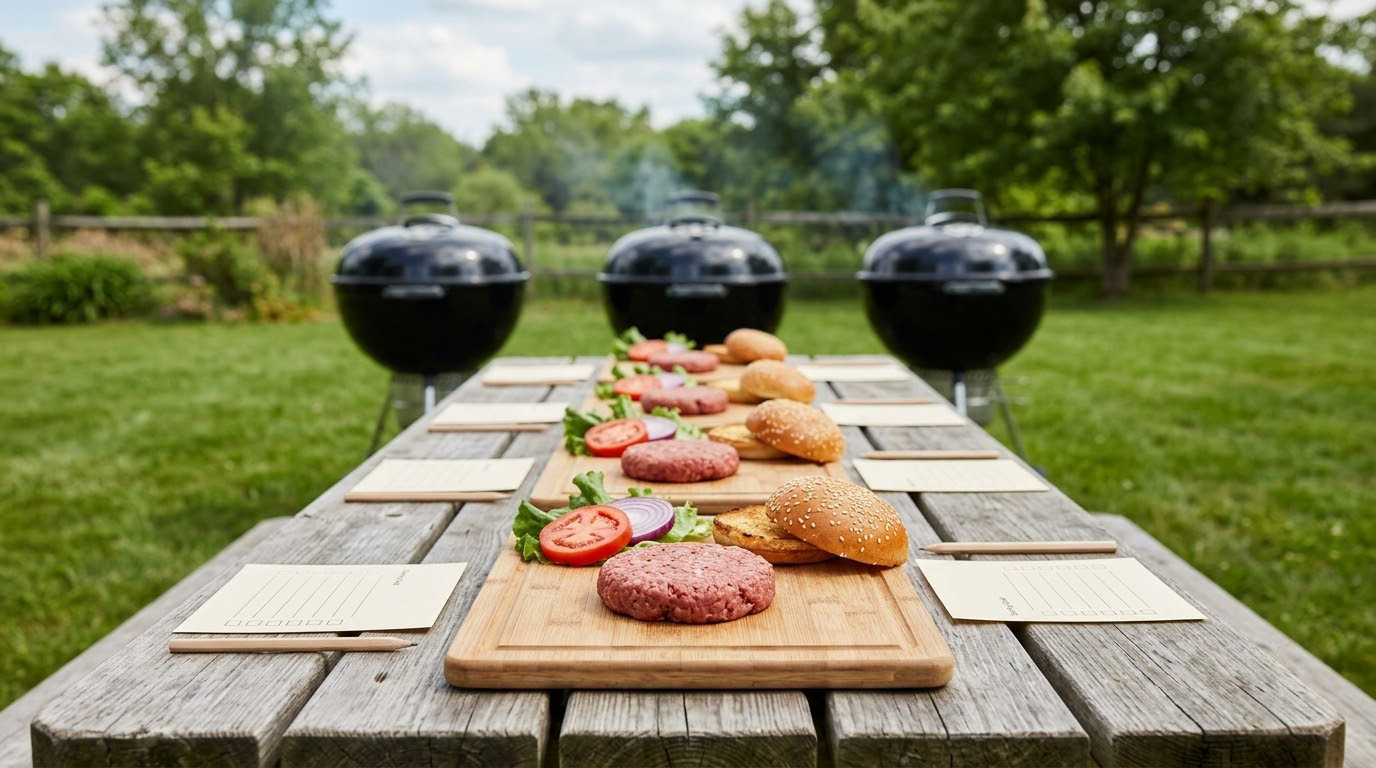
Hosting a burger cook-off is mostly five moving parts: a format, a written rules sheet, safe cooking stations, a scoring system, and a schedule everyone can see. Get those five right and the event runs itself. Get them wrong and you end up with cold burgers, an argument about scoring, and one friend quietly annoyed they lost to someone who brought a store-bought patty.
A good burger cook-off takes about four hours end to end, and most of that is prep you do the day before. Here is the version I’d actually run at a backyard: six to eight contestants, ten to twelve guests, one grill plus one electric griddle, and blind judging with three scorecards per judge. You can scale it down to four guests or up to a big family reunion with the same structure.
Table of Contents
- What You Need
- Step-by-Step
- 1. Choose the Format and Set the Rules
- 2. Decide What Competitors May Bring
- 3. Plan the Menu and Calculate Quantities
- 4. Set Up a Safe Cooking Station
- 5. Prepare Burgers and Toppings Ahead
- 6. Cook in Rounds and Keep the Schedule Moving
- 7. Create a Fair Scoring System
- 8. Serve, Announce, and Keep the Party Going
- Common Mistakes
- Frequently Asked Questions
- How many people should I invite to a burger cook-off?
- What is a reasonable budget for hosting a burger cook-off?
- Can I prepare the burger components the day before?
- What prizes work well for a burger cook-off?
- How do you judge burger cook-off entries fairly?
- How can I accommodate guests with dietary restrictions?
- Conclusion
What You Need
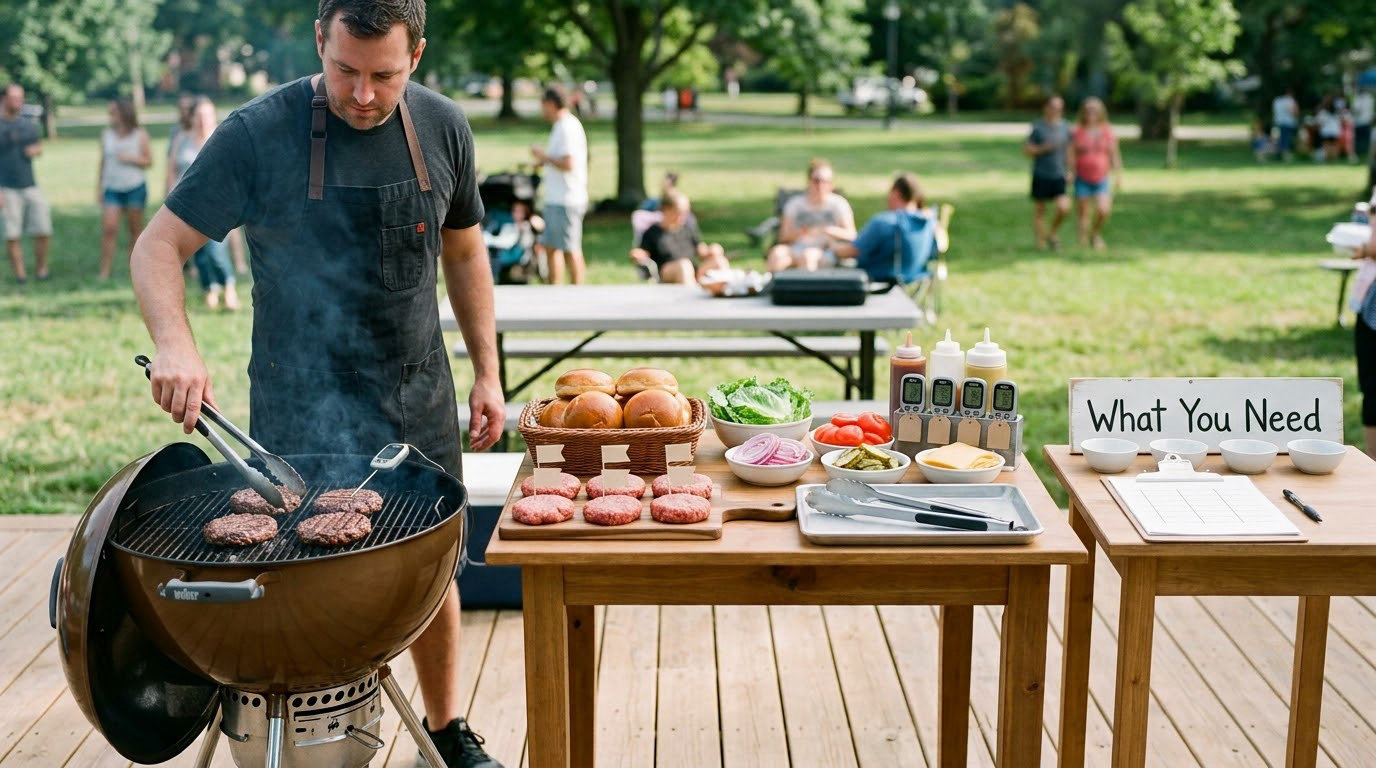
The list below covers a party of 4 to 12 guests and scales cleanly in either direction.
- Guest and contestant count. Decide who is cooking and who is only eating. Six to eight entrants is the sweet spot for a home grill.
- Cooking equipment. One grill or kettle plus one electric griddle gives you two stations. A single grill caps you around four contestants.
- Raw and cooked food separation. Two cutting boards, two sets of tongs, and a cooler or fridge space for patties that aren’t cooking yet.
- Thermometers. One instant-read for the grill and one for cross-checking. This is not optional if you’re feeding people.
- Base ingredients if the host is supplying them. Ground beef, buns, cheese slices, salt and pepper, plus one or two neutral condiments.
- Numbered toothpicks or flags. One per entry, with the entry number written on it. This is the whole blind-judging system.
- Scorecards. One per judge per entry, printed or ruled on plain paper. Count them: judges times entries, plus a couple of spares.
- Portion trays or small plates. Judges eat standing up. Holding a full plate and a scorecard makes for sloppy scoring.
- A palate cleanser. Plain crackers, bread pieces, or a splash of something neutral between entries.
- Food-safe storage. Ice for the drinks, and a cooler for patties that need to stay cold.
Add a small timing assumption to all of this: contestants arrive and set up at the same time, everyone cooks during one shared window, and all entries hit the judging table together. That single decision prevents the most common failure, which is a first burger that goes cold while the last cook finishes.
Step-by-Step
1. Choose the Format and Set the Rules
Pick one format before you invite anyone, then write it down and send it a week ahead. Open format means every contestant builds whatever they want. Same-base-plus-twist means everyone starts from identical beef, cheese, and bun and adds one required twist, which levels the playing field. A themed category, like best slider or best spicy build, works well alongside an open one for larger groups.
Also fix these five details, because they’re the ones people argue about:
- Whether contestants supply their own patties, or everyone uses host-supplied beef
- How many patties each entry includes and how big a slice each one gets
- A maximum number of toppings, or no limit at all
- The exact turn-in time and what happens to a late entry
- Whether the host is allowed to compete (I’d say no, first year)
Here’s the rules sheet I hand out. Copy it, fill the brackets, send it with the invitation:
Burger Cook-Off Rules
1. Check-in and station setup: [TIME]. Cooking begins at [TIME].
2. All burgers are cooked on site. Pre-formed patties are fine. Pre-cooked patties are not.
3. Base ingredients supplied by the host: [LIST]. Anything else, you bring it.
4. One entry per contestant: [NUMBER] patties, [NUMBER] cheese slices, and toppings you bring.
5. Topping limit: [NUMBER]. Sauces count as a topping.
6. Turn-in deadline: [TIME]. Entries on the table at the deadline are the only ones judged.
7. Entries are blind-judged. Entry numbers only until awards.
8. Judges may not judge their own entry or any entry they helped build.
9. Scores are [X] points maximum across [X] criteria. Highest total wins.
10. Tiebreaker: highest score on [CRITERION]. Still tied, the two entries re-taste head to head.
11. List allergens on your entry card at turn-in. Undeclared allergens void the entry.
12. One prize per person. Awards at [TIME].
2. Decide What Competitors May Bring
There are two workable setups, and they suit different groups. The supplied-ingredients version hands everyone the same ground beef, same bun, same cheese, and one or two basic sauces. The budget-friendly version buys the base bundle in bulk and costs less per burger while making the results about technique instead of shopping. Contestants supply only their twist ingredient.
The fully creative version lets each person bring patties, buns, cheese, sauces, and garnishes. It’s more fun for confident cooks and it’s how you’ll get that double-bacon cheeseburger that won somebody’s cook-off outright in an r/burgers thread. It also means one contestant can out-spend everyone by a wide margin, so cap the entry cost in the rules if it matters to you.
A middle path works best for mixed-skill groups: host supplies beef, buns, and cheese, contestants bring sauce or one signature topping. Evening out the beef removes the biggest gap without flattening anyone’s personality.
3. Plan the Menu and Calculate Quantities
Burger cook-off quantity math is not the same as burger party math, and that’s where hosts go wrong. At a party you plan roughly two patties per person. At a cook-off, every taster samples every entry, so you need a small taste of each burger rather than a whole one.
Work from half a patty per person per entry, then add 20 percent for seconds and dropped pieces. Use the table below as a starting point:
| Tasters | Entries | Patties per taster | Total patties | 80/20 beef | Buns |
|---|---|---|---|---|---|
| 6 | 4 | 0.5 | 13 | 4 lb | 14 |
| 8 | 6 | 0.5 | 26 | 8 lb | 28 |
| 10 | 8 | 0.5 | 42 | 13 lb | 44 |
| 12 | 8 | 0.5 | 50 | 15 lb | 52 |
The beef math assumes roughly a third of a pound per patty. For sides and extras, plan one topping per person per entry for the two most popular toppings only, since a full topping spread for eight entries turns into a sink of wilted lettuce. Add about 15 percent more buns than patties; toast failures and contestant enthusiasm both eat the gap.
On the sides, keep it to two that people actually eat standing up, like fries or a simple slaw, and skip anything that needs a knife and plate. Burgers go out fast and nobody wants to set their burger down for a side course.
4. Set Up a Safe Cooking Station
Ground beef needs to reach 160 degrees Fahrenheit (71 degrees Celsius). Poultry-based toppings like a fried chicken patty or turkey bacon need 165 degrees Fahrenheit (74 degrees Celsius). Whole cuts and fish need 145 degrees Fahrenheit (63 degrees Celsius). Check with a thermometer, not a squeeze, and note that a cook who rushes to beat the turn-in deadline is exactly the person who’d skip this.
Set up the station so it flows one direction: a raw side where patties are seasoned and formed, a grill area in the middle, and a finished side where cooked burgers rest on a clean surface. Never return a cooked patty to the raw board. Give the raw side its own tongs and its own cutting board, and label them if you have to.
Beyond the meat, keep raw patties cold until their cooking slot, run a soap-and-water handwash station within reach, and put a hand sanitizer pump on the serving table where the guests who aren’t cooking will actually touch things. Keep the grill at least 10 feet from any wall, fence, or structure, and keep a water bottle and a lid nearby for flare-ups.
My burger internal temperature guide for doneness is worth printing and taping to the prep table, because it settles arguments faster than anyone talking about “it looked done.”
5. Prepare Burgers and Toppings Ahead
Everything on this list can be done the day before and it makes the cook window feel calm instead of frantic. Form all patties to the same weight and thickness, chill them on a tray in the refrigerator, and pull them out about 20 minutes before cooking so they don’t hit the grill frozen. If you want even portions without guessing, how to make burger patties all the same size covers the weighing and portioning trick, and how to make burger patties that hold together covers the mixing side so they don’t fall apart on the grate.
Do the rest of the mise en place the day before too:
- Toast the buns, cool them, and wrap them so they stay soft
- Slice all cheese the same thickness and cold-keep it
- Put sauces in squeeze bottles or small labeled containers
- Chop toppings and keep lettuce, tomato, and onion separate and cold
- Line up a bin for each topping so the assembly line runs in the same order every time
Ask contestants to write their allergen list on an index card at turn-in: dairy, gluten, egg, soy, sesame, and anything in their sauce. Experienced hosts treat this as a requirement, not a courtesy.
6. Cook in Rounds and Keep the Schedule Moving
One shared cook window is simpler than multiple rounds and it keeps every burger warm enough to judge fairly. Ask each contestant to start at the same signal and to plate at their own station until turn-in. Cook in small batches, two patties per station at most, so nobody is juggling six burgers at once while the turn-in clock runs.
A typical four-hour schedule:
- 60 minutes before: Stations, signs, entry numbers, and scorecards ready. Condiments and palate cleanser out.
- 0:00 Check-in and station setup.
- 0:20 Grill preheat, buns on, first patties down.
- 0:30-1:30 The cooking window. Host walks the line with the thermometer.
- 1:30 Turn-in. Numbered flags go into each entry.
- 1:35 Judges are seated, entries move through in number order.
- 2:20 Tally, then announce winners while people eat.
- 2:40 Topping station opens for seconds.
If your group is bigger than about eight contestants, split into two heats instead of stretching one window. Fewer burgers per heat, same number of judges, same rules.
7. Create a Fair Scoring System
Judging fairness comes down to four things: entries are numbered, judges score independently, nobody judges their own food, and the criteria are written down before anyone sees the first burger. Then use a weighted rubric so flavor outranks plating.
| Criterion | Weight | A score of 1 | A score of 10 |
|---|---|---|---|
| Taste and flavor balance | 40% | Flat or oversalted, nothing works together | Every component earns its place, patty seasoned and juicy |
| Aroma | 20% | Cold or charred smell | Smells like a properly cooked burger the moment it lands |
| Texture | 20% | Bun falls apart, patty dry or rubbery | Juicy patty, bun holds together, toppings have crunch |
| Appearance | 10% | Sagging, sloppy, uneven | Clean build, tidy proportions, looks intentional |
| Originality | 10% | Plain cheeseburger | A distinct idea that still tastes coherent |
Two or three judges is enough for a home event. Give each judge a stack of scorecards, one per entry, and have them score in silence. No discussing, no pointing, no signals. Collect the cards, tally the totals yourself, and announce the numbers so nobody suspects you shaded the arithmetic.
To stop popularity voting from taking over, keep it separate. If you want a crowd award, run a paper ballot at the eating table after judging is done, and label it People’s Choice rather than folding it into the main score.
On flavor composition, the advice that comes up most in cook-off threads is worth repeating: judges reward a coherent idea, not a pile of toppings. Two strong flavors fighting each other usually costs points. One strong idea executed cleanly is the safer bet.
8. Serve, Announce, and Keep the Party Going
Do not build the awards into a ceremony. Read the totals, name Best Overall, name one or two category awards, hand out prizes, and let people eat. The crowd claps, someone takes a photo, and it moves on within five minutes.
Prizes that work at this level are funny rather than valuable. A nice spatula, a burger-themed mug, bragging rights for the year, or a grocery gift card for the groceries. Cash turns a cookout into a grudge match, which is a real thing hosts report.
After announcements, open a toppings station and let everybody rebuild leftovers however they want. Have one extra batch of plain patties available for anyone who entered but didn’t get enough samples to eat properly. That’s the detail people remember.
Common Mistakes
Most cook-off disasters trace back to a small number of predictable mistakes.
- No written rules. Fix: send the rules sheet with the invitation. Everything below gets easier once it’s in writing.
- Wrong portion math. Fix: count tasters times entries, not guests. Half a patty per person per entry plus 20 percent.
- Too many entrants. Fix: cap at six to eight for one grill and one griddle. More cooks than stations means somebody is cooking on a hot sidewalk.
- Overcrowded grill. Fix: two patties per station at a time, staggered cooking slots, same start signal.
- No separation between raw and cooked. Fix: separate boards, separate tongs, labeled containers, handwash within reach.
- Inconsistent portions. Fix: set a patty weight and topping count in the rules and enforce it at turn-in.
- No backup ingredients. Fix: buy 20 percent extra beef, buns, and cheese. Extra buns are also the most useful thing on the table when someone wants a second burger.
- Open judging that goes loud. Fix: scorecards, silent scoring, tables spread apart from the cook area.
- Host competing. Fix: the host runs the clock and tallies. It’s a different job and the room reads it as generous.
- Treating it like a formal competition. Fix: keep the tone casual. A backyard cook-off that feels like an official event gets tense fast, and tense is the opposite of the point.
Frequently Asked Questions
How many people should I invite to a burger cook-off?
Six to twelve guests is the range that works best. Below six, judges eat most of the entries and the format falls apart. Above twelve, portion math and grill space get hard to control. Six to eight contestants plus their guests hits the sweet spot for a backyard. Run two heats if you want more than eight people cooking.
What is a reasonable budget for hosting a burger cook-off?
The cost is driven almost entirely by whether you supply the patties. With host-supplied beef, buns, and cheese for six to eight entries, groceries stay modest and the host absorbs most of it. With a build-your-own format where everyone brings their own, your food outlay drops to buns, condiments, sides, and drinks. The prizes should stay funny and inexpensive, not cash.
Can I prepare the burger components the day before?
Yes, and it makes the cook window calmer. Form and chill patties the day before, slice all cheese, toast and wrap the buns, and pre-chop toppings. Keep anything that needs to stay cold in the refrigerator, and pull patties out about 20 minutes before cooking so they don’t hit a hot grill frozen solid.
What prizes work well for a burger cook-off?
Playful, non-cash prizes keep the mood right. A nice spatula, a burger-themed mug, a bottle of good sauce, or simply the title of champion for the year all work. Cash creates a grudge match at a casual event, and a trophy reads as trying too hard. A grocery gift card is a decent middle ground if somebody wants something real.
How do you judge burger cook-off entries fairly?
Number the entries so judges taste blind, use a written weighted rubric, and have each judge score every entry in silence without discussing. Nobody scores their own entry or anything they helped build. Use three judges, tally the cards yourself, and state the tiebreaker in the rules before the day, not after two burgers tie.
How can I accommodate guests with dietary restrictions?
Ask about restrictions when you send the rules, not on the day. Set aside a station where a plain, allergen-free burger can be built separately, with its own utensils and its own entry number if it’s competing. Require every contestant to list allergens on their entry card at turn-in, and say plainly that an undeclared allergen voids the entry.
Conclusion
Start by picking one format and writing the rules on a single page. Count your tasters, work out the patties and buns, then pick three judges who will write down what they think before they talk to anybody.
The rest is logistics, and logistics go fine when the plan is simple: one cook window, numbered entries, a written rubric, and prizes that nobody’s still thinking about the next morning. If you’re working out how to host a burger cook-off for 2026 and want it to be the kind of afternoon people talk about later, keep the judging fair and the grill area calmer than you think it needs to be.