
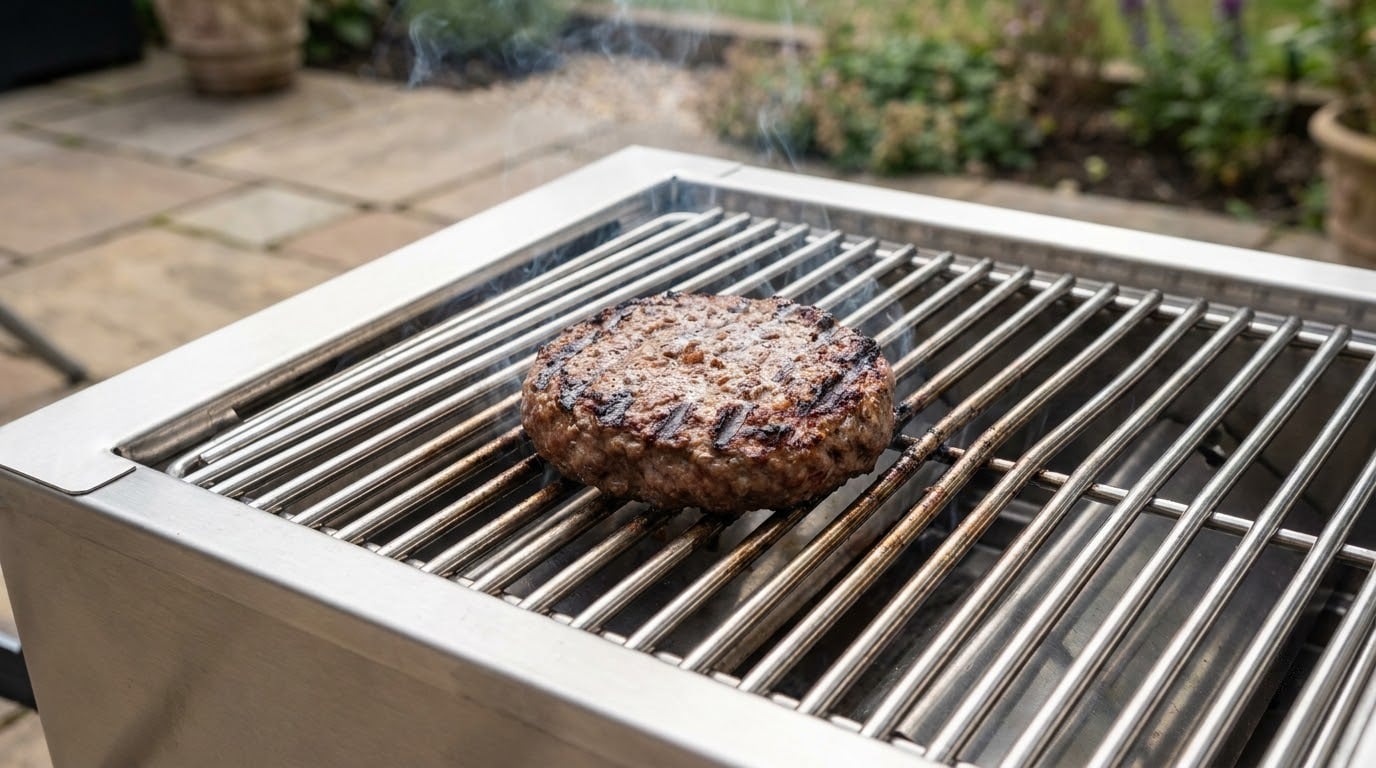
You should not press burgers on the grill. Pushing a patty down with a spatula squeezes out the juice and fat that make a burger taste good, and it is the single habit that turns an otherwise good burger into a dry, thin puck. Heat, not pressure, is what builds a crust.
Most people learned this by watching somebody at a barbecue do it, and it is hard to break a habit you watched for twenty years. I broke mine the first time a pressed patty came off the grill shrunken and drippy while the unpressed one next to it stayed plump.
Here is what actually happens when a spatula meets raw beef, why a good sear never needs that pressure, and what to do with your hand instead.
Table of Contents
- Why You Should Not Press Burgers on the Grill
- What Does Pressing a Burger Actually Do?
- Why a Good Sear Does Not Require a Spatula
- How to Grill Burgers Without Pressing Them
- Should You Flip Burgers More Than Once?
- When Some Pressure May Be Useful
- How to Tell When a Burger Is Done Safely
- Simple Tips for Juicier Burgers
- Frequently Asked Questions
- Should I press burger patties to keep them from falling apart?
- Why does pressing a burger make it release more juice?
- Are smash burgers supposed to be pressed on the grill?
- What should I do if my burgers are sticking to the grill?
- Does pressing burgers create better grill marks?
- How many times should I flip a burger while grilling?
- What to Do First Next Time You Grill
Why You Should Not Press Burgers on the Grill
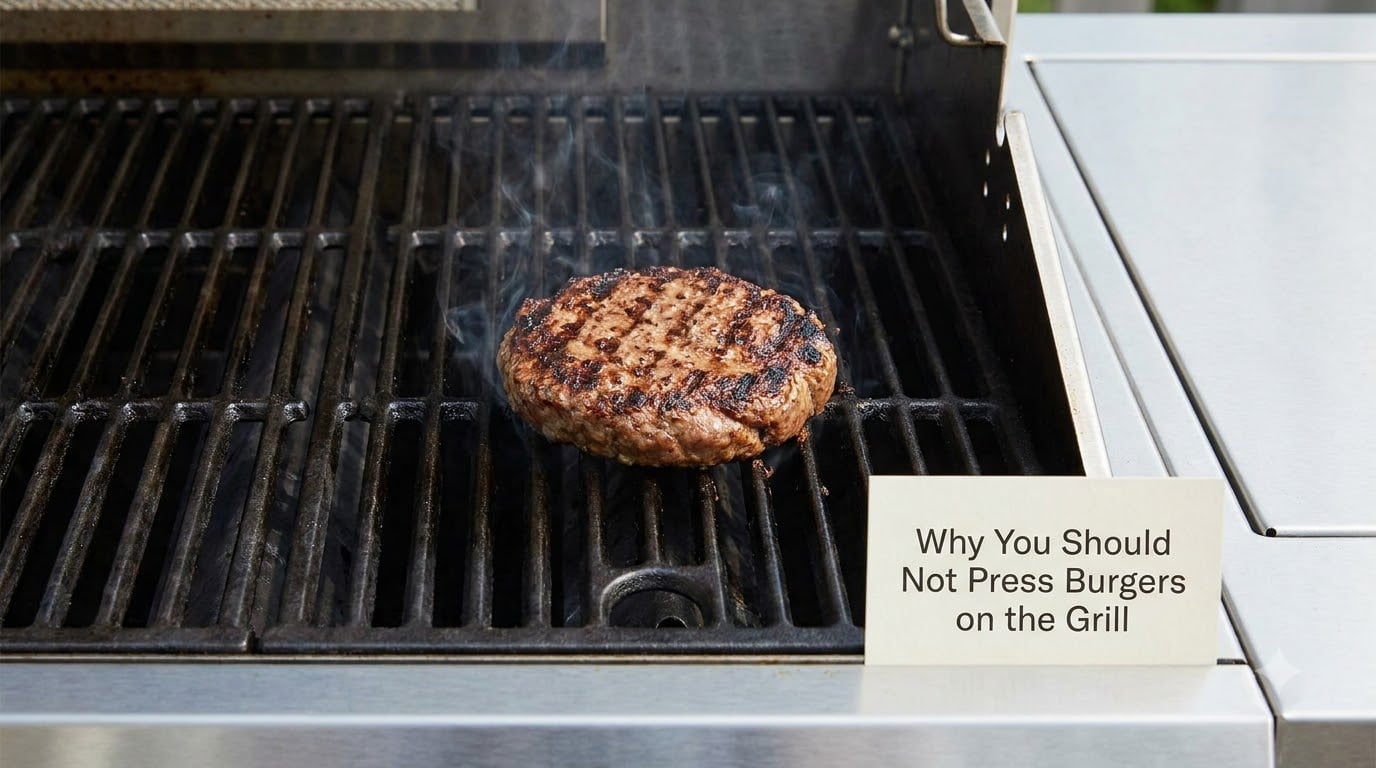
Pressing pushes liquid out of the meat and into the fire. That liquid is where most of the flavor lives, so it ends up as smoke and drippings rather than in your bun.
The result is a patty that is thinner than you shaped it, drier in the middle, and more fragile when you try to flip it. It also sticks more, because the raw meat at the top surface stays moist and gummy instead of forming a browned crust that releases cleanly from the grate.
A properly preheated grill and a light touch will give you browning and a crust without any of that. Pressing adds nothing you actually want.
What Does Pressing a Burger Actually Do?
Ground beef is mostly water, fat, and protein strands. Raw, the strands sit slack and the fat is solid. Heat changes both.
As the patty cooks, the protein strands tighten and squeeze, which pushes water and rendered fat toward the surface. A spatula pressing down accelerates that escape. The juice that drips out is the same juice that would have stayed inside.
There is a second effect people rarely consider. More surface touching the grate means more of the patty cooks by contact, but the top stays pale and wet. Browning happens where heat meets dry surface, so pressing gives you a bigger flat bottom and a raw-looking top.
You also change the shape. A patty domes as it cooks because the sides contract. Pressing flattens that dome, but it flattens it by compressing the interior rather than by fixing the cause.
Why a Good Sear Does Not Require a Spatula
Crust comes from four things: a hot grill, a clean grate, a dry patty surface, and leaving the patty alone long enough.
Heat. Gas grills want the burners wide open and preheated for 10 to 15 minutes with the lid closed. On charcoal, let the coals burn until the ash is grey on the outside and the red glow is mostly gone, which usually takes 20 to 30 minutes.
Grate. Scrape the rods with a wire brush and wipe them with a paper towel held in tongs. That grey film is the main reason patties stick, and it also insulates the meat from the heat you wanted.
Dry surface. Blot the shaped patty with a paper towel and let it sit uncovered in the fridge while the grill heats. That firms up the exterior and you get a better sear.
Restraint. Put the patty down and leave it. When the edges stop looking wet and translucent and the surface is brown, slide a thin spatula all the way under and flip in one motion. See how to stop burgers sticking to the grill for the sticking cases that survive a clean grate.
How to Grill Burgers Without Pressing Them
Start with cold meat. Handle the beef as little as possible, since working it too long makes it dense and sticky in a bad way. Form the patty with a light touch, roughly a quarter inch wider than your bun so it shrinks to fit.
Make a shallow dimple in the center with your thumb. It is about a quarter inch deep. This is not the same as pressing, and it is the fix most people are looking for: it gives the top surface somewhere to sit, so it browns flat instead of doming upward.
Season just before the patty hits the grate, with salt and pepper. Seasoning earlier pulls moisture out of the surface ahead of time, which is the opposite of what you want for browning.
Place the patties away from you, press down once gently for about three seconds to make full contact, and then stop touching it. The initial press is about contact, not force.
Use the spatula only to lift and flip. If it is not scraping against the grate, you are applying too much downward force.
Should You Flip Burgers More Than Once?
For a thick burger, one flip is usually enough. Every flip tears the crust that just formed and exposes a new moist surface to the heat, so it keeps starting over.
One confident flip preserves more juice than moving the burger three or four times, and it keeps the exterior darker. You can still adjust to your grill: a very hot gas grill might need an earlier flip, a cooler one more time.
Thin smash-style patties are the exception. They cook fast enough that one flip, or none at all, is often right.
When Some Pressure May Be Useful
There are two cases where a light touch is legitimate.
The first is correcting a placement. If a patty hits the grate crooked or folded against the bars, nudging it flat is just fixing a mistake, not cooking technique.
The second is a very thin smash burger. Those are deliberately pressed onto a hot flat-top for about 60 to 90 seconds to maximize crust-to-meat ratio. That is a different style of burger with a different goal, and it does not transfer to a thick pub-style patty.
If you want that style, tell yourself which one you are making before the meat hits the grill. Deciding mid-cook is how you end up with a thin dry patty you did not want.
How to Tell When a Burger Is Done Safely
Color is not a temperature reading. A burger can look done on the outside and still be undercooked in the middle, which is exactly what happens when the outside gets over-pressed and scorched first.
Use an instant-read thermometer in the thickest part of the patty, avoiding the edge. The USDA safe minimum internal temperature for ground beef is 160°F (71°C). Cook to that minimum and no less.
Insert the probe during the last part of cooking so you do not lose the juices you worked to keep. Rest the burger a few minutes before serving and the juices redistribute instead of running out onto the plate.
Simple Tips for Juicier Burgers
Use ground beef with around 20 percent fat. That is the ratio most consistently recommended across grilling communities, and it is fat that gives you moisture once the proteins tighten.
Stop pressing during cooking. If you keep reaching for the spatula, rest your hand on the grill handle instead.
Keep patties a consistent thickness. An uneven patty cooks unevenly, and you end up overcooking the thin part to catch up.
If fat drips and flares, move the patty to a cooler side of the grill rather than crushing it. Controlling flare-ups on a grill is mostly a two-zone setup and a move at the right moment.
And if your patties keep shrinking into sad little discs, read why burgers shrink so much on the grill. It is usually fat ratio and overworking the meat, not the grill.
Frequently Asked Questions
Should I press burger patties to keep them from falling apart?
No. Pressing makes a patty more fragile, not less, because the cooked surface that holds it together gets torn and the interior is compressed. If your patties fall apart, the usual causes are meat that has been overworked, a loose or crumbling shape, or flipping too soon before a crust forms. Shape gently, chill the patties, and let them sit untouched until the edges brown before flipping.
Why does pressing a burger make it release more juice?
Ground beef is water, fat, and tightening protein strands. As the patty heats, those strands contract and push liquid outward, and pressing speeds that process along. What drains onto the grate is the moisture you wanted to eat. The patty also ends up thinner and denser, which is why pressed burgers taste dry no matter how good the beef was.
Are smash burgers supposed to be pressed on the grill?
Yes, and that is the whole point of the style. A very thin ball of beef is pressed onto a hot flat-top for about 60 to 90 seconds to build maximum crust in minimum thickness. Thick pub-style burgers are the opposite goal, and pressing them on a grill does nothing but squeeze out juice. Decide which burger you are making before it hits the grate.
What should I do if my burgers are sticking to the grill?
Scrape and wipe the grate with a wire brush and paper towel before preheating, blot the raw patties dry, and let them chill uncovered while the grill heats. Give each patty one gentle press for full contact, then leave it alone. If it still sticks, it is usually a dirty grate or a grill that was not hot enough when the meat went down.
Does pressing burgers create better grill marks?
Pressing gives you a bigger, flatter contact patch, so it creates grill marks faster, but you are trading browning for compression. A patty left alone on a hot clean grate develops a deeper browned crust across its whole surface in about the same time, which looks better and tastes better. If you want distinct marks, move the patty only after the first side has set.
How many times should I flip a burger while grilling?
One flip for a standard thick burger. Each flip tears the crust you just built and exposes moist meat to the heat, so the exterior keeps restarting. Judge by browning and a thermometer reading rather than by the clock. Very thin smash-style patties may need one flip or none at all depending on how hot your surface is.
What to Do First Next Time You Grill
Put your spatula down and cook one burger without touching it. Scrape the grate, preheat properly, blot the patty dry, dimple the center, and let it sit until the edges brown.
Compare it to a pressed one. That is usually the moment the habit breaks.