
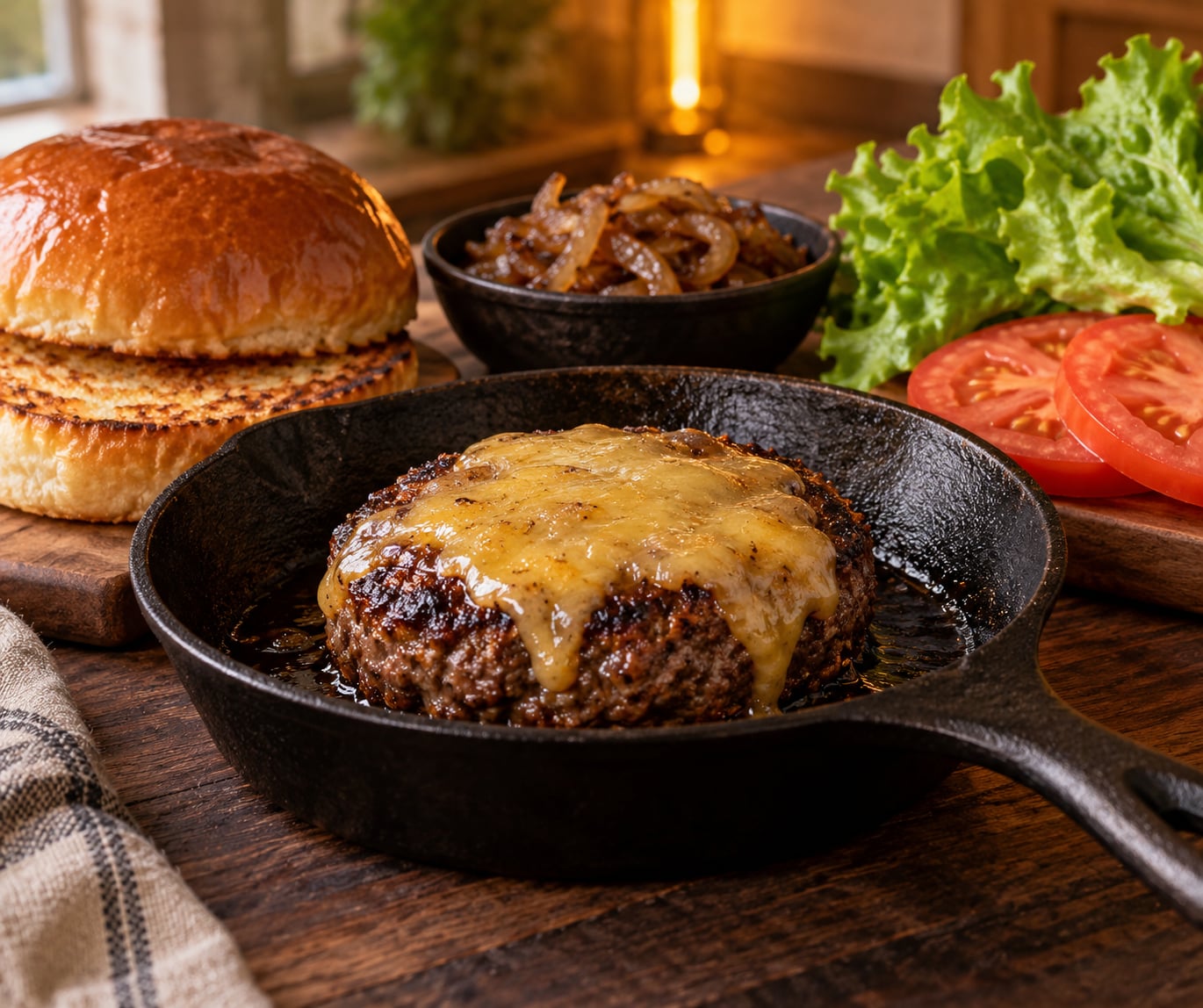
A steakhouse burger is a thick, fatty beef patty seared hard in a very hot cast iron skillet, cooked to 160°F for safety, then stacked with melted cheese, caramelized onions and sauce on a butter-toasted bun. Learning how to make a steakhouse burger at home takes about 20 minutes of active cooking, and the whole thing hinges on two things most people get wrong: beef with enough fat in it, and a pan hot enough to build a real crust.
I’ve cooked this version dozens of times at home, and it’s the one burger method that makes guests ask what happened. No grill required, no special equipment beyond a heavy skillet and a spatula that can handle a 6-ounce patty.
Table of Contents
- What You Need for a Steakhouse Burger at Home
- Step-by-Step: Make a Steakhouse Burger at Home
- Common Mistakes and How to Fix Them
- Frequently Asked Questions
- What kind of ground beef is best for a steakhouse burger at home?
- Should I make steakhouse burger patties thicker than regular burgers?
- How do I keep a homemade burger juicy instead of dry?
- How long should I cook a thick burger patty on each side?
- What cheese melts best on a steakhouse-style burger?
- Can I make a steakhouse burger without a cast-iron skillet?
- Conclusion
What You Need for a Steakhouse Burger at Home
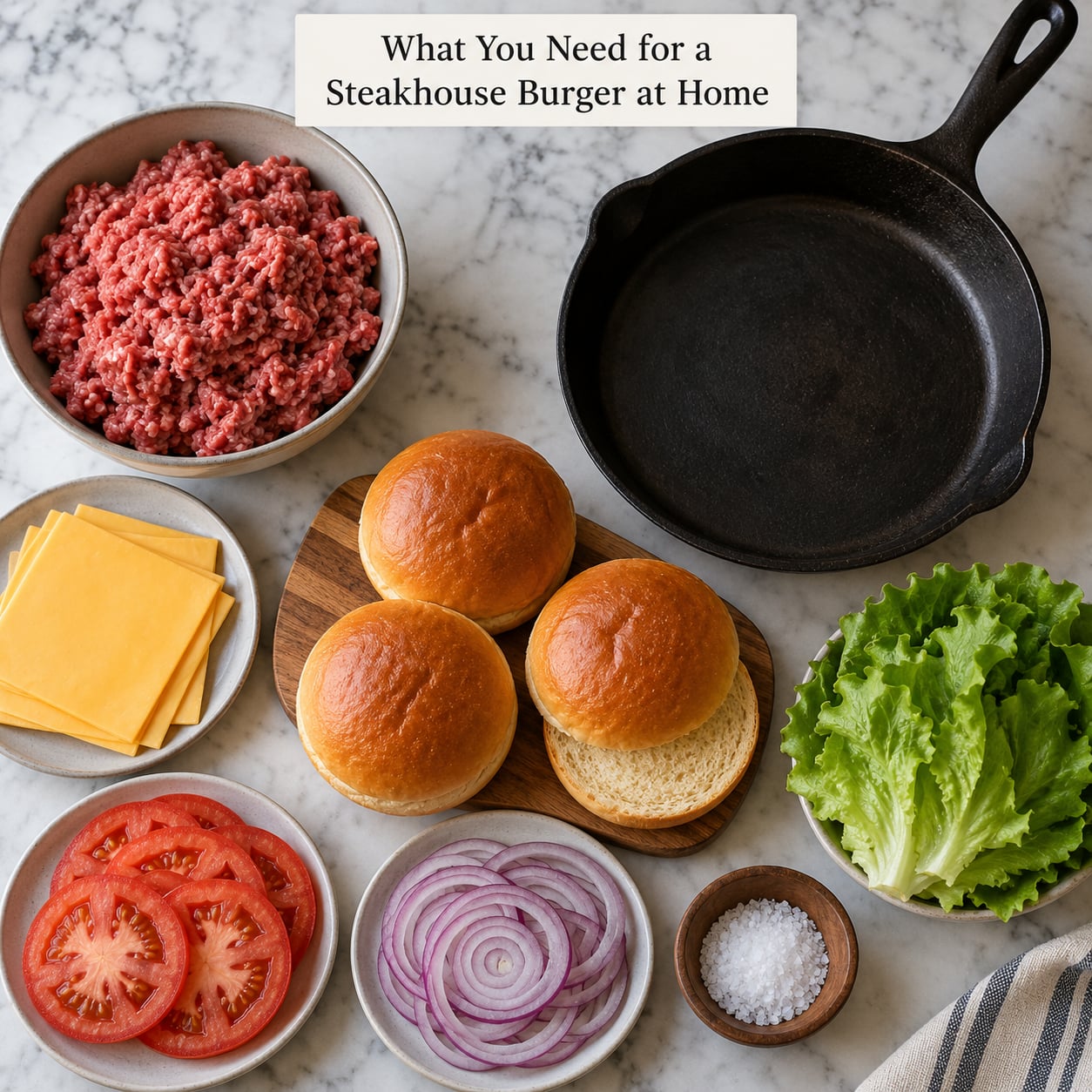
Here’s the shopping list for two burgers. The quantities matter more than most recipes admit, because the whole method is calibrated for a patty about three-quarters of an inch thick.
- 1 pound 80/20 ground beef, or a chuck and brisket blend if you can get one. There’s a full breakdown of why fat ratio matters in what cuts make the best burger blend.
- 1 teaspoon coarse salt and about half a teaspoon of black pepper, or 2 teaspoons of Montreal steak seasoning if you like more bark.
- 1 tablespoon Worcestershire sauce, mixed into the beef. It seasons the inside of the patty, which plain salt never reaches.
- A 10 to 12 inch cast iron skillet or heavy stainless pan. Something with weight, so it doesn’t cool down when the meat hits it.
- 2 tablespoons high-smoke-point oil, like avocado, canola or grapeseed. Butter burns at searing temperature.
- 4 slices cheese — American, cheddar, Swiss or provolone. Two per burger is the steakhouse look.
- 2 brioche buns, or potato buns if you want a slightly chewier roll.
- 1 tablespoon unsalted butter for the buns, plus optional thin slices of bacon for basting.
- Toppings: lettuce, thick tomato slices, raw onion, and caramelized onions if you have the patience. A spoonful of burger sauce does more than you expect.
The one prep note that changes everything: don’t form the patties until the pan is hot. Seasoning beef with salt too early pulls moisture to the surface, and those beads are what turn a good sear into a steaming gray one. Shape, rest, then season at the moment the patty goes down.
Step-by-Step: Make a Steakhouse Burger at Home
1. Form Thick, Even Patties Without Overworking the Beef
Weigh out 6 ounces of beef per burger and cup it loosely in your palm. Pat it into a disc about a half inch wider than the bun and press the edges to about three-quarters of an inch thick.
Handle it as little as possible. Compact ground beef has connective structure that holds the patty together, and squeezing it like cookie dough destroys that, which is why overworked burgers crumble and turn dense. More on patty formation if you want the full breakdown.
Press a shallow thumb indent into the center of each patty, about a quarter inch deep. The difference between a flat patty and a domed one is that indent, and it also keeps the patty from curling into a taco shape in a hot pan. Leave the edges ragged and slightly loose rather than smoothing them into pucks.
Let the formed patties sit at room temperature for 10 to 15 minutes while everything else comes together. Cold beef hitting a screaming hot pan steams before it browns.
2. Heat the Skillet Until It Is Very Hot
Set the skillet over medium-high to high heat and give it a full five minutes to get there. Cast iron announces readiness with a faint wisp of smoke and a heat-shimmer you can almost see over the surface.
Add about a tablespoon of high-smoke-point oil and swirl it around until the whole base of the pan is glossy. Drop a small pinch of beef into the oil — if it sizzles loudly and browns on contact, the pan is ready. If it barely reacts, wait another two minutes.
Skip the oil entirely and you get a well-seasoned cast iron pan that will still sear, but oil costs you nothing and buys you more crust. Resist butter at this stage; it browns in seconds at this temperature.
3. Sear the Patties Without Flipping Too Early
Lay the patties down away from you, one finger from the edge of the pan so you don’t get a hot-oil spit on your wrist. Season the exposed surface generously with salt and pepper, then season the second side lightly.
Leave them alone. For a three-quarter inch patty you want roughly 3 to 4 minutes on the first side. Peeking lifts the patty and tears the crust you spent that time building. The signals that it’s time to flip: the edges look cooked and browned, a good amount of clear rendered fat collects around the base, and the spatula slides under without resistance.
Flip once, cook another 2 to 3 minutes, and check doneness with an instant-read thermometer in the thickest part. Ground beef should hit 160°F for food safety. Pull it at 155 to 158°F if you like it juicier, since carryover heat finishes the job while the patty rests.
If you’re working over a gas or charcoal grill instead of a skillet, use a two-zone fire — burners or coals on one side, empty space on the other. Sear the patties hard over direct heat first, then move them to the indirect side to finish with the lid closed. This is the same logic as the skillet: sear fast, finish gentle.
4. Add Cheese and Melt It During the Final Cooking Stage
Put the cheese on the patty within the last 30 seconds of cooking so it melts without the patty overcooking underneath. American and mild cheddar melt smoothly and stay put; Swiss and provolone stretch further and bring a nuttier flavor.
Either cover the skillet with a lid for 20 to 30 seconds to trap steam, or toss a small knob of cold butter into the pan and spoon the foaming butter over the top. That baste is the single biggest upgrade you can make, and it’s what restaurant kitchens do that most home pans don’t.
Pull the patties out at 160°F, lay the cheese-topped patties on a plate, and let them rest 3 to 5 minutes. Resting lets the muscle fibers relax and reabsorb the juice that carryover cooking pushed toward the center. Skip this and the first bite squirts and the rest of the patty is dry.
5. Toast the Buns and Build the Burger in a Stable Order
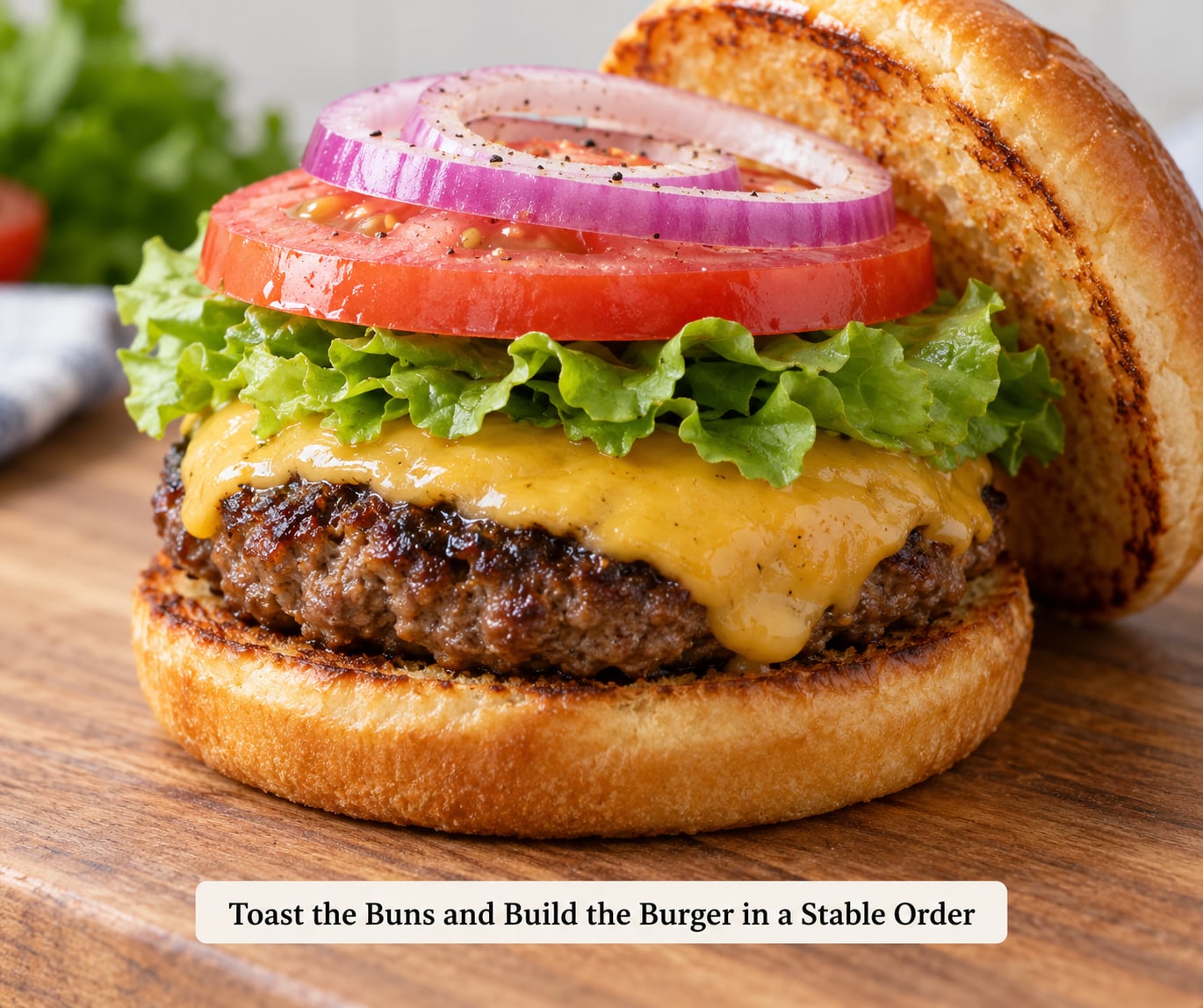
Melt the butter in the same skillet once the patties are out, cut the buns in half, and lay the cut faces down for 30 to 60 seconds until the edges are golden and the inside is just warmed through. A hot bun is a structural material, not a garnish.
Build from the bottom up, and the order is doing real work: bun, sauce spread thin, lettuce, tomato, patty, cheese, onions, a final pinch of salt on the tomato. Sauce goes on the bottom bun rather than both so it doesn’t soak through in seconds, and lettuce sits against the bun as a moisture barrier between the sauce and the patty.
The patty goes on after the wet vegetables, not before, so the heat keeps the cheese melting against something warm. Skip the tomato slice’s seeds and center if you’re feeding people who don’t want a loose pile — that’s the single most common reason a stacked burger falls apart in someone’s hands.
Serve immediately. A steakhouse burger that sits for ten minutes is a warm bun with cold cheese, and it’s the only point at which this whole method stops working.
Common Mistakes and How to Fix Them
The patty puffed into a ball. You skipped the thumb indent. Press a shallow well in the center before seasoning, and it stays flat through cooking.
The beef stuck and tore. The pan wasn’t hot enough, the patty hit before the oil was hot, or you moved it during the first minute. Scrape any burnt bits off the skillet, wipe out the oil, reheat, and try again — burnt residue is what makes the second attempt stick too.
The burger came out dry even though you used 80/20. Overcooking is almost always the culprit, not the meat. Watch the thermometer instead of the clock, pull at 160°F, and give it a real 3 to 5 minute rest. Check your beef too: if it was ground chuck from a display case it’s often closer to 85/15 than the label suggests.
The bun went soggy. Butter and toast it for a full 30 seconds rather than 10, keep sauce to a thin layer on the bottom bun only, and add lettuce between sauce and patty as a barrier. Assemble to order, not ahead.
The cheese broke into strips instead of melting. Either it was too cold or you used cheese shreds. Use cold slices laid flat, add them early enough to actually melt, and pick American, cheddar, Swiss or provolone rather than a hard cheese like Parmesan or a low-fat block that won’t flow.
You salted too early. Salt applied more than about 15 minutes ahead pulls water to the surface and the patty steams instead of searing. Salt at the moment it hits the pan.
The whole thing tasted flat despite good beef. Season in layers — Worcestershire mixed into the raw beef, salt and pepper on the patty, and a spoon of burger sauce made at home on the bun. One seasoning hit is never enough.
Frequently Asked Questions
What kind of ground beef is best for a steakhouse burger at home?
An 80/20 ground chuck or a chuck and brisket blend gives the best steakhouse-style burger at home. The 20 percent fat gives the patty enough juice and fat to stay tender through the sear, and 80/20 browns well without needing binders. If you can only find 75/25, that works and adds richness, but 90/10 lean beef needs Worcestershire or a panade to avoid tasting dry.
Should I make steakhouse burger patties thicker than regular burgers?
Yes. A steakhouse-style patty is about three-quarters of an inch thick and weighs roughly 6 ounces, which is noticeably bigger than a fast-food patty. Thickness is what holds the cheese and keeps the center juicy, but it also means longer cooking: about 3 to 4 minutes per side in a very hot pan. Thinner smash-style patties cook in under two minutes and want an 85/20 or leaner blend.
How do I keep a homemade burger juicy instead of dry?
Three things do most of the work: use beef with at least 20 percent fat, stop cooking at 160F rather than cooking through to well-done, and rest the patty 3 to 5 minutes before assembly. Resting lets the muscle fibers reabsorb the juice pushed toward the center by carryover heat. Pressing the patty with a spatula while it cooks squeezes out fat and dries the meat.
How long should I cook a thick burger patty on each side?
For a three-quarter inch patty, cook 3 to 4 minutes on the first side without moving it, then flip once and give it another 2 to 3 minutes. Confirm doneness with an instant-read thermometer rather than the clock, since pan size and burner strength change the timing. Ground beef needs to reach 160F for food safety; pull it at 155 to 158F if you want more juice.
What cheese melts best on a steakhouse-style burger?
American cheese is the most forgiving because of its emulsifiers, and cheddar gives a fuller flavor that survives a hard sear. Swiss and provolone melt cleanly and stretch far, while pepper jack adds heat without any prep. Skip shredded low-fat cheese and anything aged hard like Parmesan, since neither melts into a smooth layer. Two slices per burger is the restaurant look.
Can I make a steakhouse burger without a cast-iron skillet?
Yes, you just need something heavy that holds heat. A 12 inch stainless steel skillet works well, and so does a sheet pan on a stovetop burner. A thin nonstick pan is the worst option because it cools the instant the beef hits it and gives you a pale, steamed patty instead of a crust. On a grill, use a two-zone fire and move the patties off direct heat to finish.
Conclusion
If you only change one thing in how to make a steakhouse burger at home, buy 80/20 beef instead of the lean stuff you’ve been using. Everything else is technique you can pick up tonight.
From there the order matters: heavy pan preheated for five full minutes, patties salted only as they land, one flip and no peeking, cheese on at the end, a 3 to 5 minute rest, and buns toasted in butter right before assembly. Do all of that and you get a burger with a real browned crust and a hot, melted center, which is the difference everyone notices but nobody can name until they taste both side by side.