
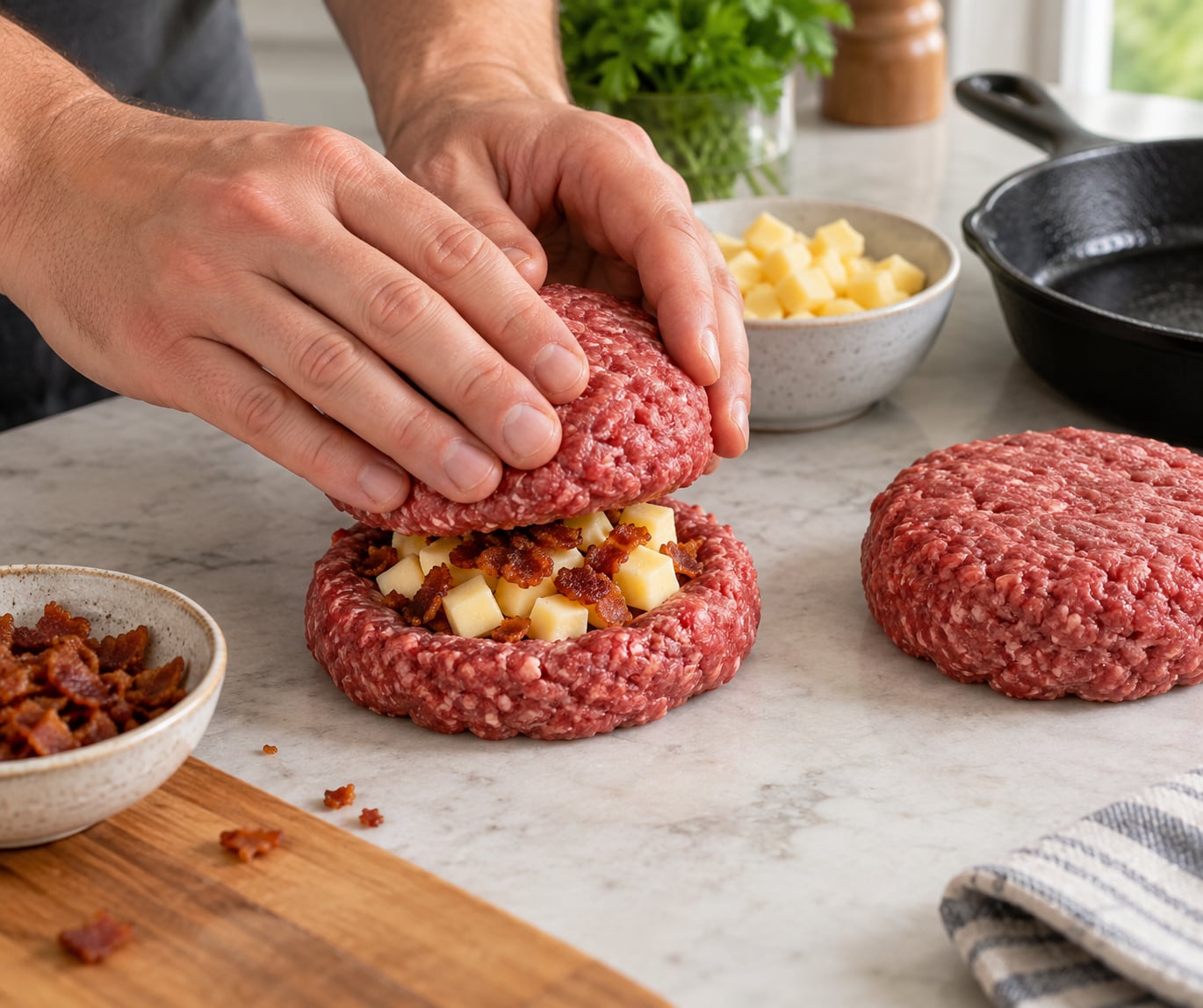
To make stuffed burgers, flatten half the ground beef into a thin patty, pile the filling in the middle well clear of the edges, cap it with a second thin patty, then pinch the seam shut and chill it for 15 to 30 minutes before cooking. Cook over medium heat until the inside reaches 160°F (71°C). The whole batch takes about 50 minutes including chill, and the job is easy once you stop pressing the meat.
The reason people get disappointing results is almost never the filling. It is a loose seam, meat that went into the pan warm, and a heat setting high enough to scorch the outside before the thick centre catches up. Fix those three things and a stuffed patty behaves like a regular burger.
What You Need
For four stuffed burgers you want about 1½ pounds of ground beef, and the fat content matters more than the brand. An 80/20 ground chuck blend has enough fat to stay juicy through the second flip; leaner 90/10 dries out before the centre is safe to eat.
Ingredients
- 1½ lb (680 g) 80/20 ground chuck
- 4 slices thick-cut bacon, cooked and crumbled, or 4 oz (115 g) cheese plus 4 strips raw bacon
- Cheese for stuffing: 4 oz (115 g) pepper jack, cheddar, or American, cut into cubes or shredded
- 1 small onion, diced and caramelized, or pre-cooked mushrooms
- 1 tsp garlic powder
- Salt and black pepper, divided
- 1 tbsp Worcestershire sauce (optional, for the meat mix)
Skip the raw onion if you would rather not pre-cook anything. Use caramelized onion and you get sweetness without the water that breaks the seal.
If you like a leaner game, a bison burger takes the same technique, but keep the same 80/20-style ratio and shorten the cook by a minute.
Equipment
- Cast iron skillet or a grill with a lid
- Instant-read thermometer (the single most useful tool here)
- A wide spatula, thin enough to slide under a patty without tearing it
- Parchment paper or a rimmed plate for chilling
You do not need a stuffing press, a forming press, or any specialty tray. A bowl, your hands and a flat surface are enough.
Timing at a glance
- Prep: 15 minutes
- Chill: 15 to 30 minutes
- Cook: 6 to 8 minutes per side depending on method
- Total: about 50 minutes
- Yield: 4 stuffed burgers
Time the chill like a real step rather than a suggestion. It is the difference between a patty that holds together and one that opens in the pan.
Step-by-Step: How to Make Stuffed Burgers
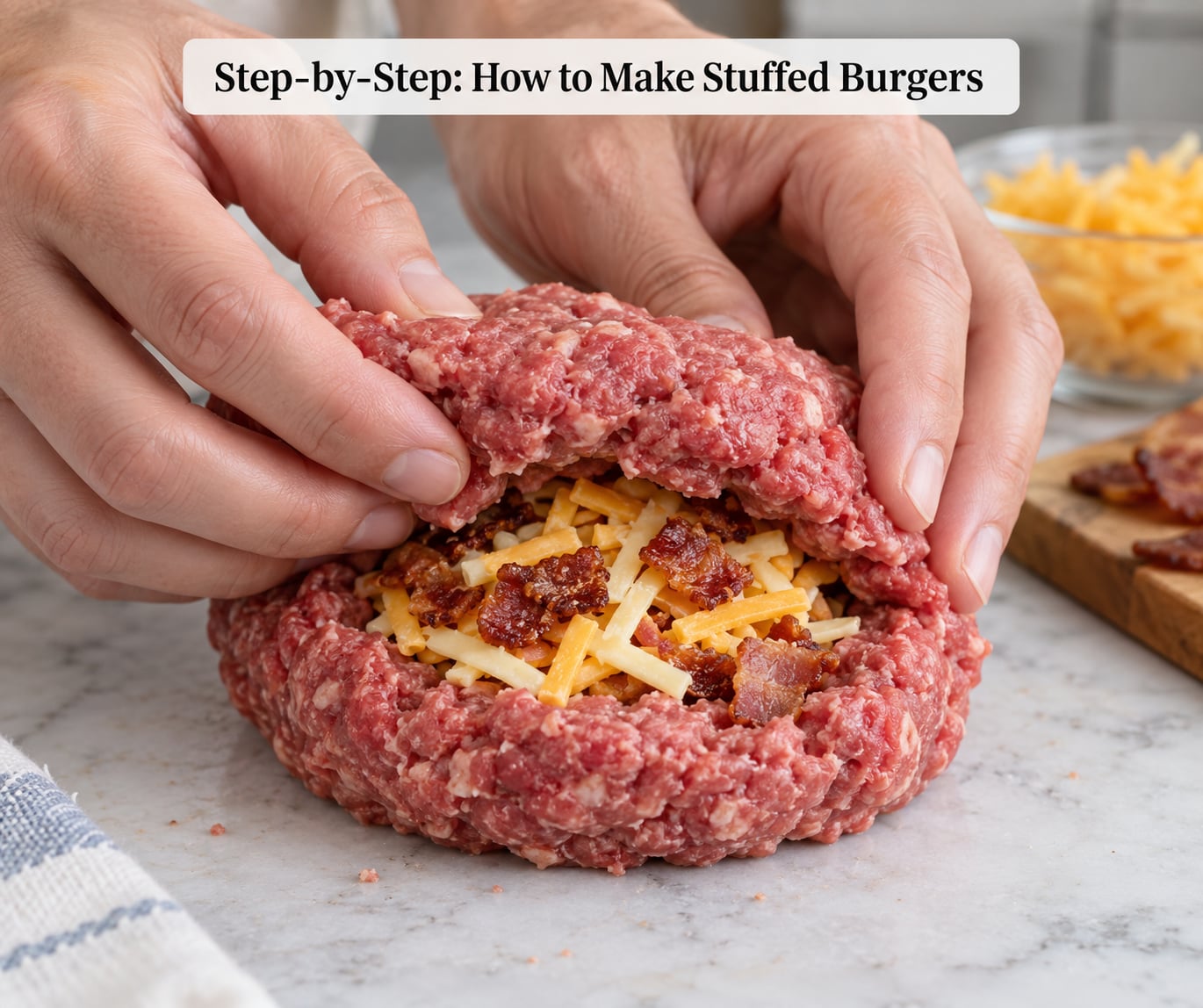
Work in this order and every later step gets easier. Season the outside, not the inside, so the browning surface is dry and the filling keeps its own seasoning.
How to Choose a Filling That Stays Inside
The best fillings are low in water and high in fat. That is the whole test, and it is why cheese outperforms almost everything else.
Cheese is the reliable choice. Pepper jack melts smooth and stretches without grabbing the meat, sharp cheddar adds flavor and needs a little less heat to soften, and American cheese is the fail-safe when you want zero risk of a grainy center. Shredded cheese melts faster and spreads, which helps seal the middle. Cubed cheese stays in one place and gives you the molten core people picture when they say stuffed burger.
Cured meat is the second-best partner. Bacon adds fat and salt, and it holds together when it is crisped first and crumbled small. Slower-cooked meat like pulled pork or Italian sausage works too, but chop it fine and squeeze out excess juice before it goes in.
Vegetables need pre-cooking, always. Raw onion and raw mushroom release water that turns the seam into a leak. S´té them first, drain them well, and cool them down. Jalapeños are the exception that works raw because they are dry, though slicing them thin helps.
Sauces belong in thin spreads on the meat, not in a mound in the center. Ranch or aioli is fine applied sparingly; anything loose like barbecue sauce will push the seam open.
A useful shortcut: if a filling releases water when you squeeze it, cook it first. That single rule answers most of the complaints you see about burgers splitting in the pan.
How to Form and Seal the Patties
Divide the beef into eight roughly equal balls, about 3½ ounces each. Even portions are what keep the burger cooking at an even rate; a lopsided patty browns on one side and stays raw in the middle.
Flatten each ball to about ¼ inch thick and about 4½ inches wide, wider than your bun. Put the first patty down, add a small mound of filling in the center, and keep it at least ¾ inch from the edge. That margin is the seam you need.
Now seal it. There are three methods that work, and all of them come down to removing air and closing every gap.
Two thin patties: the everyday method and the one most home cooks already use. Lay the second patty over the first, press gently from the center outward, then pinch the rim all the way around between your thumb and forefinger until it looks like one continuous piece of meat. This is the default because it needs no tools.
Thumb hole: form one thick patty, press a wide hole into the center with your thumb, drop the filling in, then pull the meat up and over to close the top. Faster for a single burger, but easier to leave a thin spot that tears.
Plastic-wrap roll: lay a sheet of plastic wrap down, roll the beef flat to an even rectangle, leave a ½ inch bare border, dot the filling across the middle, fold the edges over like a ravioli and roll it into a log. Cut into portions. The roll gives the most even thickness of the three, which matters if the patties are thick and you are cooking to temperature rather than time.
After sealing, press out any trapped air and flatten the patty to an even ½ to ¾ inch. Push down gently with the heel of your hand; hard pressure squeezes out the fat you came for.
Season both sides generously now, and chill on a plate or between parchment for 15 to 30 minutes. Cold meat firms the fat and lets the seam set.
How to Cook Stuffed Burgers Without Falling Apart
A stuffed patty is thicker than a plain one, so high heat scorches it before the center is done. Medium heat, a lid, and a thermometer solve it.
Heat a cast iron skillet over medium and add a thin film of oil or a spoon of the bacon fat. Sear the patty for 3 to 4 minutes without moving it, then cover and cook another 3 to 4 minutes. Flip once and repeat. Check with the thermometer in the thickest part; you want 160°F (71°C) for ground beef.
On a gas grill, set one zone to medium and one to medium-high. Sear on the hot zone for 2 minutes a side, then move the patty to the cooler zone, cover, and cook until it reads 160°F. On charcoal, bank the coals to one side and cook away from the direct heat, same idea.
Use the broiler only for the last 90 seconds if you want a seared top on a bunless burger. Broiling from the start burns the outside while the middle stays cool.
In the oven, set it to 400°F (205°C) and bake on a preheated sheet for 12 to 14 minutes, flipping once. Air fryers run hot, so 375°F (190°C) for 8 to 10 minutes is closer, with the same temperature check at the end.
| Method | Heat | Time per side | Total |
|---|---|---|---|
| Cast iron skillet | Medium, covered | 3 to 4 minutes | 7 to 8 minutes |
| Gas grill | Medium to medium-high, two zones | 2 to 3 minutes, then indirect | 8 to 10 minutes |
| Charcoal grill | Medium, coals banked aside | 2 to 3 minutes, then indirect | 8 to 10 minutes |
| Oven | 400°F (205°C) | 6 to 7 minutes | 12 to 14 minutes |
| Air fryer | 375°F (190°C) | 4 to 5 minutes | 8 to 10 minutes |
Cooking burgers on the stove raises the smoke question for most people. Our guide to stove-top burgers without smoke covers the vent and heat settings in detail.
Two rules keep the patty intact. Never press it with the spatula, because you squeeze the seam and push the filling out. And flip no more than twice, using a thin spatula slid all the way under.
Common Mistakes
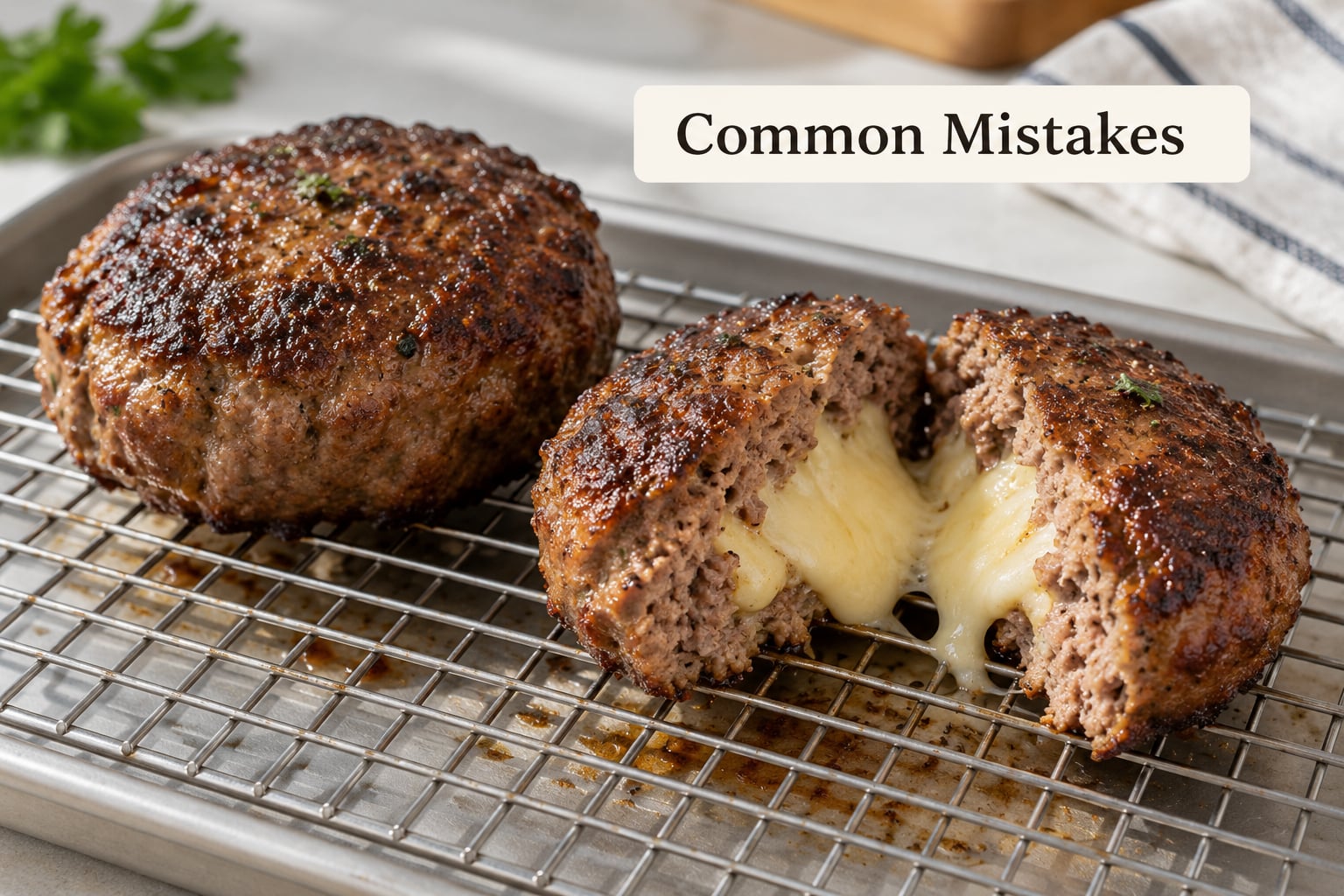
Almost every failure traces back to the seam or to heat. Here is what went wrong and what to change.
| What happened | Why | Fix |
|---|---|---|
| Filling leaked into the pan | Filling placed too close to the edge, or too much of it | Keep the mound in the center with a ¾ inch border, and use less filling than you think |
| Seam opened while flipping | Meat was warm or the patty was not rested after sealing | Chill 15 to 30 minutes so the fat firms and grips the seam |
| Burger crumbled apart | Pressed too hard during forming or on the spatula | Press gently, seal with fingertips, slide a thin spatula under the patty |
| Outside burned, center raw | Heat too high for a thick patty | Move to medium, use a lid, and check the center at 160°F |
| Dry, dense meat | Overworked the beef or cooked too long | Handle the beef lightly, stop the moment the thermometer hits 160°F |
| Uneven thickness | Patties rolled by hand without measuring | Use the plastic-wrap roll, or compare each patty against a quarter |
| Watery filling pocket | Raw onion or mushroom added straight from the fridge | Pre-cook and drain every wet filling before stuffing |
One note on leaked cheese: if the seam does give way, leave it. The browned cheese stuck to the pan turns into a crisp cheese crust that is genuinely the best part.
Tips for Serving Stuffed Burgers
Rest the burger 2 to 3 minutes off the heat before it hits a bun. The trapped steam and juice redistribute instead of running out onto the plate, and the patty firms up enough to eat without falling through the bottom.
Toast the buns in the rendered fat after the burgers come off. Add toppings after toasting so the bread does not go soggy.
Go easy on the condiments. The inside already carries cheese and salt, so a thin layer of mustard or a pickled onion on top is enough. Pickled jalapeños work well against a cool, mild filling like mozzarella or chicken.
For sides, keep them out of the sauce habit. A simple green salad, thick-cut fries, or a bowl of slaw all stand up next to a rich burger. Skipped the bun entirely and you have a low-carb burger that plates like a steak.
With beer, aim at a light, clean lager or a pilsner. A heavy cheeseburger with a hoppy double IPA turns into a greasy mouthful after two bites, while a crisp pilsner cuts straight through the fat.
Stuffed patties also freeze well. Lay them on a tray to freeze solid first, then bag them; they keep about three months and cook straight from frozen with 2 extra minutes.
If you want to know what a binder such as breadcrumbs does to the texture before you commit, we compared burgers with and without breadcrumbs, and it is a separate decision from stuffing. The two thin patties already give you enough structure.
Frequently Asked Questions
What is the best filling for stuffed burgers?
Cubed or shredded cheese is the most reliable filling. Pepper jack melts smooth, sharp cheddar adds flavor, and American cheese never turns grainy. Bacon is the best partner because it adds fat and holds together once crisped and crumbled. Skip raw onion and mushroom, or pre-cook them, because the water they release is what opens the seam.
Should stuffed burgers be cooked on a grill, skillet, or broiler?
Skillet or grill both work well. A cast iron skillet over medium heat with a lid gives you the steadiest, most forgiving result, at roughly 7 to 8 minutes total. On a grill, sear hot for two minutes a side, then move to a cooler zone and cook until the center reads 160u0026deg;F. Save the broiler for the final minute or two.
How do you keep the filling from coming out?
Keep the filling mound in the exact center with at least three-quarters of an inch of bare meat around it, and use less filling than seems reasonable. Press the second patty on gently from the center outward, then pinch the rim all the way around. Chill the sealed patty for 15 to 30 minutes before it hits any heat.
How long should stuffed burgers cook?
About 7 to 8 minutes in a covered cast iron skillet, 3 to 4 minutes a side. On a grill, expect 8 to 10 minutes including indirect cooking. In a 400u0026deg;F oven it takes 12 to 14 minutes, and in an air fryer at 375u0026deg;F about 8 to 10 minutes. Test the thickest part and stop at 160u0026deg;F, since the patties keep cooking off the heat.
Can stuffed burgers be made ahead and frozen?
Yes. Seal and chill the patties, then freeze them flat on a tray before moving them into a bag so they do not stick together. Frozen stuffed patties keep roughly three months and cook straight from frozen, just add about two minutes to the cooking time and check that the center reaches 160u0026deg;F before serving.
Can I use cheese as the filling without making the patty soggy?
You can, and cheese is the safest filling to use. Shred it for a faster melt or cube it for a defined molten center, and stay under about an ounce per burger. Overfilling is what makes a patty soggy, not the cheese itself. Keep the mound in the middle so the sealed meat, not the cheese, is what you bite through.
Conclusion
Start tonight by sealing four patties and giving them 30 minutes in the fridge before anything else. That chill is the single step most recipes skip, and it is the one that keeps the cheese where you put it.
For most home kitchens, a covered cast iron skillet over medium heat is the most reliable setup, with a thermometer in the thickest part and a stop at 160°F (71°C). Go to a two-zone grill once the seam holds its shape on the first try.