
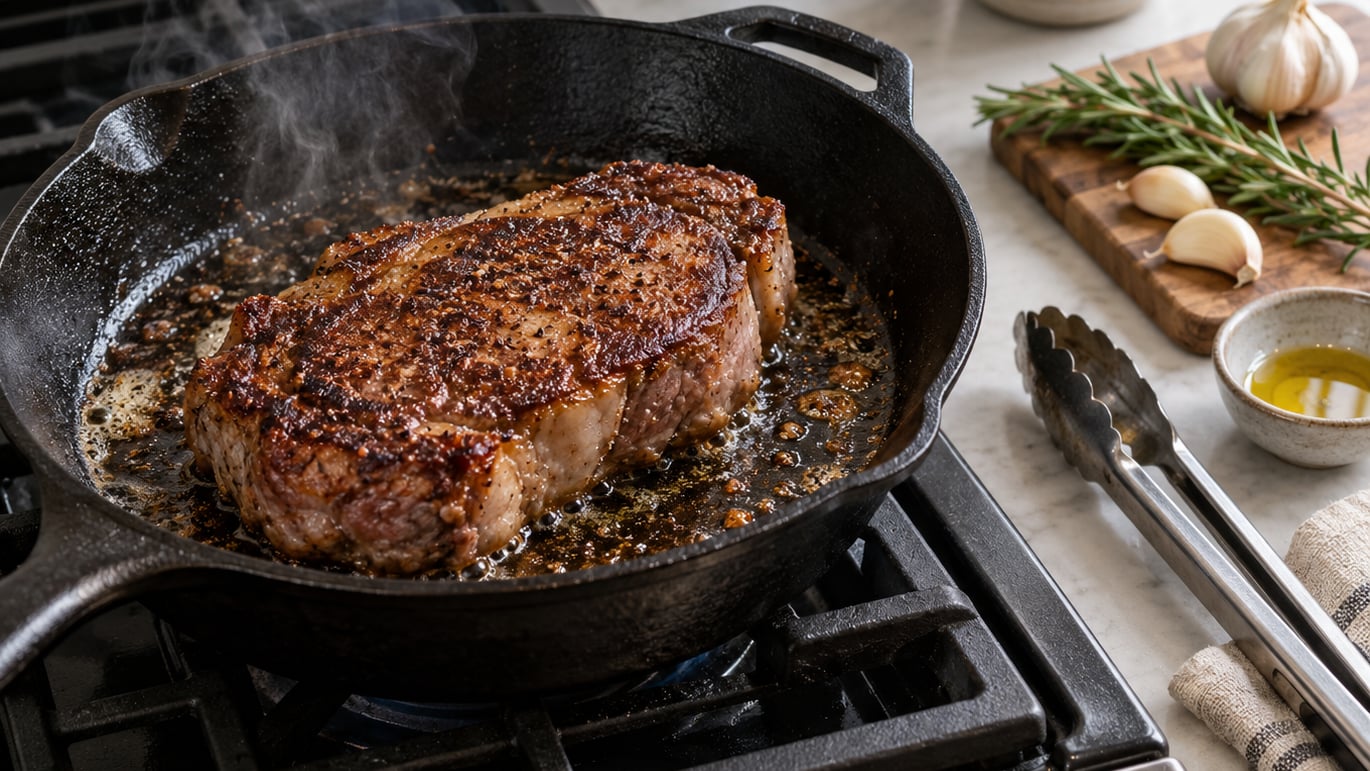
Cooking steak in a cast iron skillet is a high-heat pan sear, and it takes about 20 minutes of actual cook time. Preheat the empty pan on medium-high for roughly 5 minutes, add a thin film of high smoke point oil once it is hot, lay a thoroughly dried and salted steak in the pan, and leave it alone for 2 to 4 minutes per side. Baste with butter near the end, then rest it 5 to 10 minutes before slicing.
Cast iron is the best stovetop pan for this job because it holds heat. A cold 1.5-inch ribeye can drop a stainless steel skillet by 100 degrees or more the second it touches, and that temperature crash is the difference between a deep brown crust and a grey, steamed exterior. Cast iron barely notices the meat arriving, so the surface of the steak stays hot enough for the Maillard reaction, the browning process that builds flavor and fond in the pan.
None of this takes more than half an hour from counter to plate, including the rest. Most of the time is unattended.
What You Need
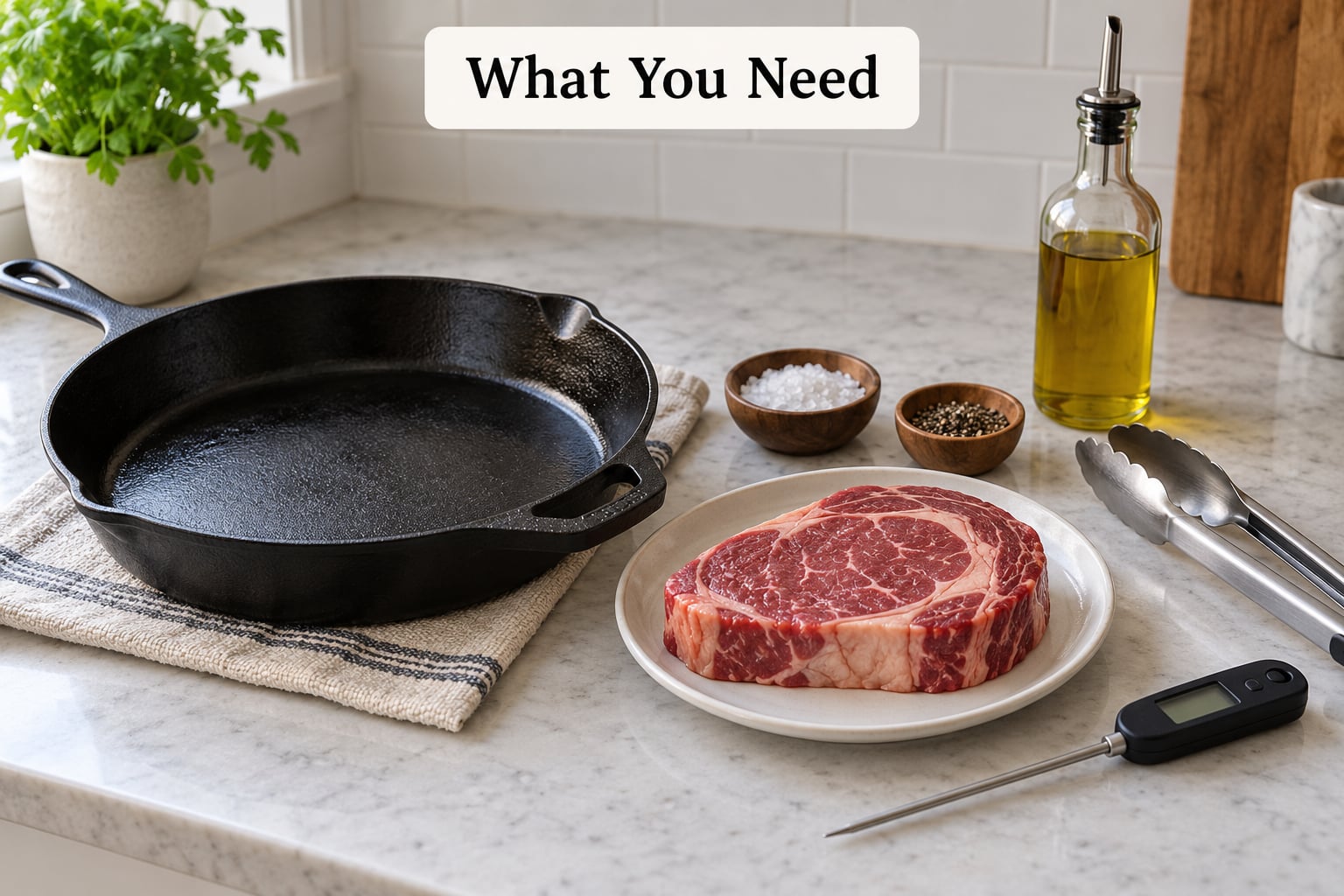
You do not need a pile of equipment. Six things, and two of them are optional but change the result more than anything else you could buy.
- Cast iron skillet, 10 or 12 inch. A 10-inch fits one 8-ounce steak with a good inch of clearance around the edges. A 12-inch fits two steaks side by side, though two steaks in a 12-inch pan lose more heat than one does.
- Instant-read thermometer. The single biggest difference between a good steak and a guess. Insert it from the side into the thickest part.
- Tongs. A fork tears the crust off. Metal tongs with a scalloped or flat tip grip the meat without puncturing it.
- Kosher salt and cracked black pepper. Diamond Crystal or Morton, coarse. Table salt is roughly half the volume, so a teaspoon of it is not a teaspoon of kosher.
- High smoke point fat. Avocado, canola, or ghee work well. You need about a tablespoon for a 10-inch pan.
- Butter, garlic, and a sprig of rosemary or thyme for the baste. Optional, and the step most people skip that they should not.
A wire rack and a rimmed baking sheet also earn their space. A rack keeps the steak off the counter so juices run off the bottom instead of turning the underside soggy.
Step-by-Step: How to Cook Steak in a Cast Iron Skillet
Choose the Right Steak Cut and Thickness
Thickness drives everything. It decides whether a stovetop method works at all, and how many minutes per side you are actually looking at.
A New York strip or sirloin at 1 to 1.25 inches is the easiest place to start. It has enough fat and marbling to flavor itself and enough thickness to survive a hard sear. A ribeye at 1.5 inches is more forgiving because the fat renders down and bastes the outside as it cooks. Filet mignon is the opposite: it is lean, so it needs either a shorter cook or butter basting, or it dries out.
A flank steak runs about an inch thick and cooks fast, but it is best marinated and sliced across the grain. Anything past 2 inches needs an oven finish or a reverse sear, and I will get to that below.
Bone-in versus boneless matters less than most guides claim, though a bone acts as a modest heat sink. Marbling is the one thing worth paying up for. Cook steaks that have sat in the fridge until they lose the chill, so take them out 30 to 45 minutes before you heat the pan.
Prepare the Steak and Skillet
Pat the steak dry with paper towels until the surface feels almost tacky. This is the step that separates a good sear from a bad one. A wet steak spends its first minute steaming instead of browning, and the crust that should form never gets a chance.
Salt both sides generously, about 1 teaspoon of kosher salt per pound, and add pepper. If you have 30 minutes, salt it now and leave it uncovered on a rack. The surface dries further while the seasoning works in.
Heat the empty cast iron on medium-high for about 5 minutes. A 5-minute preheat is the right target for a home burner, and cast iron manufacturers will tell you to stay on low or medium. That advice is about protecting the seasoning during casual frying, not about searing. Look at the pan and use your hand near the handle: you should feel a steady wave of heat.
Add the oil once the pan is hot, not before. Oil in a cold pan smokes off long before the meat goes in, and it seasons the pan rather than cooking the steak.
Sear Without Moving the Steak
Wait until the oil shimmers across the surface of the pan, not until it smokes. Then lay the steak down away from you, away from the handle, and press it flat for ten seconds with tongs to make full contact.
You should hear a loud, steady sizzle. A weak hiss means the pan was not hot enough, and a violent spitting sound with no sizzle usually means the oil was past its smoke point. Once the steak is in, leave it there.
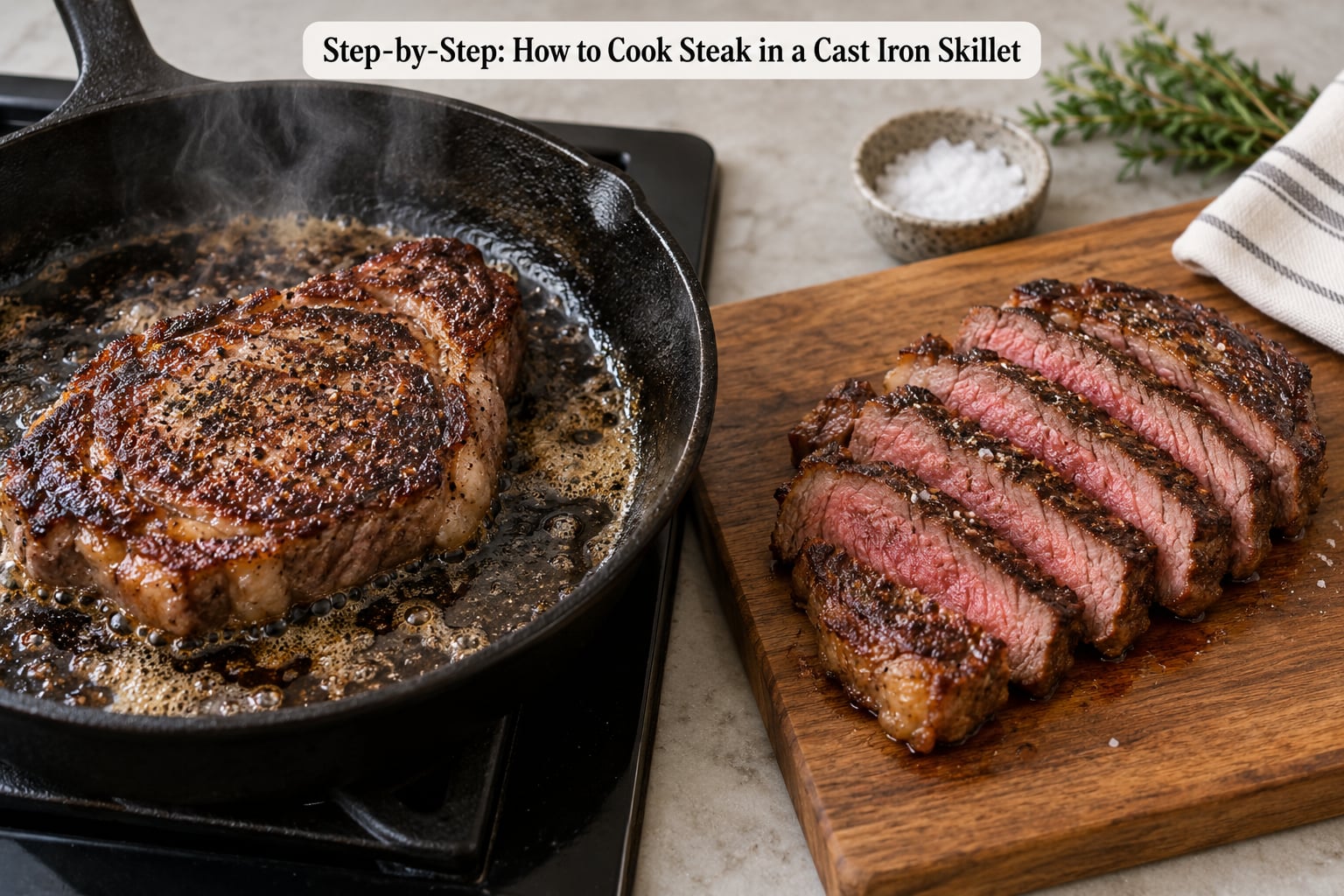
The crust releases on its own when it is ready to turn, usually after 2 to 4 minutes depending on thickness. If you have to scrape it with a spatula, it needs more time. Resist the urge to flip every 30 seconds, though plenty of cooks do it on purpose and get good results: flipping several times on a thick cut evens out the temperature gradient through the middle, and that is a legitimate approach. Just do not flip so often that the crust never sets.
Turn once with tongs, sear the second side, and move on. A thick steak is now past the point where a stovetop alone cooks it evenly all the way through.
Finish to Your Preferred Doneness
Push the thermometer into the side of the steak and read the center. Here is where the rest of the heat goes: the steak keeps cooking after it leaves the pan, so pull it 5 degrees below your target.
| Thickness | Sear per side | Method for medium-rare |
|---|---|---|
| 3/4 inch | 2 minutes | Stovetop only, 4 to 5 minutes total |
| 1 inch | 2 to 3 minutes | Stovetop only, 5 to 6 minutes total |
| 1.5 inch | 3 to 4 minutes | Stovetop only, 8 to 9 minutes total |
| 2 inch | 3 to 4 minutes | Reverse sear or oven finish recommended |
For a 2-inch steak, the stovetop method breaks down around 1.5 inches. Beyond that, the outside overcooks long before the center catches up, and you get the grey band people complain about. Two fixes.
The oven finish is the simple version: after the first sear, put the pan in a 425F oven and cook to temperature, checking every 2 minutes. The reverse sear is more consistent: bring the steak to about 115F in a 225F oven first, then sear it 60 to 90 seconds per side in the screaming-hot cast iron. For anything over 1.5 inches, experienced cooks usually reach for the reverse sear, and cast iron is the ideal finishing pan because it holds that heat long enough to crust the edges fast.
| Doneness | Pull temperature | Notes |
|---|---|---|
| Rare | 120 to 125F | Very soft, almost liquid center |
| Medium-rare | 125 to 130F | Warm pink center, the most common target |
| Medium | 135 to 140F | Firm pink, no blood |
| Medium-well | 145 to 150F | Mostly brown with a hint of pink |
| Well done | 155F and up | Dry, which is why few cooks choose it |
The USDA minimum safe internal temperature for whole cuts of beef is 145F. That is a food safety floor, not a doneness preference, and the gap between 125F and 145F is where the argument about steak actually lives.
Rest, Slice, and Serve
Move the steak to a wire rack for 5 to 10 minutes, roughly 5 minutes per inch of thickness. Resting lets the juices redistribute instead of running out onto the cutting board in a puddle.
Slice against the grain. Find the direction of the muscle fibers on the cut, usually obvious on a strip steak, and cut across them at a slight angle. Cutting with the grain makes every fiber pull apart separately, which is the difference between tender and chewy no matter how well you cooked it.
While the steak rests, the fond in the pan is worth keeping. Deglaze with a splash of water or stock, scrape up the brown bits, and whisk in a spoon of butter for a quick pan sauce. You will need about a tablespoon of fat per steak, so read the cast iron against stainless steel pan comparison before you shop for equipment.
Common Mistakes and Fixes
The steak sticks and tears. Almost always one of three things: the steak was wet, the pan was not hot enough, or the seasoning is bare. Pat the meat dry, preheat longer, and if it still sticks, leave it another 30 seconds, since it will release on its own.
The crust is grey or pale. The pan dropped temperature, or the steak went on before the oil was shimmering. A 5-minute preheat and a loud sizzle on contact are the cues.
A grey band between the crust and the center. This is normal on a thick cut seared hard on the outside. Flipping more often, finishing in the oven, or using the reverse sear reduces it.
The pan smokes and sets off the alarm. The oil went in too early or too much of it went in, or the burner is larger than the pan. Use a tablespoon, add it to a hot dry pan, and if you have a range hood, turn it on before the pan goes hot. If you love a smoky sear, grilling over charcoal outdoors is a better place for it.
The whole kitchen fills with smoke. Your fat is burning, not searing. Avocado, canola, and ghee are the safest picks; olive oil works but has a lower smoke point than most people assume.
Two steaks at once cook unevenly. Every extra piece of cold meat drops the pan temperature. Cook them in batches unless you have a 12-inch skillet and only two steaks, and give the second one an extra minute on the first side.
You have a ceramic cooktop. Induction and radiant electric elements cycle on and off, so the pan does not stay hot between pulses and cast iron is heavy enough to scratch the glass. Lift the pan instead of dragging it, and give it a longer preheat, around 8 minutes, to hold temperature. Enameled cast iron, like Le Creuset, should be brought up gradually on low or medium, since blasting a cold enameled pan at full heat can crack the coating. A bare Lodge or Fielding pan has no such limit.
You sliced it straight off the heat. The juices run out and the meat goes dry. Ten seconds of patience fixes it. For a burger-style patty cooked the same way, the oven-burger method handles the same physics in a different shape.
Frequently Asked Questions
What is the 3-3-3 rule for steaks?
The 3-3-3 rule is a rough memory aid from restaurant kitchens: roughly 3 minutes on the first side, 3 minutes on the second, and 3 minutes of rest. It is a starting point for a steak near 1.5 inches thick seared on very hot cast iron, not a rule. Thickness, starting temperature and how hot your burner actually gets move the numbers a lot, which is why the timing table above is safer to follow.
How long do you cook a 2 inch thick steak in cast iron?
About 3 to 4 minutes per side gets you a sear, but a 2-inch steak is too thick to finish on the stovetop alone without a grey band and a dry edge. The reliable method is a reverse sear: bring the steak to 115F in a 225F oven, then sear it 60 to 90 seconds per side in preheated cast iron. An oven finish at 425F after the first sear also works and is simpler.
Do I need oil to cook a steak in a cast iron skillet?
You need a thin film of fat, about a tablespoon for a 10-inch pan, and lean cuts really do need it. A heavily marbled ribeye can sear with almost nothing, but the added fat gives the crust more even browning. Use avocado, canola, ghee, or beef tallow, add it to the hot dry pan, and wait for a shimmer. Oil added to a cold pan burns off before the steak arrives.
Do you put oil in cast iron before searing steak?
Heat the pan dry first, then add the oil. Oil in a cold pan is seasoning the pan, not cooking the steak, and most of it evaporates before you are ready. The sequence is: preheat empty skillet about 5 minutes on medium-high, add a tablespoon of high smoke point oil, wait until it shimmers without smoking, then lay the dried and salted steak in away from you.
What temperature should a cast iron skillet be for steak?
Aim for a pan surface temperature around 425F for the sear, which is medium-high on most home burners after a 5-minute preheat. If you own an infrared thermometer, it reads cast iron accurately. The classic technique popularized in the media goes further, taking the pan until it is just smoking for a hard sear, then basting with butter and garlic near the end. Drop to medium-low for anything after the first flip.
Do you cover the steak while cooking in cast iron?
No. Covering traps steam, and steam is the opposite of a sear. Leave the steak uncovered so the surface stays dry and the crust keeps browning. If you are finishing a thick cut in the oven, leave the pan uncovered there too, and only cover the resting steak loosely with foil if you want to hold its temperature while the rest of the meal comes together.
Conclusion
Start with the steak, not the pan. Take it out 30 to 45 minutes early, salt it, pat it bone dry, and preheat the empty cast iron for 5 full minutes before any oil goes in. That sequence is what produces a crust that is brown rather than grey, and it is the part most home cooks skip.
Once the steak is in, the whole method is heat and timing: 2 to 4 minutes per side, a butter baste in the last minute, and a thermometer reading instead of a guess. Pull five degrees below your target, rest it 5 to 10 minutes, and slice against the grain. Ten minutes of work, and you will stop guessing at doneness entirely.