
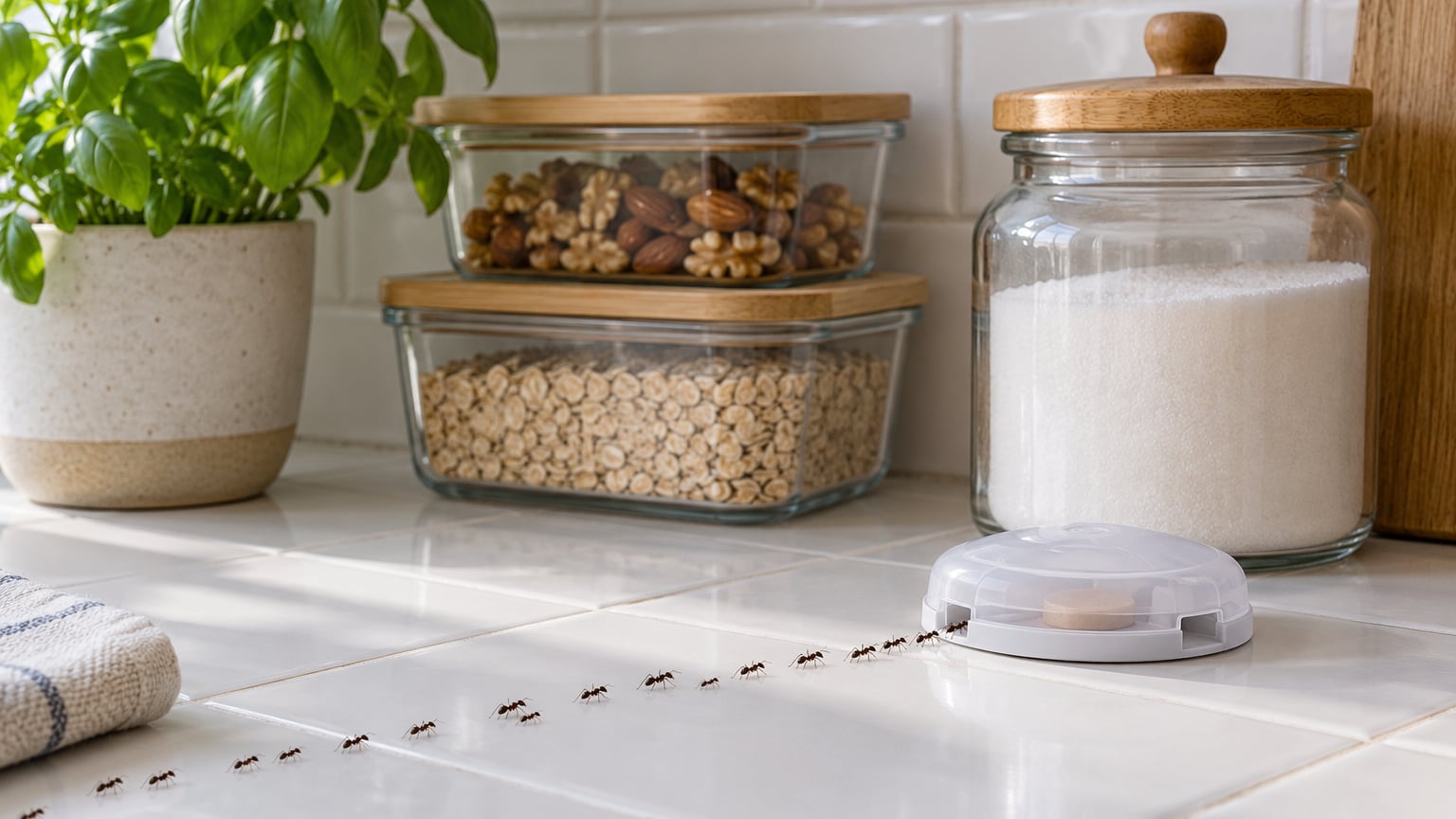
To get rid of ants in the kitchen, use a slow-acting borax or boric acid bait so the foragers carry it back to the nest, then take away their food and water and seal the gap they came in through. Spraying the trail kills a few dozen workers and changes nothing at all, because the queen is untouched and keeps replacing them.
Done properly, this takes an evening to set up and five to fourteen days to finish. Most kitchens clear out well inside that window, and the ones that do not usually have a specific, findable reason: damp timber, a wall void, a crack around a pipe that is bigger than a pencil.
Before the steps, one thing worth saying plainly. Ants in a kitchen are not usually a hygiene failure. They are a forager trail from a colony somewhere in the wall, under the slab, or in a yard next door, and the crumbs you cannot see are simply a better offer than whatever they found outside. The same checklist professional kitchens use for what to look for in a clean restaurant kitchen applies here at a smaller scale: attractants, water, and entry points.
Table of Contents
- What You Need to Get Rid of Ants in the Kitchen
- Step-by-Step: How to Get Rid of Ants in the Kitchen for Good
- Confirm it’s ants before you try to get rid of ants in the kitchen
- Find where the ants are entering
- Remove food and standing water
- Seal entry points without trapping ants inside
- Set ant bait near active trails
- Use boric acid only as the label directs
- Check daily and decide whether more treatment is needed
- Prevent ants from coming back
- Common Mistakes That Make Kitchen Ants Worse
- Frequently Asked Questions
- How long does it take to get rid of ants in the kitchen?
- Why do more ants appear after I put down ant bait?
- Are ants in my kitchen dangerous?
- Does boric acid kill ants, and is it safe to use indoors?
- What if ants keep coming back after I clean the kitchen and seal the gaps?
- How do I tell ordinary ants apart from carpenter ants or termites?
- Start With the Trail and the Food Source
What You Need to Get Rid of Ants in the Kitchen
You need six things, and most households already own four of them. The list is short because the method is about timing and placement, not equipment.
- Identification supplies. A small jar or a sealed plastic bag with a lid, plus a magnifier or a phone camera zoom. You want to see the ant, not guess at it from a distance.
- A flashlight. For following trails along baseboards and into the dark under the sink. A red-light torch works even better, because ants cannot see red light and will keep walking while you film them.
- Airtight food containers. Glass or hard plastic with a proper seal, not a bowl with plastic wrap over it. This matters more than any product you buy later.
- Degreaser and a disinfectant. Warm soapy water for the trail lines, and a proper kitchen degreaser for the film on cabinet walls, cupboard hinges, and the base of the fridge and oven. Grease is invisible and ants find it easily.
- Sealants. Kitchen-safe silicone sealant or acrylic caulk for gaps around pipes and countertop edges, plus door weather stripping for thresholds that admit a draft.
- Ants bait that reaches the colony. A commercial gel bait station registered with the EPA, or a labelled borax or boric acid product sold for indoor ant control. Read the label before you buy, not after.
What not to do is combine products. Do not put a spray next to a bait station, do not pour a different insecticide on the same trail, and never mix borax into a homemade cleaner. Repellent and bait work against each other: one draws ants in, the other pushes them away before they take anything home.
Step-by-Step: How to Get Rid of Ants in the Kitchen for Good
Confirm it’s ants before you try to get rid of ants in the kitchen
Most of what people find in a kitchen really is an ant, but two lookalikes change the plan completely, so spend two minutes on this first. Put a few workers in the jar and look at them closely.
True ants have a pinched waist between the thorax and the abdomen, elbowed antennae, and a body that narrows sharply in the middle. Termites have straight, beaded antennae and a waist that looks like no waist at all. Carpenter ants are large — often half an inch — and their nest is in damp or damaged wood, not in a food cupboard. If you see wood shavings, sawdust, or a section of timber that sounds hollow when you tap it, stop treating this as a cleaning job. The moisture is the problem, and that is a building repair, not a bait station.
Size matters too. Ants that are difficult to see without glasses are usually ghost ants or pharaoh ants, both of which reproduce quickly in small numbers and prefer protein in some seasons. A clear view of the specimen tells you which bait to buy later.
Find where the ants are entering
Follow the trail backwards until it disappears, and that is your entry point. Ants walk in single file along a scent trail, so the line is easier to follow than you expect, especially in the evening when the kitchen is quiet.
Work along the baseboards, the underside of the countertop, the gap where the sink and drain pipes meet the wall, the dishwasher door seal, the door threshold, window frames, and switch plates. Pull the fridge and oven out at least once a year and look at the floor behind them, because a gap there is a highway and it is often the single most productive thing you find all evening.
Also work outdoors. Walk the perimeter of the house and watch where a line of ants enters or leaves the soil, especially near planting beds, downspouts, and pavers. If the trail runs to a gap in the foundation or a door sweep, you have found the real door. If it vanishes into a wall void with no visible gap, note the location and come back to it in the sealing step.
Remove food and standing water
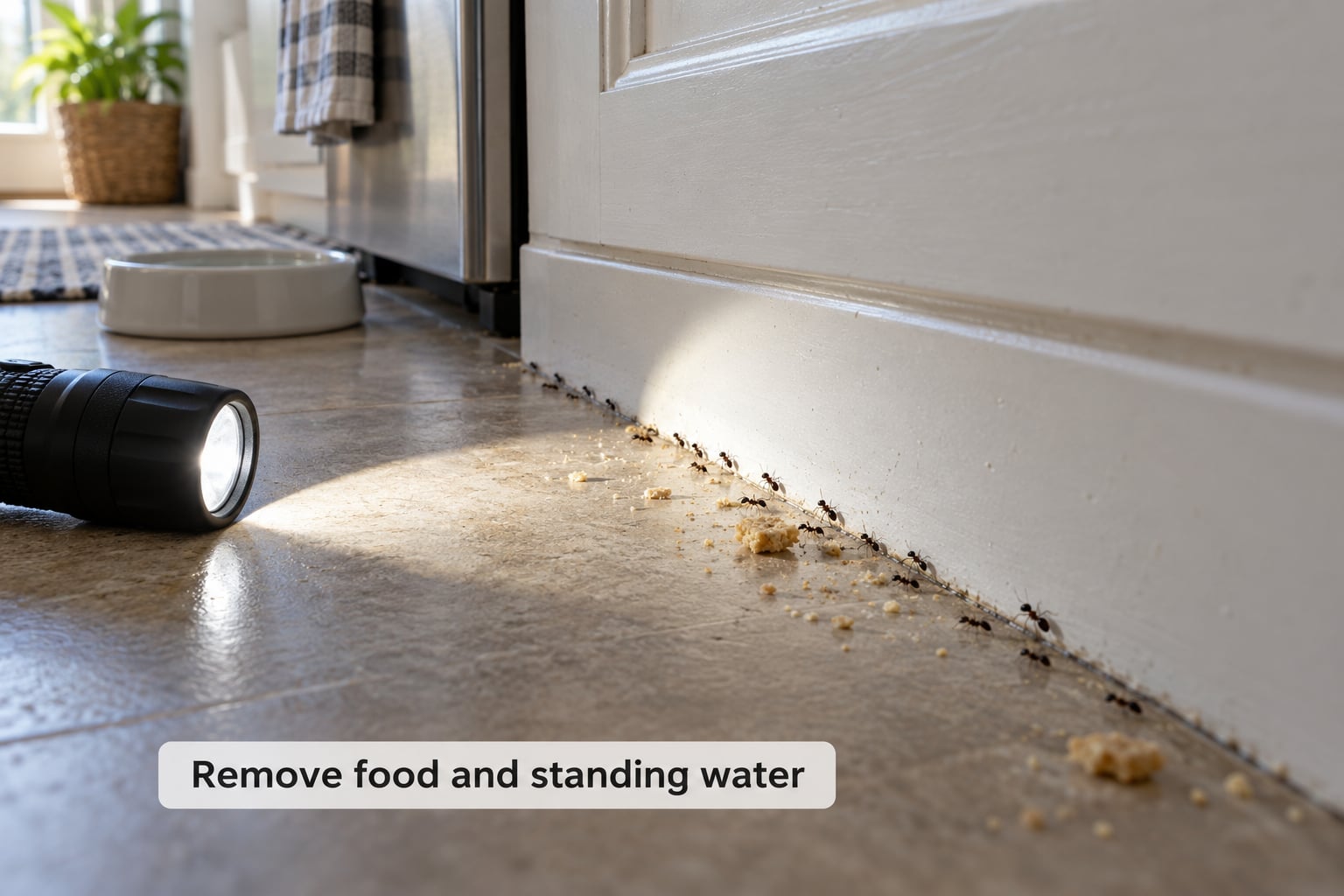
Cut off three things: food, water, and grease. People usually think about the first one, and the other two do most of the work.
Go room by room rather than kitchen-wide. Wipe counters and stovetops with warm soapy water, then degrease the vertical surfaces — the underside of wall cabinets, the side of the fridge, the toe kicks — because grease is a food source and it does not look like grease. Vacuum or wipe the seams of the baseboards and the edges where the floor meets the cabinetry, which is where most of the crumb traffic runs.
Store dry goods, cereal, flour, rice, and pet food in airtight containers, not in the open bag on the counter. Put the fruit in the fridge. Take bins out regularly rather than letting them become a full load, and give the bin lid a wipe when you do.
Water is the attractant most people miss. Fix a dripping faucet, wipe standing water in the sink and the basin of the garbage disposal, dry the counter after you rinse, and watch for a damp dish towel folded on the oven handle. Ants need water far more often than they need a sandwich, which is why you can have a spotless kitchen with a full sink of dishes and a steady ant trail through it.
You know this step worked when: the trail is thinner or gone by morning, and crumbs no longer appear within a few hours of you sweeping the floor.
Seal entry points without trapping ants inside
Seal what you found, but do it after the bait is working, not before. Sealing a gap while ants are still living inside simply moves the problem to the next crack, and you will be doing this again in a week.
For small gaps around pipes and along countertop edges, use kitchen-safe silicone sealant. For a door threshold that lets a draft in, fit or replace the weather stripping. For a gap wider than about 6 mm where a mouse could also get through, pack it with steel wool first and caulk over the top, otherwise the sealant sags out of an empty hole over time.
Do not attempt structural, gas, electrical, or significant moisture work yourself. Damaged timber, a leaking supply line, a failed circuit, or a foundation crack needs a licensed tradesperson. Sealing over one of those makes the problem quieter and more expensive, not smaller.
You know this step worked when: after the colony is gone, a week passes with no ants and the gap still looks closed.
Set ant bait near active trails
Set the bait where the ants are already walking, not in the corner where you saw one last week. The active line is the only reliable guide you have to the nest, and bait placed off that line is the most common reason a treatment appears to do nothing.
Read the label first and follow it exactly. Gel and liquid stations are indoors-ready and enclosed, with entry holes small enough that a child or a curious cat cannot reach the bait. Place several stations along the trail rather than one big one, spacing them along the line and near the entry point you identified.
Here is the mechanism, because it explains everything else. A fast-acting spray kills a worker before it gets home. A slow-acting toxicant does not: the worker eats the bait, carries it back to the nest, and shares it mouth to mouth with other ants in a behaviour called trophallaxis, including the queen. The colony is fed the active ingredient from the inside, and it collapses over days rather than hours.
Keep the bait away from children, pets, food preparation surfaces, and open containers. Put it under a sink, behind an appliance, or along a baseboard nobody brushes against.
Use boric acid only as the label directs
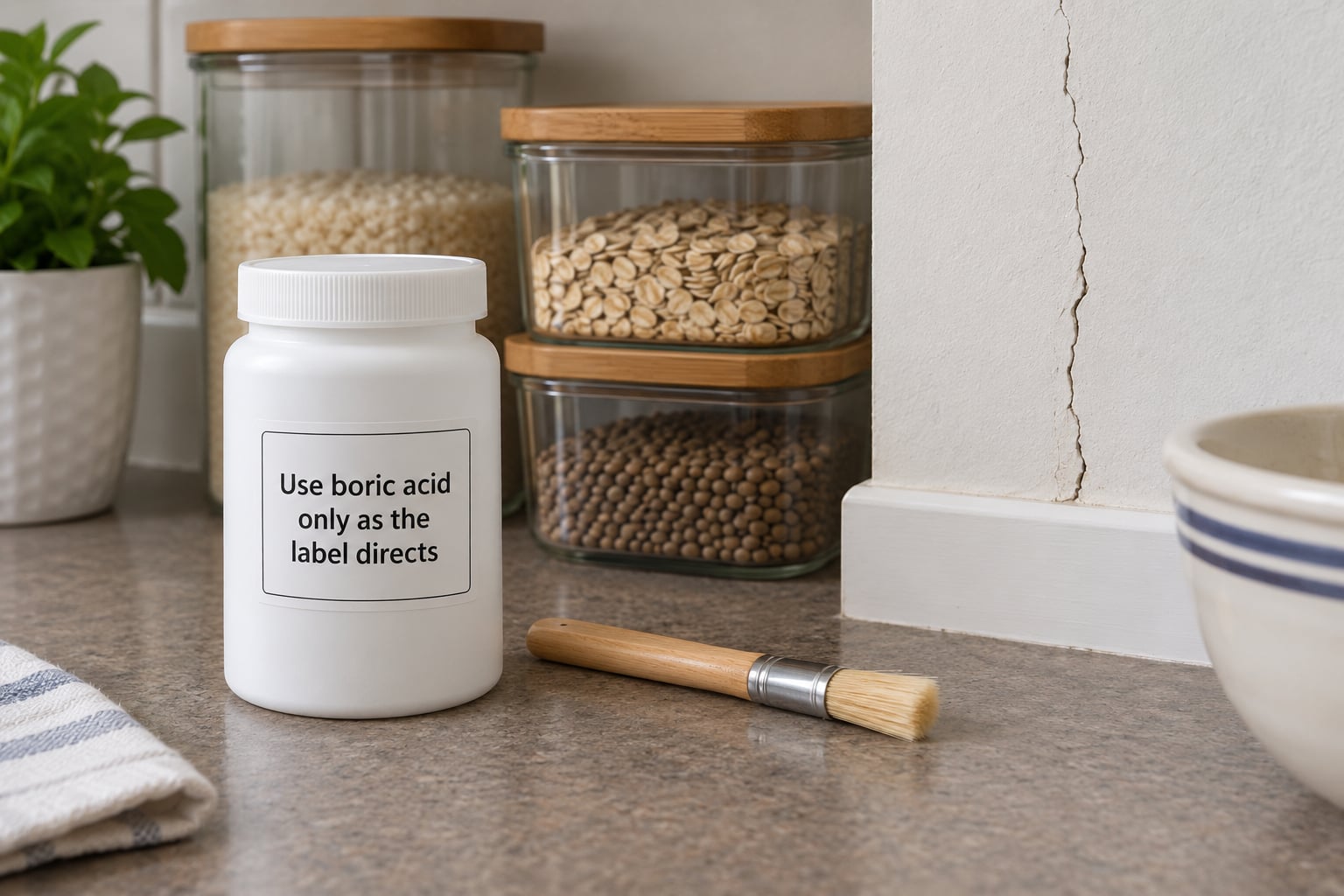
Boric acid and borax are the same compound family, sold at different concentrations, and both work as a slow stomach poison that also dries the insect out. Use them the way the label says, and only indoors in places no one can reach, such as inside a wall crack, an unused outlet, or the void behind an appliance.
Put the product where the ants already walk and keep it out of reach at the same time, which is why an enclosed gel or liquid station does most kitchens more good than a poured or dusted product. It stays put, it stays in contact with the foragers, and nobody can scoop it into a plate of food by accident.
Concentration matters, and the label is what controls it. Bait that is too strong kills on contact and teaches the colony nothing, because the ant never makes it home. Bait that is too weak is treated as ordinary food and does little. If you see ants walking over the bait and dying on the counter right beside it, that is a strength problem, and the fix is a weaker application or a different labelled product, not more bait.
Two hard rules. Never mix borax or boric acid with anything that is not on a product label, and never improvise a spray, powder, dough, or cleaner containing it. Homemade pesticide recipes are unregulated, easy to overdose, and the reason some of the advice you have read online is dangerous to a cat or a small child. Borax is not a baking ingredient you can sprinkle near a pet bowl, and a cotton ball soaked in a homemade borax and sugar mix is exactly the kind of unlabelled mixture that ends up in a lunchbox.
Check daily and decide whether more treatment is needed
Look at the trail once a day for about two weeks. That single habit is what separates a treatment that works from one that quietly fails, because the day-to-day numbers tell you far more than the first morning does.
For the first two days, traffic usually increases. That is the bait being found and carried home, and it is the best early sign there is. On days three to five you should start seeing fewer workers on the trail and more of them behaving oddly, slowing down, walking in circles near the nest rather than the counter. That is where the dead ones turn up too: under the sink, behind the fridge, in a corner near the entry point. The people who report this and assume the bait failed have usually found the proof that it worked.
Replace a station when it dries out or empties, following the label, and keep the original one out for the full period the label specifies. Do not add a second brand on top of the first, and do not clean the bait away because it looks untidy. If a scent spray or vinegar goes near the line, the ants lose the trail and stop taking the bait.
By around day fourteen you should see a clear drop. If activity is identical to where it started, one of three things is true: the bait type does not match what this species eats, the nest is somewhere you cannot reach, or you have a moisture problem feeding a carpenter-ant-type nest rather than a food-driven one. That is the point to reassess rather than keep pouring in more product.
Prevent ants from coming back
Once the trail stops, spend ten minutes a week keeping the kitchen unattractive. Wipe counters daily, take the bins out before they fill, keep dry goods and pet food in sealed containers, and wash pet bowls rather than topping them up.
Run the tap for a few seconds and dry the sink rim so nothing sits damp. Check under the sink every month or two for a new drip or a swollen baseboard, since that is the early warning. Look at the same entry points after a storm or a cold snap, when ants move indoors as the outdoor food runs out, and reseal anything that has opened up.
Keep the outdoor edge boring too. Wipe up crumbs and pet food from the patio and step, and clear plant debris away from the foundation. Ants that never find a reason to walk toward the house in the first place never give you a trail to follow.
For the deep-clean side of this, our guide to getting grease smell out of a kitchen covers the film that keeps ants coming back long after the visible crumbs are gone, and how to clean a kitchen after frying has a good degreasing routine for the worst offender of all.
Common Mistakes That Make Kitchen Ants Worse
Almost every failed attempt comes down to one of six mistakes, and all of them are fixable.
Killing the ants you can see. A spray or a swat removes the foragers on the counter and leaves the colony, the brood, and the queen running. The trail reappears within days, which is why it feels like proof that nothing worked.
Spraying while baiting. Repellent breaks the scent trail before the worker reaches the nest, and the poison never gets carried home. This is the single most common DIY error. When a bait is working, you do not spray anything near the line, and you do not wipe it with vinegar or a scented cleaner.
Mixing products. Two different insecticides do not add up to a better result. They cancel each other out, and the combination can leave a residue you are then exposed to every time you use the counter.
Ignoring grease and hidden crumbs. A wiped-looking counter can still carry a film of grease along the cabinet fronts, the shelf edges, and the floor seam behind the bin. Clean the seams and the vertical surfaces, not just the flat top.
Sealing ants in without fixing the real entry point. If you close one gap while the colony is alive, the next gap becomes the new highway. Find where the trail comes from, and seal it once the bait has worked.
Cleaning the bait away too early. Bait that looks like a dried-up blob gets binned on day three, right when the colony is being fed. Leave it in place for the label’s full duration.
Two more worth mentioning. Do not rely on essential oils, coffee grounds, cinnamon, or lemon peels as a fix — most of them disrupt a trail for a few hours and then evaporate, and concentrated oils around cats and dogs are a genuine veterinary concern. And do not use loose diatomaceous earth near food prep areas, where it becomes a dust that everyone inhales.
Frequently Asked Questions
How long does it take to get rid of ants in the kitchen?
Most kitchens clear in five to fourteen days once bait is in place and food and water are cut off. Traffic often rises in the first two days because foragers are finding the bait. By days three to five the line thins and you may find slow or dead workers near the nest. If activity is unchanged at day fourteen, the bait type, the nest location, or a moisture problem is the likely cause.
Why do more ants appear after I put down ant bait?
More ants at first is normal and it is a good sign. The workers you are counting are following a trail to a new food source, and slow-acting bait is that source. Over the first two days the number of trips rises before the colony starts losing foragers. Keep the bait in place, do not spray, and do not clean the line. Ants walking over the bait and dying right next to it means the bait is too strong.
Are ants in my kitchen dangerous?
The common kitchen ants, including ghost ants, pharaoh ants, odorous house ants, and pavement ants, do not bite or sting people and they do not spread disease in a home kitchen. The exceptions are fire ants, which sting when their nest is disturbed, and carpenter ants, which do not eat wood but signal damp or damaged timber in the structure. If you have fire ants, or you see wood damage, treat it as a different job and get help.
Does boric acid kill ants, and is it safe to use indoors?
Yes, and used as the label directs it is safe for a normal household when placed where no one can reach it. Boric acid and borax are the same compound family and act as a slow stomach poison that also dehydrates the insect, so a worker carries it back to the nest before dying. Keep it away from children, pets, dishes, and food, use enclosed bait stations indoors, and never make a homemade spray or mixture from it.
What if ants keep coming back after I clean the kitchen and seal the gaps?
Check four things in order. Is the bait type wrong for this species, since protein-feeding species ignore sugar? Is the bait off the active trail or too weak or too strong? Is something wet, such as a drip or a damp towel, still attracting them? And is the nest outside your reachable area or inside a wall void? If fourteen days of correct baiting changes nothing, or the trail splits behind an appliance, that is the point to call a pest professional.
How do I tell ordinary ants apart from carpenter ants or termites?
Ants have elbowed antennae and a pinched waist; termites have straight beaded antennae and no waist. Carpenter ants are much larger, often half an inch, and they nest in damp or rotten wood rather than in food. Look for wood shavings, sawdust, or timber that sounds hollow when tapped. If you find those, the problem is moisture in the structure, which is a building repair, not a bait job, and it needs a professional.
Start With the Trail and the Food Source
If you do one thing tonight, follow the ant line until it disappears and note exactly where it goes. That single piece of information decides everything else, because it tells you where to put the bait and which gap to seal.
Then remove what you can reach. Put dry goods and pet food into airtight containers, wipe down the counter and the cabinet fronts, dry the sink, and fix the drip. Set an enclosed bait station on the trail, following the label, and leave it alone. Expect more ants for a couple of days rather than fewer, and keep the spray bottle in the cupboard until the whole thing is finished. That is how to get rid of ants in the kitchen without turning your counters into a chemical experiment.