
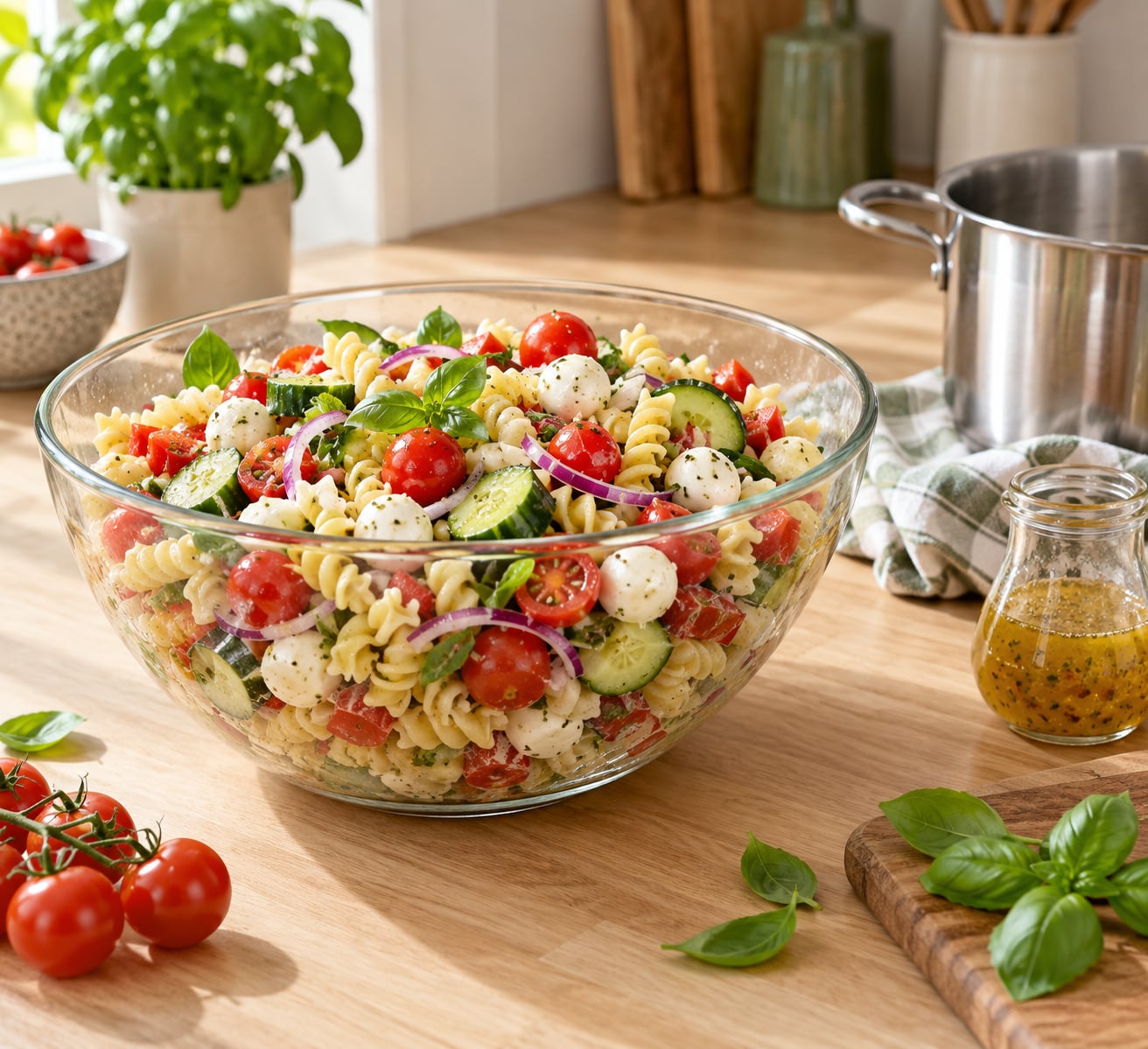
To make pasta salad for a crowd, plan on 1 pound of dry short pasta for every 8 to 10 people eating it as a side dish, or every 4 to 6 people if it is the main. The base recipe below makes about 3 pounds of pasta and serves 12 to 16 as a side. Active time is about 40 minutes, plus two to four hours of chilling.
Big-batch pasta salad is not just a bigger bowl of the same recipe. The pot has to be big enough, the pasta has to be cooled before it soaks up the dressing, and the dressing gets added in stages. Skip any one of those and you end up with a clumpy, dry, watery salad at the worst possible time.
Here is the method I use, the quantities for 10 to 40 people, and the timeline for making it the day before.
What You Need
The base batch below yields roughly 12 to 16 side portions. It also works as the centerpiece for a small crowd if you double the add-ins and skip the bread.
Base recipe for 12 to 16 as a side
- 3 pounds (48 ounces) dry short pasta — rotini, penne, cavatappi, shells or rotelle
- 1.5 pounds cherry or grape tomatoes, halved
- 1 large cucumber, chopped
- 2 red or green bell peppers, chopped
- 1 small red onion, thinly sliced
- 15 ounces mozzarella pearls, roughly 2 cups
- 1 can (15 ounces) chickpeas, rinsed and drained
- 1 cup black or Kalamata olives, pitted
- 1 large bunch fresh basil or parsley, roughly chopped
- 4 cups Italian-style vinaigrette dressing, plus more for serving
- 2 tablespoons olive oil for the cooling step
- Salt and cracked pepper to taste
If you want a creamy version instead, swap the vinaigrette for a homemade mayonnaise dressing: 1.5 cups mayonnaise thinned with 2 tablespoons milk and 1 tablespoon lemon juice, plus a spoon of mustard and a splash of vinegar. Creamy salads want a little more pasta water in the mix, since the sauce clings harder.
Equipment, sized for the headcount
The rule of thumb for water is about 1 gallon per pound of dry pasta, so a 3-pound batch needs a 12-quart pot. Using a smaller pot with more batches takes longer but works fine.
- One pot holding 12 quarts or more for the pasta, plus a second pot if you cook in batches
- Two or three rimmed sheet pans for cooling the pasta in a single layer
- One large mixing bowl per pound of pasta — a 5-pound batch is heavy to toss in one bowl
- A colander or slotted spoon big enough to hold a pound of pasta
- 3-quart lidded containers for transport, roughly one per 10 servings
- Serving spoons and at least one dish per 10 people so the line keeps moving
- Cooler and ice packs for any trip longer than 30 minutes
Quantities for 10, 15, 20, 30 and 40 people
Measure by weight, not by box count, and round up. A 16-ounce box of dry pasta cooks to about 8 cups, so one box feeds roughly 8 to 10 people as a side or 4 to 6 as a main.
| People | Dry pasta | 16-oz boxes | Vinaigrette | Add-ins | Finished yield |
|---|---|---|---|---|---|
| 10 | 1.5 lb | 1 box | 2 cups | 5 cups | about 10 cups |
| 15 | 2 lb | 2 boxes | 2.5 to 3 cups | 7 cups | about 15 cups |
| 20 | 2.5 lb | 3 boxes | 3 to 3.5 cups | 9 cups | about 20 cups |
| 30 | 3.5 lb | 4 boxes | 4.5 to 5 cups | 13 cups | about 30 cups |
| 40 | 4.5 lb | 5 boxes | 6 cups | 17 cups | about 40 cups |
Scale add-ins the same way: roughly 2.5 to 3 cups of vegetables, cheese and beans per pound of dry pasta, plus half a cup of strong flavors like olives, pepperoni or artichoke hearts.
Step-by-Step: How to Make Pasta Salad for a Crowd
1. Cook the pasta until just tender
Bring a large pot of water to a rolling boil and salt it until it tastes like the sea — about 1 tablespoon per gallon. Add the pasta in batches rather than all at once if your pot is smaller than the full batch, because pasta dropped into cold water cooks unevenly and sticks.
Cook it 1 to 2 minutes short of the package time. A cold salad needs firmer pasta than a hot one, and the extra minutes of chilling continue to soften it. The strands should bend easily with a firm bite in the center when you pull one out.
2. Cool the pasta without making it sticky
Drain the pasta in a large colander and let it sit for two minutes so it stops dripping. Do not rinse it under cold water: that strips the starch that helps dressing cling, and the pasta will taste bland hours later. Instead, spread it across rimmed sheet pans, toss it with the olive oil, and leave it on the counter until it stops steaming.
For a large batch, an ice bath works too — set the drained pasta into a bowl of ice water for 3 to 4 minutes, then drain and spread out again. The strands should separate when you shake the pan. If they clump into one solid sheet, break them apart gently with your hands.
3. Prepare the vegetables and optional add-ins
Chop everything to roughly the size of one bite. Halve the tomatoes, dice the cucumber and peppers, thinly slice the onion, and drain the chickpeas and olives well so they do not water down the bowl.
Salt the cut vegetables lightly as you go, not heavily, then hold them over a colander for 10 minutes to drip. Skip this step for cucumbers, which release water on their own once cut, and instead add them just before serving if you can.
Add-ins per pound of pasta: 1 cup protein such as grilled chicken, Italian sausage, pepperoni or tuna, and half a cup of strong flavors such as roasted red peppers, marinated artichoke hearts or Kalamata olives. Save leafy herbs and anything with crunch until the last minute so they stay lively. If you want a second cold dish for the same table, how to make macaroni salad for a cookout follows the same cool-and-dress logic.
For grilled chicken, cook it to 165°F (74°C) and cool it completely before mixing. Kitchen cooks I know all say the same thing: mixing warm protein into a cold salad warms the whole bowl and dulls the dressing.
4. Make the dressing and season the salad
For a vinaigrette, the ratio that works at scale is about 1 to 1.5 cups dressing per pound of dry pasta. Shake or whisk it hard with 1 to 2 tablespoons of the starchy water left from the pot — that cloudy water is what emulsifies the dressing so it stays smooth instead of separating.
Taste it on its own before it touches the pasta. Too sharp means more oil, too flat means more salt, too sweet means more vinegar or a squeeze of lemon. If you are using bottled dressing, add the pasta water a tablespoon at a time; bottled dressings are already seasoned and they need less help than homemade ones.
5. Toss, chill, and serve in bulk
Do this while the pasta is still slightly warm. Add half the dressing to the warm pasta and toss hard for a full minute, then fold in the vegetables and cheese. Warm pasta drinks up dressing and gives it something to hold onto instead of leaving it slick in the bowl.
Chill the covered salad for at least 2 hours and up to 24. Before serving, loosen it with a splash of reserved dressing or a few tablespoons of cold water, taste again for salt, and add the herbs, raw cucumber, or anything crisp you held back.
Transport it cold in lidded containers and put it straight into a cooler or refrigerator when you arrive. Set out small batches and refill the bowl rather than putting the whole thing on the table at once. If you are building a full grill menu around it, how to make a burger salad bowl is a good second cold plate.
Common Mistakes
Most failed crowd-sized pasta salads come down to the same handful of problems, and each one has a straightforward fix.
- Overcooking the pasta. Pull it 1 to 2 minutes early. Pasta continues to cook in the bowl and while it chills, so the finish time you want is firmer than what looks right straight from the pot.
- Rinsing the pasta under cold water. It strips the starch that makes dressing cling, and the salad tastes dry by hour three. Cool it on sheet pans with a little oil instead.
- Watery vegetables. Salting and draining cut tomatoes, cucumber, peppers and onion for 10 minutes pulls out excess liquid. That extra water is what turns a batch into soup at the bottom of the bowl.
- Not enough dressing. Pasta keeps absorbing it overnight. Start with 1 to 1.5 cups per pound, then always carry a little extra in a separate bottle. A dry pasta salad is a sad pasta salad.
- Mixing in one giant bowl. A 4-pound batch weighs more than most mixing bowls are rated for, and folding it by hand takes forever. Mix in separate bowls, one per pound or two, then combine them.
- Adding everything too early. Fresh herbs, cucumber, lettuce and greens go in at the end. They wilt, shrink and go dull within hours of hitting the dressing.
How to Scale and Store Pasta Salad
Scaling is simple arithmetic once you have a base: pounds of pasta times the number of people divided by 8 for a side dish, or by 5 for a main. Everything else scales from the pasta weight — 2.5 to 3 cups of add-ins and 1 to 1.5 cups of dressing per pound. The same logic applies to the rest of the menu; how to double a burger recipe for a crowd walks through the headcount math for a main dish.
Do not scale the pot or the bowl past what they can hold. If you are going past about 5 pounds of pasta, cook in two batches and cool in shifts; a pile of pasta more than an inch deep on a sheet pan cools too slowly.
Make-ahead timeline
- The day before: Cook and cool the pasta, chop the sturdy vegetables, whisk the dressing, and mix it all together. Refrigerate covered.
- Two hours before the event: Take it out of the refrigerator, stir, and taste. Adjust with reserved dressing or a splash of water.
- Right before serving: Fold in the fresh herbs, raw cucumber, and any cheese you want to stay crisp.
Refrigerated pasta salad keeps 3 to 4 days at or below 40°F (4°C), and it often tastes better on day two once the flavors settle. For mayonnaise-based salads, eat it within 3 days since the dressing is a dairy and egg product.
Food safety matters more once the salad is out of the fridge. Do not leave it at room temperature longer than 2 hours, or 1 hour if the outdoor temperature is above 90°F (32°C). Keep it in a shaded spot, on ice, or in a cooler, and use a separate clean spoon for each trip to the bowl. If you are adding grilled chicken, cook it to 165°F (74°C) first.
For serving, one large dish looks better but rarely feeds a crowd without a bottleneck. A 3-quart container serves about 10 people comfortably, so for 30 people you want three of them, each with its own spoon, and you refill them as they empty.
Frequently Asked Questions
How many pounds of pasta do I need to feed 20 people?
Plan on 1 pound of dry short pasta for every 8 to 10 people serving it as a side, so 20 people as a side needs about 2 to 2.5 pounds. If the salad is the main dish, use 1 pound per 4 to 6 people, which means 3 to 5 pounds for the same 20 guests. Round up to the next whole 16-ounce box, and you are finished with the math.
How many boxes of pasta do I need for 30 people?
Three 16-ounce boxes feed about 30 people as a side dish, since one box cooks to roughly 8 cups and a side portion is about 1 cup. If pasta salad is the main event for 30 guests, go with four or five boxes. Buy the same shape every time if you can, since mixed boxes cook at different rates and turn mushy at different times.
Should I rinse pasta for a cold pasta salad?
Skip the rinse. Running cold water over the pasta strips away the surface starch that helps dressing cling, and a rinsed pasta salad tends to taste dry by the next hour. Drain the pasta well, spread it on a rimmed sheet pan, toss it with a little olive oil, and let it cool on the counter until it stops steaming. An ice bath works too, but drain and oil it right after.
Can I make pasta salad the day before?
Yes, and most cooks say it tastes better on day two. Make it fully the night before, refrigerate it covered, and add a splash of reserved dressing or cold water plus fresh herbs before serving. Hold back anything crisp, like cucumber, lettuce, and shredded cheese, because those soften and shrink once they have been dressed for hours.
How long can pasta salad sit out at a party?
Keep it at room temperature no more than 2 hours, or 1 hour when the outdoor temperature is above 90 F. Set the bowl over ice, keep it out of direct sun, or use smaller serving dishes and refill them so each one is empty and fresh. With mayonnaise-based dressing, be stricter, since the egg and dairy make it spoil faster once it warms up.
How long should pasta salad chill before serving?
Give it at least 2 hours, and up to 24 hours if you are making it ahead. Chilling lets the dressing soak into the pasta and the flavors marry, which is why pasta salad often improves overnight. Chill it covered so it does not absorb fridge odors, then loosen it with a little extra dressing or water right before it goes out.
Conclusion
Start by weighing the dry pasta: 1 pound per 8 to 10 people as a side, per 4 to 6 as a main. Cook it one minute shy of al dente, cool it on sheet pans with a little oil, then toss it with half the dressing while it is still warm and let the whole thing chill for at least 2 hours.
From there, pick the add-ins your crowd actually eats and choose a dressing style they will tolerate, vinegar-based if you want it to hold up longest, creamy if you want it richer. Serve it cold in smaller dishes, keep it under two hours out of the fridge, and carry extra dressing to the party.