
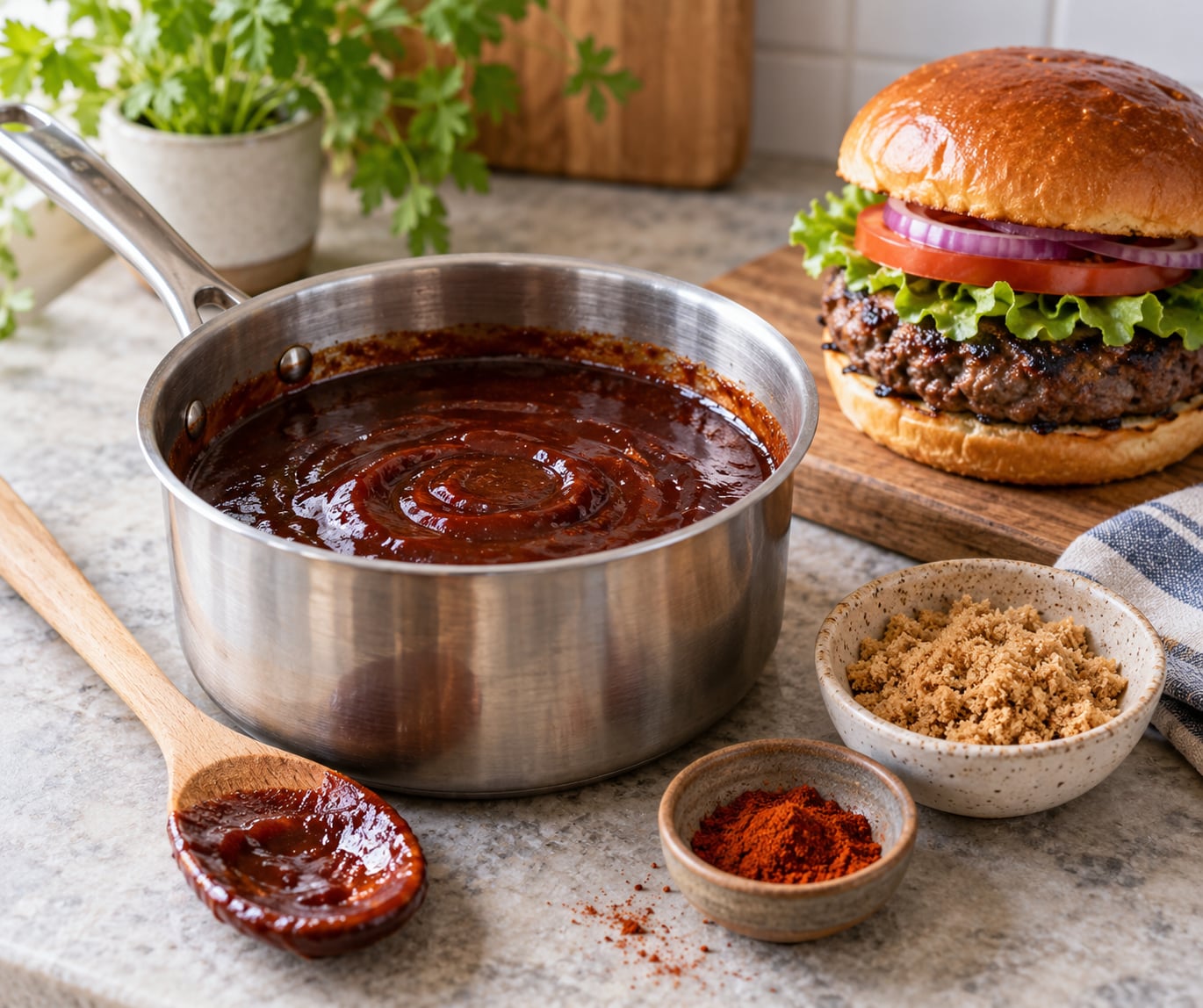
Homemade BBQ sauce takes about 25 minutes start to finish and costs you one saucepan. You simmer ketchup, brown sugar, vinegar and spices together until the liquid cooks off and the sauce turns dark, glossy and thick enough to cling to a burger bun. There is no grill required, which is the whole point if you are working with a stovetop and a craving.
The formula below is the one I keep on hand. It lands somewhere between sweet Kansas City and tangy Carolina, and it stays loose enough to dip, thick enough to brush. I make it every few weeks and freeze the surplus in ice cube trays. If you have never done this before, read the whole method once, because the only real trap is the heat setting.
What You Need
The equipment list is short enough that you almost certainly own everything already.
- A medium saucepan, 2 to 3 quart, with a lid set nearby
- A wooden spoon or silicone spatula
- A whisk or fork for the dry ingredients
- A fine mesh strainer, optional but useful
- Airtight containers or an ice cube tray for freezing
Now the base formula. It makes roughly two cups of finished sauce.
- 1 cup (240 ml) ketchup
- 1/2 cup (120 ml) firmly packed brown sugar, about 100 g
- 1/2 cup (120 ml) apple cider vinegar
- 2 Tbsp (30 ml) Worcestershire sauce
- 1 Tbsp (15 ml) Dijon or yellow mustard
- 2 tsp smoked paprika
- 1 tsp garlic powder
- 1 tsp onion powder
- 1 tsp fine salt
- 1/2 tsp freshly ground black pepper
Each one earns its spot. Ketchup supplies the body, the cooked tomato flavor and most of the salt, so it works as a sweetener and a savory base at the same time. Brown sugar is the primary sweetener and the source of the sticky, glossy finish that forms when it reduces. Apple cider vinegar is the acid that cuts through all that sweetness, and it is the ingredient people most often under-dose.
Worcestershire sauce brings fermented savoriness. Mustard adds a mild sharpness that people rarely notice directly but miss when it is gone. Smoked paprika is the smoke, and the spice level here is deliberately restrained so you can raise it later. Garlic powder, onion powder, salt and black pepper round it out. If you cook for someone who reacts to onion or garlic, drop both powders and add a pinch of extra smoked paprika in their place; dehydrated onion flakes work too if texture is what you are after.
Ketchup, vinegar, brown sugar and the three spices are pantry staples. Worcestershire and Dijon are the two optional items, and a teaspoon of yellow mustard covers the mustard slot perfectly well.
Step-by-Step
Learning how to make BBQ sauce from scratch comes down to four stages: mix, flavor, simmer and adjust. Most of the work is the simmer, and the part most people rush is the adjustment. Total time is about 25 minutes, and the active work is closer to 10.
1. How to Make BBQ Sauce From Scratch: Mix the Base
Whisk the smoked paprika, garlic powder, onion powder, salt and black pepper together in a small bowl first. Dry spices distributed this way break up evenly instead of settling into the bottom of the pan and clumping into bitter specks.
Pour the ketchup into the saucepan, then add the brown sugar, vinegar, Worcestershire, mustard and the spice bowl. Stir over medium heat until the sugar has dissolved and the mixture looks like one smooth, slightly watery sauce. A properly mixed base before heating is thinner than you expect, almost like warm ketchup with extra liquid, and that is correct.
Do not double the sugar when you substitute. If you use honey, maple syrup or white sugar, use the same volume, and reduce it to about 1/4 cup if you want the sauce noticeably less sweet. For the vinegar, rice wine vinegar is the mildest swap, distilled white vinegar the sharpest, and both work at the same 1/2 cup.
On molasses, one note saves a lot of people a wasted batch. Black strap molasses is intensely sulfurous when cooked in an acidic sauce, and that bitter note is the single most common complaint about homemade versions. Unsulfured or light molasses gives you the deep, dark color without the edge. If black strap is all you have, use half the volume and add maple syrup to make up the difference.
2. Build the Tangy-Sweet Flavor
Every direction below starts from the same base, so nothing has to be cooked twice.
- Sweeter: add 1 to 2 Tbsp more brown sugar at the start, or 1 Tbsp honey near the end.
- Smokier: add 1/2 tsp extra smoked paprika, or 1/4 tsp liquid smoke stirred in at the very end. Start small, because liquid smoke cannot be removed once added.
- Hotter: 1/4 tsp cayenne, 1 chipotle pepper in adobo minced in, or 1 to 2 tsp sriracha. For a child-friendly version, simply leave the pepper out rather than trying to substitute around it.
- Molasses-rich: 2 Tbsp light molasses stirred in with the brown sugar for deeper color and a rounder sweetness.
- Vinegar-forward: add another 2 to 3 Tbsp apple cider vinegar. This is the move that turns the same pot into Carolina-style sauce for pulled pork.
If you are making the sauce for a specific protein, match the direction to it. Smoky and sweet works on brisket and ribs, vinegar-forward suits pulled pork and chopped chicken, and a mild version with no heat is the one most kids will accept on a burger.
3. Simmer Until Thick and Glossy
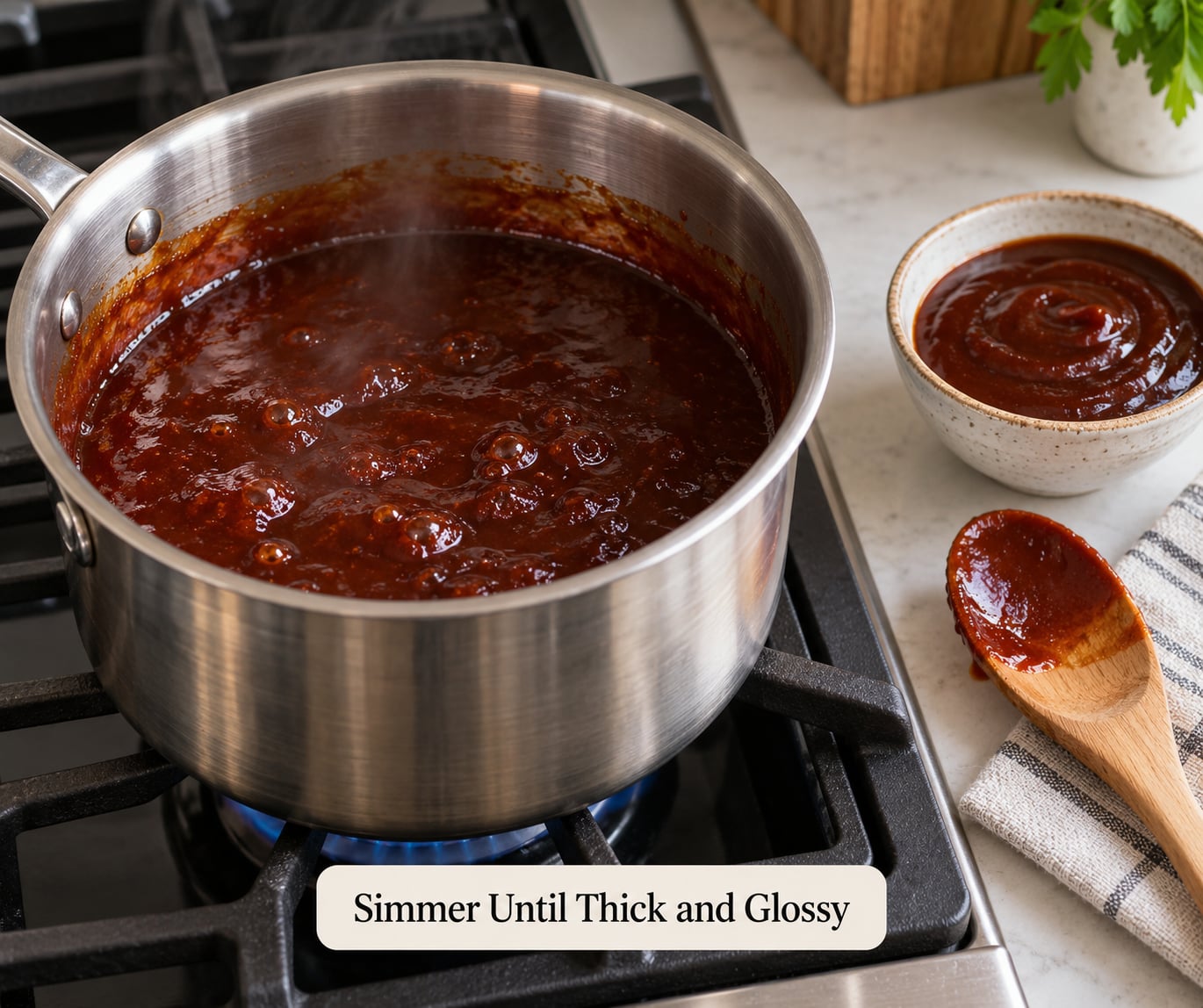
Once it comes to a gentle boil, drop the heat until you see a bubble or two every second or two. That is a simmer, not a boil, and the difference is the entire quality of the sauce.
Leave the lid off, stir every two or three minutes, and let it cook for 15 to 25 minutes. Tomato-forward sauces with a full cup of ketchup usually land in the 15-minute range. Vinegar-heavy or molasses versions need closer to 25 or even 30.
You know it is ready when the sauce coats the back of the spoon and a fingertip drawn through the pan leaves a clean line that fills in slowly. The surface should look glossy rather than wet, and it should pull away from the sides of the pan when you tilt it. Tasting it too early is the most common source of panic, and the raw mixture genuinely does taste sharp and thin. It will not taste like a finished sauce until roughly three quarters of the way through.
Never raise the heat to save time. A rolling boil scorches the sugar, boils off the vinegar aroma, and can tip a sauce with any chipotle or hot pepper in it straight into bitter. Boiling also drops the sauce faster than it caramelizes it, so you lose the flavor you were cooking for. If the sauce seems to be reducing too quickly, pull it off the heat for a minute rather than turning the burner down further.
4. Cool, Taste, and Adjust
Pour the finished sauce into a heat-safe container and let it cool at room temperature before putting a lid on it. Tightening a lid on a hot saucepan traps steam, and the condensation thins the sauce again over the next day. Once it feels cool to the touch, cover it and refrigerate.
Now taste it properly, and change one thing at a time.
- Too sweet: stir in 1 Tbsp vinegar at a time, then taste again.
- Too tart: add 1 Tbsp brown sugar, or a splash of water if the thickness is already right.
- Too salty: only dilution fixes it. Add a tablespoon of warm water and a little more vinegar.
- Too spicy: more brown sugar and vinegar, plus another spoonful of ketchup if the color bothers you.
- Too thick: loosen with water or a little extra vinegar, a spoonful at a time.
Store the sauce in an airtight container in the refrigerator for about five days, and use it within that window for the best flavor. For longer storage, freeze it in ice cube trays, then transfer the frozen cubes to a freezer bag or container. They keep for up to three months. Thaw a few cubes in a small bowl in the refrigerator overnight rather than on the counter, or drop them straight into a pan on low heat while the meat rests.
One thing to know before you plan around it: sauce cools thicker than it cooks. If it spread nicely while warm and sets like taffy the next day, stir in a teaspoon of water or vinegar before spreading it on a bun or a pizza crust.
For the sauce itself, a plain burger sauce made with mayo and pickles takes five minutes and pairs well when you want something cool next to the smoke. If you like a peppery, tangier condiment, how to make comeback sauce is worth trying alongside it.
Common Mistakes
- Cooking on high heat. The fix is the lowest setting your stove will hold at a bare simmer. Slow is the whole method.
- Reducing too far. Sauce that clumps and refuses to spread needs water or vinegar, not more heat. Pull it the moment it coats the spoon.
- Salting everything up front. Ketchup and Worcestershire both carry salt, so use the 1 tsp in the base and add the rest at the end, after the liquid has reduced. Once a sauce is salty you cannot remove it, only dilute.
- Relying on ketchup as the only flavor. If you can taste the ketchup, the acid and smoke are too low. Add vinegar and smoked paprika rather than more ketchup.
- Storing it warm. Cool it uncovered first, then cover and refrigerate. Never ladle hot sauce straight into a sealed jar.
- Fearing a bitter taste from paprika or cayenne. That edge comes from high heat and from black strap molasses, not from the spices themselves. Simmer gently and use light molasses.
A few tips that make this easier in practice. Doubling the recipe works with no changes, but add the extra vinegar and spices in the same proportion and give it another saucepan if your current one is full. Triple batches want a stockpot and low heat the whole way, since a bigger volume of sugar takes longer to reduce without scorching.
If you want a smooth sauce rather than a textured one, pass it through a fine mesh strainer while it is still warm, pressing on the solids. That costs you some body, so make a second batch if you want both styles on the table.
On serving temperature, room temperature is the norm. A warm sauce is easier to spread and better for glazing ribs during the last stretch of a cook, but straight-from-the-fridge sauce works fine on a burger, hot dogs or as a dip.
Hold sauce back until the end of the cook. Sugar burns fast, so on ribs, chicken wings or brisket, brush it on for the final 15 to 20 minutes. If you are cooking without a grill at all, how to make burgers for meal prep covers keeping patties juicy once you have the sauce sorted. For a thinner everyday condiment to keep in the fridge, how to make burger sauce at home takes five minutes.
Frequently Asked Questions
Do I need to use ketchup in homemade BBQ sauce?
No. Ketchup is a shortcut, not a requirement. It supplies body, cooked tomato flavor and salt in one cup, but it also brings its own sweetness, which is why some cooks swap it for tomato paste thinned with water or vinegar. That version tastes less like catsup but takes a little longer to reduce. Both work; the ketchup version is easier for a first batch.
How can I make BBQ sauce thicker without cooking it for hours?
Cook it a little longer uncovered, stirring often, until it coats the back of a spoon. For a faster fix, whisk 1 tsp cornstarch with 1 Tbsp cold water and stir it into the warm sauce, then simmer for two minutes. Never use flour, which tastes raw and turns the sauce cloudy. Remember that a chilled sauce thickens, so loosening it with a little water before serving is often enough.
How long does homemade BBQ sauce keep in the refrigerator?
About five days is the safe window, covered and kept cold. Let the sauce cool uncovered first so condensation does not dilute it, then refrigerate in an airtight container. For longer storage, freeze it in ice cube trays for up to three months and thaw a few cubes overnight in the fridge or directly in a warm pan. A batch used within the week always tastes noticeably fresher.
Can I make BBQ sauce without brown sugar?
Yes. Use the same volume of honey, maple syrup, white sugar or light molasses, and remember that maple is the least sweet of those. If you are cutting sweetness rather than swapping one sugar for another, drop the brown sugar to 1/4 cup and add 2 to 3 Tbsp extra apple cider vinegar. You get the body and the glaze without the candy finish that makes a sauce cloying on a burger.
Should homemade BBQ sauce be served hot or at room temperature?
Room temperature is the norm for burgers, hot dogs and dipping. Warm sauce spreads more easily and glazes better, so a gentle reheat in a pan works well if you are finishing ribs or wings. Avoid boiling it and skip long microwave reheats, which can dull the vinegar and smoke. Cold sauce straight from the fridge is thicker, so stir in a teaspoon of water or vinegar first.
Conclusion: Start With the Base
The whole method reduces to four things: combine the base, add your flavor direction, simmer it uncovered at a bare bubble for 15 to 25 minutes, then cool and taste before serving. Salt goes on at the end, vinegar goes in early and gets topped up late, and heat stays low the entire time.
If this is your first batch, make it exactly as written, then adjust one variable on the next try. Most people decide they want less sugar and more vinegar, which takes about thirty seconds with a tablespoon and a good deal of learning. Start by mixing the base tonight and letting it simmer slowly rather than trying to build every flavor at once.