
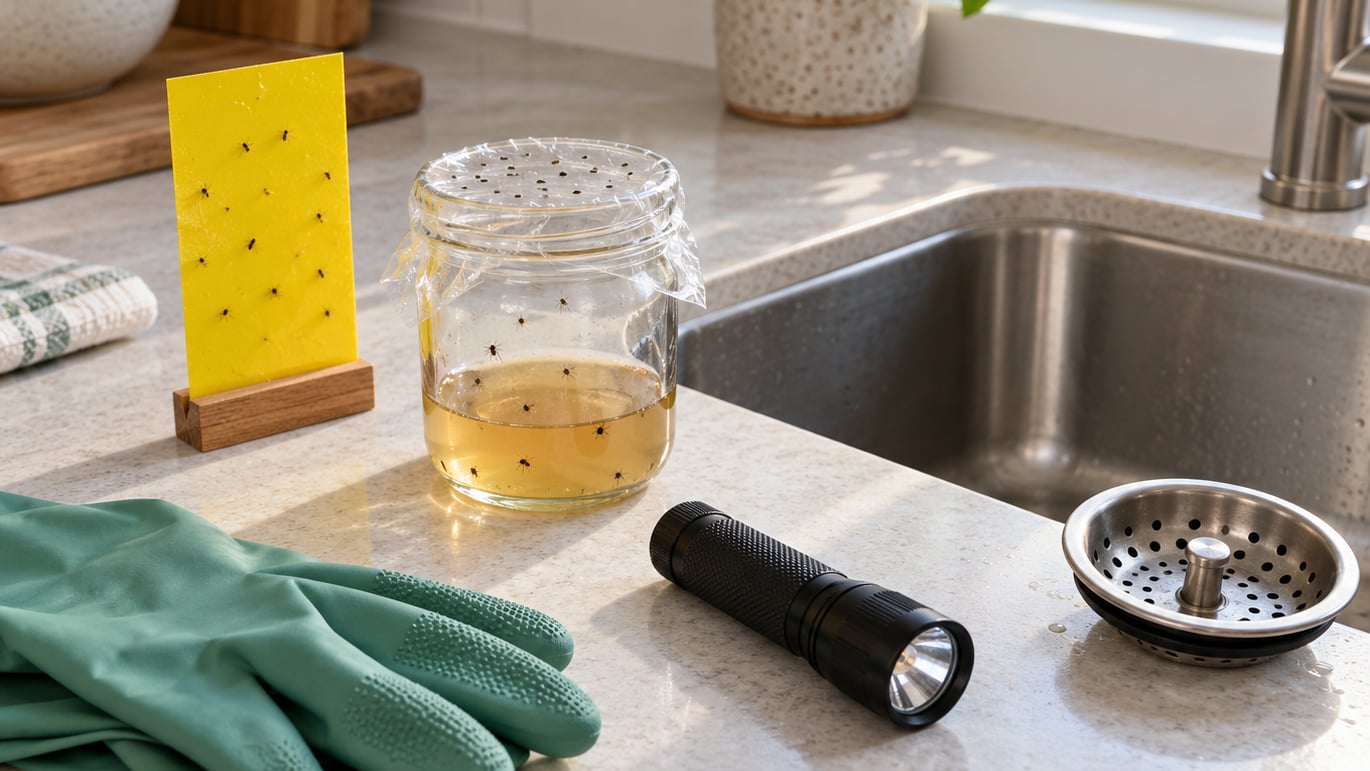
To get rid of gnats in the kitchen, start by removing what they are laying eggs in and then trap the adults: throw out overripe produce, take the trash out, scrub the sink drain and garbage disposal, and set out a shallow dish of apple cider vinegar with a drop of dish soap covered in plastic wrap with pinholes. Most kitchens clear up in 7 to 14 days when the source is gone. Trapping without cleaning takes longer, because the trap catches adults while the breeding source keeps producing new ones.
That first part is the piece most guides skip. A gnat trap is a mop, not a fix, and it works best on day two rather than day one.
What You Need to Get Rid of Gnats in the Kitchen
The whole job costs less than a single takeout order and takes about an hour of real work spread over two evenings. Most of what you need is already in the house.
- A shallow dish, small jar or bottle for the vinegar trap, plus apple cider vinegar, granulated sugar and a bottle of liquid dish soap.
- Rubber gloves, a sponge or small brush, and an old toothbrush you are willing to lose to the drain.
- Baking soda, an enzyme drain cleaner and a bottle of unscented household bleach kept well away from every other cleaner.
- A plastic wrap roll or a rubber band for sealing the trap, plus a toothpick or pin for the pinholes.
- Paper or mesh drain covers, and a flashlight for looking behind the disposal splash guard.
Optional but useful: yellow sticky cards for counting gnats, a kitchen vacuum with a hose attachment for collecting spoiling produce, and a bag of fresh potting soil or coarse sand if houseplants are involved.
If you are considering an insecticide, read the label first and follow it exactly. Most products meant for kitchens are applied to surfaces and cracks rather than sprayed into the air, and many are not labeled for food prep surfaces at all. Never mix a labeled product with bleach, vinegar, ammonia or another cleaner, and keep every one of them away from dishes, countertops where food is prepared, kids and pets.
Step-by-Step
Step 1: Identify Where the Gnats Are Most Common
Where the gnats gather tells you what to clean, and the pattern is more reliable than the size. Watch the kitchen for five minutes in the morning and again in the evening before you touch anything.
Fruit flies. They hover over the fruit bowl, the trash can or the recycling bin. About the size of a pinhead, amber or dark, moving in quick bursts rather than hovering steadily. Ripe and rotting fruit, vegetable scraps and an unsealed trash can are what breeds them.
Fungus gnats. They cloud around a houseplant and drift up when you water or walk past. Slender, dark gray, mosquito-like, and weak fliers. Moist potting soil, algae in wet soil and overwatering are the source.
Drain flies. They come up out of the sink drain and cluster at the disposal or the dishwasher hose. Moth-like, tan or gray, holding their wings folded over the body. They breed in the organic film and biofilm inside the pipe and in food stuck in the disposal trap.
If the gnats are biting your ankles or arms, you have a different pest, and household traps will not touch it. Sand gnats, biting midges and no-see-ums live outdoors near damp ground. Moth flies are noticeably fuzzy and larger than a pinhead. Call a pest professional for bites, or for gnats that appear only in the bathroom and basement rather than the kitchen.
Step 2: Find and Remove the Source of Gnats in the Kitchen
Work room by room and take everything out rather than wiping surfaces in place. A fridge shelf cleaned in place always keeps something behind it.
Empty the refrigerator line by line and look for anything soft, split or leaking. A single mushy banana under the crisper drawer feeds a colony for two weeks, which is why the problem returns right after you thought you handled it. Compost and potato peelings are the usual culprits.
Check the pantry for open flour, cereal or bagged produce, and move any bagged staples into sealed containers. Fruit belongs in the refrigerator until you are ready to eat it, and a fruit bowl left on the counter for days is an invitation.
Take the trash out, then rinse the can with hot soapy water and dry it. Do the same for the recycling container, which usually holds a surprising amount of juice and peel residue. Scrub the bin with a brush where the wheels meet the plastic.
Then look at the water side of things. Pull the plug, lift the disposal splash guard, and check the drain for a slimy film or food particles. If gnats are coming from the sink rather than the fruit bowl, that pipe film is the source and everything else on this list matters less.
For houseplants, check the soil of every pot in the room, including any that came home from a nursery in the last few weeks. Fungus gnats travel in with new plants and then spread to the rest of the collection. A saucer holding standing water counts as a breeding spot too.
Step 3: Clean the Kitchen Thoroughly
Now clean the places where eggs and larvae are stuck. Wipe down counters, backsplash, cabinet faces and the undersides of shelves where juice has run and dried, then mop the floor rather than sweeping it dry.
For the drain and disposal, work in this order:
- Put on gloves and remove the disposal splash guard.
- Scrub the disposal chamber and the visible pipe with an old toothbrush and a paste of baking soda, then rinse.
- Pour a cup of boiling water down the drain to melt the film, wait ten minutes, then flush with hot water for a full minute.
- Follow with an enzyme drain cleaner used at the label rate, usually at bedtime, so it sits in the pipe all night. Enzyme cleaners digest the organic film that bleach only strips.
- Repeat on three or four consecutive nights. One treatment knocks the count down; several nights in a row clear the pipe.
You can get rid of gnats in the kitchen sink with bleach instead, at half a cup of unscented bleach per gallon of cold water, poured slowly and flushed with hot water. It works, but it is a blunt tool: it kills on contact and leaves no residue, so a biofilm-heavy pipe often refills within a couple of weeks. Use it when a drain smells or when you need a fast knockdown, and use the enzyme cleaner for the follow-through.
Whatever you pour down the sink, never combine bleach with vinegar, ammonia, dish soap or a previous drain cleaner in the same session. The gas that can form is a real poisoning risk, and the whole kitchen has to be ventilated while you run the tap.
While you are in there, scrub the counter and sink edge properly. Grease and sugar residue give fruit flies a reason to stay near the sink even after the fruit is gone. Our guide on getting grease smell out of a kitchen covers the waxy film that builds up around the faucet base and stove edge, and cleaning a kitchen after frying has a good breakdown of the surfaces people skip. If you run a kitchen for a living, what to look for in a clean restaurant kitchen is the longer version of the same inspection routine.
Step 4: Trap or Treat the Remaining Gnats
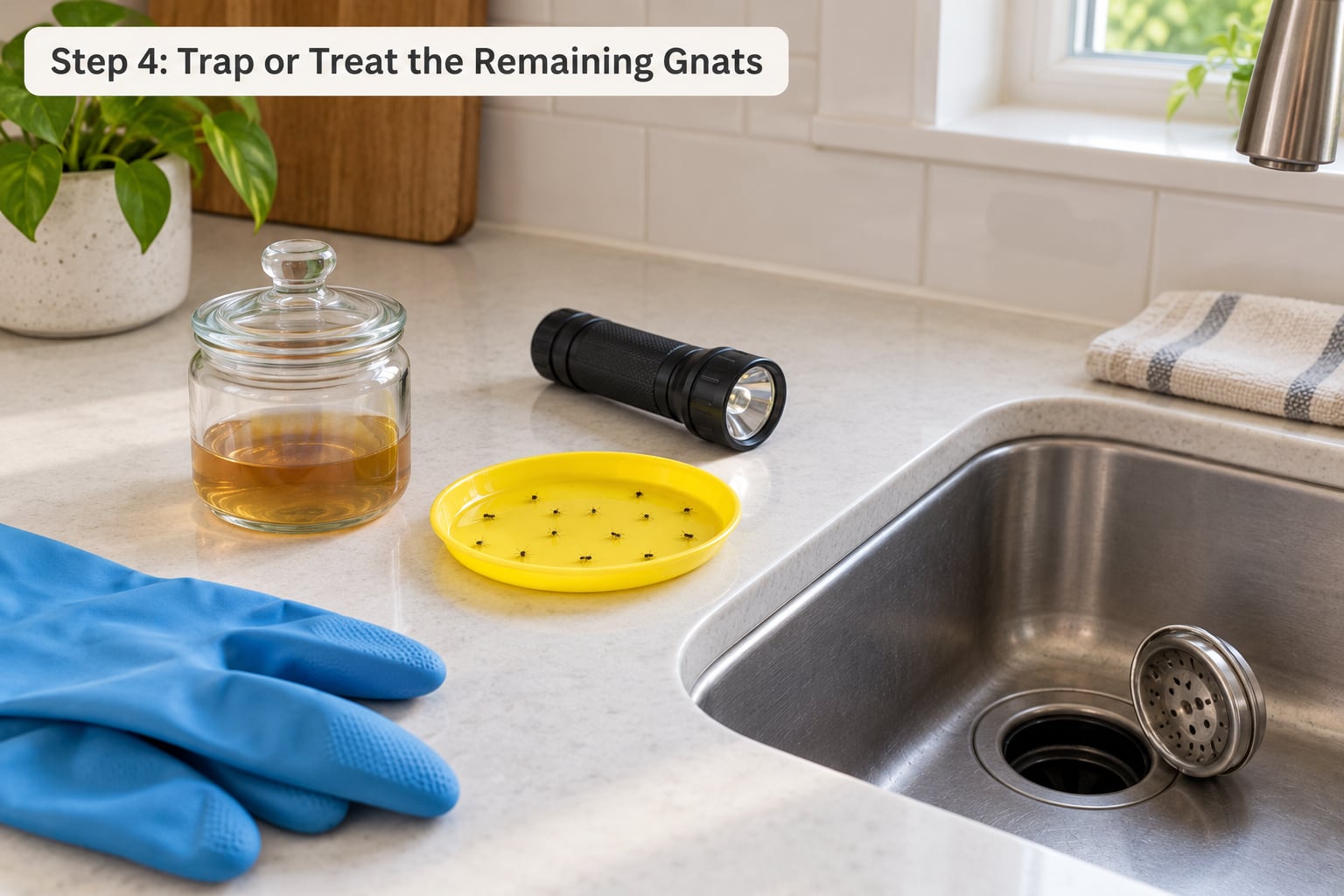
Trapping works on adults. Put it in place on the same day you clean, not a week later.
The apple cider vinegar trap is the one most people come back to. Pour half an inch of apple cider vinegar into a shallow dish, add a tablespoon of sugar and one or two drops of dish soap, stir gently, then stretch plastic wrap over the top and puncture a dozen pinholes with a toothpick. The sugar draws them in, the vinegar keeps them, and the soap breaks the surface tension so they cannot float back out. Fruit flies fall for it readily. Fungus gnats mostly ignore vinegar traps, and drain flies are better handled with sticky cards near the drain.
A bottle trap works the same way with less fuss. Mix a tablespoon of apple cider vinegar with a teaspoon of sugar and a drop of soap, pour it into a narrow-necked bottle, and cap it loosely. A wine bottle with a little red wine and a drop of soap does the same job for fruit flies.
The cheapest trap is the produce bowl. Put a banana peel or a piece of ripe melon in a jar, cover the top with plastic wrap and pinhole it, and set it away from your actual food. Do not leave uncovered fruit out while you do this; you will be feeding the trap and your counter at the same time.
Yellow sticky cards are a monitor more than a solution. Hang one near the fruit bowl and one near the sink, then count what lands on them every two days. That count is the most honest measure of whether the infestation is actually declining, and it tells you which area is still the problem.
If you use an insecticide, follow this rule: read the whole label, confirm it is labeled for the room and the surface, apply it only where the label directs, keep people and pets out until the label re-entry time has passed, and never spray over open food, dishes or a sink you just cleaned. Foggers and spray-insecticide products are a poor fit for a kitchen, because they leave a residue on every food contact surface and they kill nothing that is living in the drain.
Step 5: Prevent Gnats From Returning
Once the last week passes without new gnats, the cycle is broken. Keeping it broken is mostly storage habits.
- Refrigerate ripe fruit, and empty the fruit bowl every two days rather than topping it up.
- Use sealed containers for flour, rice, cereal and open bags of produce.
- Take trash and recycling out at least every couple of days, and wash the cans.
- Wipe up juice, sugar and syrup spills the same day, including under the sink and behind the trash can.
- Keep drains covered with mesh or paper covers, and run hot water for a minute after dishes that carry oil or starch.
- Do a monthly drain flush with an enzyme cleaner, before any fly appears.
- Check window and door screens for holes and leave the door shut during peak fly season. Gnats are small enough to walk through a torn screen edge.
- Let houseplant soil dry out between waterings, empty saucers, and top-dress pots with a thin layer of coarse sand or grit so damp soil is not exposed.
Common Mistakes
Almost every kitchen that keeps its gnats makes at least one of these calls. The quick list: spraying visible gnats and leaving the source, keeping fruit on the counter for a week, rinsing the drain instead of scrubbing it, treating once and assuming a drain is clean, using scented cleaners that cover the smell without removing the film, and combining drain products. Each has a fix below.
Common Mistakes and Quick Fixes
Spraying the gnats you can see. Aerosol spray kills adults in seconds and changes nothing about the eggs and larvae in the drain, the soil or the fruit. The population rebuilds within days, which is why it looks like the spray attracted more. Remove the source first, then trap.
Pouring bleach down the drain once. One flush strips the top layer and leaves the biofilm behind. Use half a cup per gallon of cold water, flush with hot water, then follow with an enzyme cleaner on three consecutive nights.
Rinsing the sink instead of scrubbing it. Water moves the film around and pushes it deeper into the trap. Take the splash guard off and scrub the chamber and pipe with a toothbrush.
Relying on smells. Peppermint, lemon, cinnamon and eucalyptus oil make a room smell cleaner and may deter gnats briefly. None of them kill larvae or remove a breeding site, so on their own they cost you a week.
Using a fruit-fly trap against fungus gnats. Fungus gnats are drawn to damp soil, not sugar. Drying the soil out between waterings, clearing saucers and adding a top dressing of sand does more than any trap.
Mixing drain cleaners. Bleach plus vinegar or bleach plus ammonia releases a gas that fills the room. Open a window, use one product at a time, and flush thoroughly between steps.
Leaving the compost or a damp mop bucket in the kitchen. Both breed the same flies. Keep compost outside or in a sealed bin, and wring the mop out fully.
A realistic timeline helps here, because progress is not linear:
- Day 1 to 2: traps fill quickly. Visible activity may look unchanged, since the adults outnumber the larvae you just removed.
- Day 3 to 5: the sticky card count should drop noticeably. Gnats still appear but stay near the trap.
- Day 7: most kitchens see only a handful a day, usually around the plant or the sink.
- Day 10 to 14: an infestation with the source removed is over. If you are still seeing several a day on day 10, the source is somewhere you have not cleaned yet.
Check the sticky cards rather than the ceiling. Seeing two gnats drift past in an evening on day 8 is normal. Seeing a fresh cloud over the same bowl on day 8 means something is still breeding there.
Frequently Asked Questions
What are the tiny gnats in my kitchen?
They are almost always one of three types. Fruit flies cluster around fruit, trash and recycling and move in quick bursts. Fungus gnats are slender and hover around houseplant soil, especially right after watering. Drain flies come up out of the sink drain and disposal and look moth-like with wings folded back. Which type you have decides what you clean, so spend two minutes watching where they gather before you start.
How long does it take to get rid of gnats in the kitchen?
Seven to fourteen days is the usual range once the breeding source is removed. Adults may still show up on day two or three because they outlive the larvae you cleaned out. Judge progress by the number of gnats landing on a yellow sticky card every two days, not by the gnats still flying past. If the count has not fallen by day 10, you have missed a source.
Do gnats come from the sink drain?
Drain flies do, and the giveaway is that they appear right at the drain opening or around the garbage disposal with no fruit anywhere nearby. The larvae live in a film of organic matter inside the pipe. Scrub the disposal and pipe, flush with boiling water, then use an enzyme drain cleaner at the label rate on several consecutive nights. Fruit flies near the sink usually trace back to fruit or trash instead.
Does vinegar get rid of fruit flies?
Vinegar in a trap catches plenty of adults, but it does not end the problem on its own. The reason vinegar works in a dish is the drop of dish soap, which breaks the surface tension so flies cannot escape, plus the sugar that draws them in. The bigger job is removing ripe fruit, rinsing the trash can and scrubbing the counter, because every surviving female lays eggs within days.
Why are there gnats near my houseplants?
Fungus gnats breed in damp potting soil and organic matter, which is exactly what a freshly watered pot provides. They also arrive home inside plants bought from a nursery. Let the soil dry out fully between waterings, empty any saucer holding water, and cover the surface with coarse sand or grit. Yellow sticky cards on the soil surface catch the adults while the drier soil stops the cycle.
Is it safe to use bug spray in a kitchen?
Only if the product label specifically covers kitchens and the surface you are treating. Many sprays are not registered for food prep areas, and the residue transfers to anything set on that counter. Never spray into the air, never spray near open food or dishes, and keep children and pets out until the label re-entry time has passed. Draining biofilm out of the pipe beats spraying, which does nothing for larvae.
Conclusion
Start by finding the breeding source, not by buying another trap. Empty the refrigerator, take the trash out, scrub the drain and disposal, and check the houseplant soil, then set the vinegar trap the same day. From there it is a two-week monitoring job: count gnats on a sticky card every other day, and when the numbers fall and stay down, keep the storage and drain habits that got you there.