
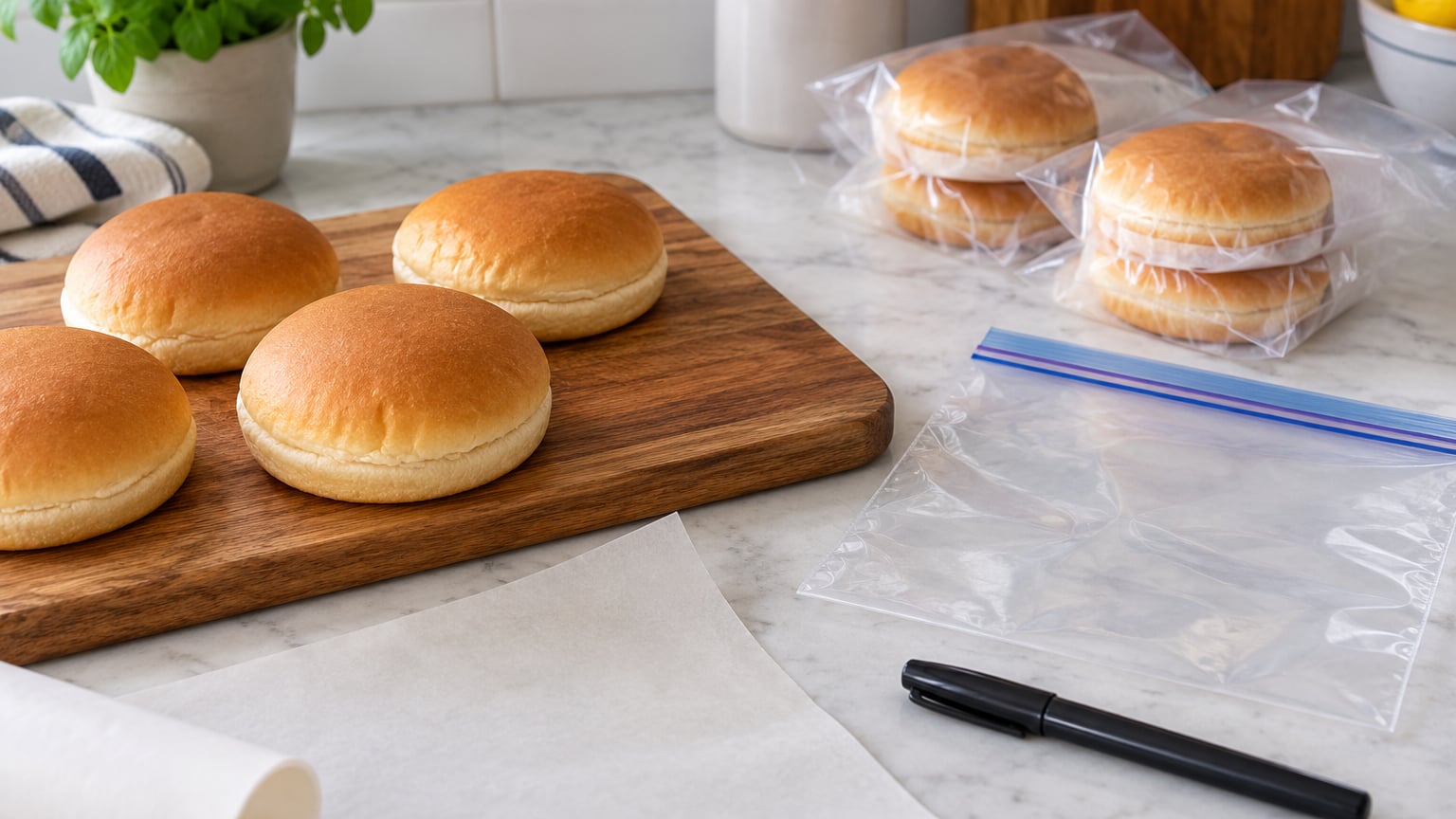
To freeze hamburger buns, let them cool completely, wrap them tightly so no air touches the bread, seal them in a heavy-duty freezer bag with the excess air pressed out, label the bag, and lay it flat in the freezer. They keep their best quality for about three months. Thaw them in the closed bag on the counter for 30 minutes, then toast until the middle is comfortably warm. If you bake buns in a double batch or always end up with a few left over from a cookout, this takes about ten minutes and stops the waste.
The whole thing comes down to one thing: air. Freezer burn is not a safety problem, it is a texture and flavor problem, and it happens when bread is exposed to moving freezer air. Seal that out and the crumb survives the freezer in good shape.
One thing worth knowing up front. The refrigerator does not do what people think it does. Buns go hard in the fridge because starch keeps re-crystallizing at that temperature, so a week in the fridge can leave you with bread that tastes older than a month in the freezer. Freezing stops that process instead of slowing it down.
What You Need
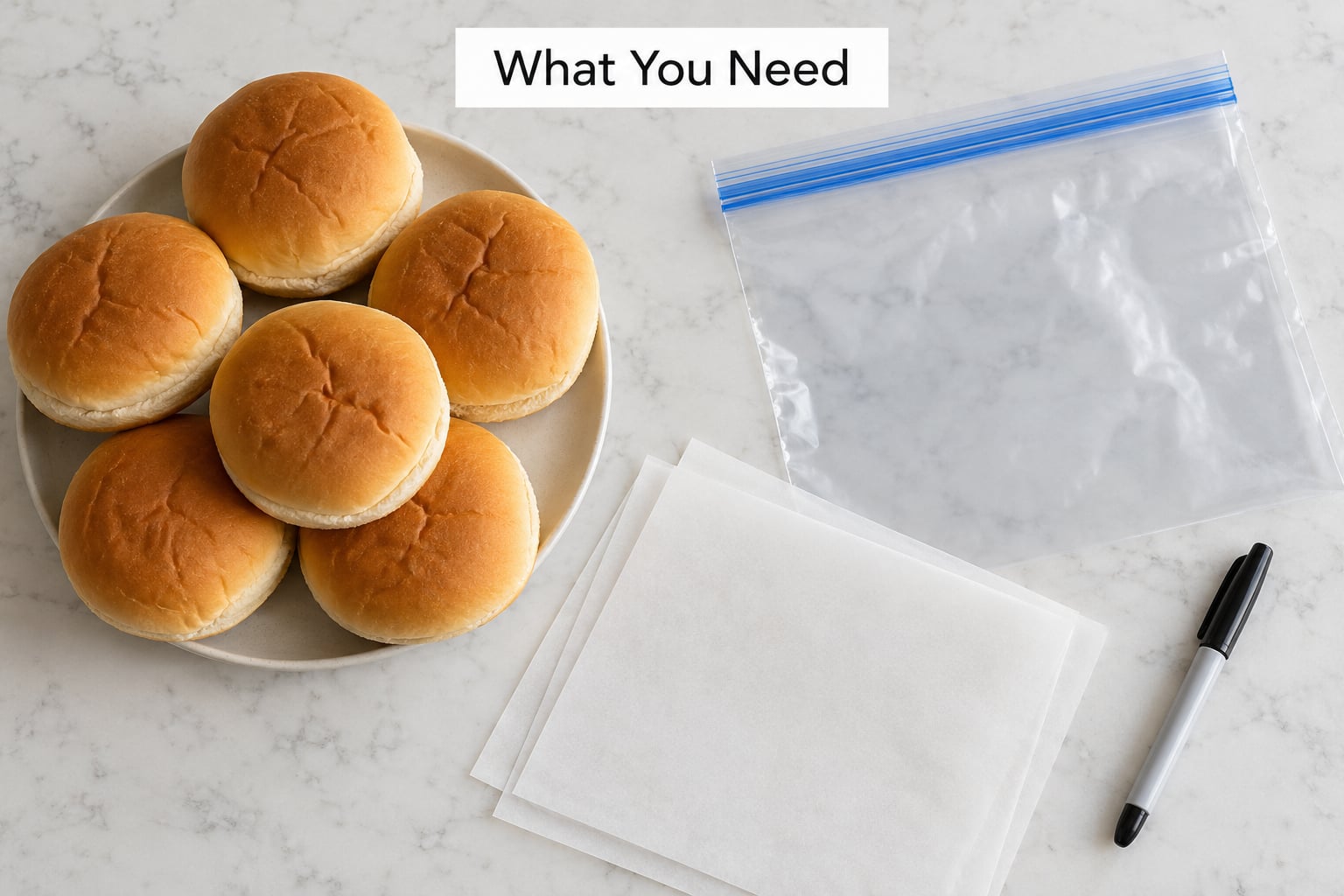
You need less than you would think:
- Fresh hamburger buns from the store, or a batch you baked and have already cooled.
- Plastic wrap, parchment paper, or aluminum foil to protect the cut surfaces.
- A heavy-duty zip-top freezer bag or an airtight container. A thin produce bag will not hold anything back.
- A marker or freezer labels so you know what is in there and when it went in.
Parchment between the layers is optional. It stops the buns from sticking to each other, which matters more for seeded and brioche buns than for plain ones.
Step-by-Step
How to Prepare the Buns for Freezing
Buns have to be completely cool before they go anywhere near a freezer bag. Warm bread releases steam, and trapped steam turns into condensation and then ice crystals, which is exactly the soggy, gummy result most people blame on the freezer itself.
For store-bought buns, freeze them as soon as you get home if you know you will not use the whole pack. Check the use-by guidance on the bag and treat that as the ceiling for quality, not the freezer. Homemade buns can go in once the crumb and the interior are fully at room temperature, which takes longer than you would guess, maybe 45 minutes on a rack.
Wrap the Buns So They Stay Fresh
Pair the buns cut side to cut side, in a single layer, so the soft interior surfaces are touching and protected. If the pack is eight buns, that is four pairs. Slice the pairs down the middle now if you want to toast single halves later, since it’s awkward to do with frozen bread.
Wrap the pairs in plastic wrap, foil, or a sheet of parchment, then drop the whole bundle into a heavy-duty freezer bag. Close the bag, press the air out flat with your hands, and seal it. One layer of plastic around each pair and a freezer bag around everything is enough. Triple-wrapping in foil works too, and it survives a bag puncture better.
Seal the edges of the bag as tightly as you can. Resealable zip bags are fine as long as the seal line is clean, with no crumbs or fat across the zipper, because a leak there is what defeats the whole method.
Label and Freeze the Wrapped Buns
Write the date and the number of buns on the bag with a marker, or stick a label on it. This sounds fussy until you are standing in the freezer six weeks later and can tell a bag of dinner rolls from a bag of burger buns. Labeling also tells you whether a bun is still inside its best window.
Lay the bag flat in the freezer, near the top if you have room. Flat matters because a soft bag of buns under a frozen container for a month comes out as a compressed brick, and no amount of toasting fixes that shape.
Keep the freezer at 0F (minus 18C). Bread stays safely frozen for months, but the quality is best in the first two to three, after which the crumb slowly loses moisture no matter how well it was wrapped.
Thaw Hamburger Buns Without Making Them Soggy
Leave the wrap on. This is the part that surprises people, and it is the detail that decides whether your buns come back soft or come back chewy. A bun that thaws exposed to the air dries out; a bun that thaws sealed lets the moisture that moved into the ice crystals redistribute back into the crumb.
For one or two buns, put the bag straight on the counter for about 30 minutes, still sealed. Home cooks on r/Cooking describe exactly this, and it is the most reliable method. For a whole pack, move the bag to the refrigerator the night before and take it out in the morning. It thaws more slowly, which is a good thing.
What you should not do is warm a sealed bag. Heat plus a closed plastic bag means condensation forms and lands on the cut surface, and you get a bun that is wet on the outside and dry in the middle. Open the bag first, then warm.
If you need a bun in the next ten minutes, move the bag between the counter and the fridge every few minutes, or set a single bun on a damp paper towel on a plate. There is more on this in how to keep burger buns from getting soggy.
Toast or Reheat Frozen Buns
Thawed buns go back into a hot oven at 300F (150C) for 5 to 10 minutes, cut side down on a baking sheet. That is the number most guides agree on, and it is slow enough that the middle warms through without the crust scorching. A toaster works for a single bun. An air fryer at 300F for 4 to 5 minutes is the fastest route to a bun that tastes like it came off a restaurant pass.
You can also toast from frozen. Set the buns cut side down in a 350F (175C) oven for about 10 minutes with no thawing at all, and expect a slightly firmer crumb. It is a good trick when a guest shows up early and you planned nothing.
Skip the microwave. Bread goes from soft to tough in a handful of seconds there, and nobody has ever taken a microwave-warmed bun to a table with a straight face. More on the toasting side in how to toast burger buns properly.
How Long Can Frozen Hamburger Buns Last?
Quality holds for roughly two to three months. Past that, buns are still perfectly safe to eat but start to taste drier and denser, and any color or flavor from the wrapper slowly migrates back into the crumb.
The safety question is separate from the quality question. Best-by dates on bread are about quality, not a spoilage cliff, and freezing puts a stop to mold growth entirely. Buns that were frozen solid are fine months later. Thaw them sealed, look at them, and if there is no mold and no off smell, they are fine to eat.
Signs that quality has drifted rather than safety: pale, papery patches on the crust, a hard edge, a flat flavor, or a faint freezer smell that does not fade after thawing. All of it is safe, none of it is good. Freezing does not preserve a bun perfectly, and expecting identity is the fastest way to feel let down by a method that actually works well.
For context on the other end of the scale, buns left on the counter in their store bag are good for a day or two. Buns in the refrigerator usually turn hard within a week, and the common recommendation among home cooks is to freeze first and thaw as needed rather than to refrigerate at all.
Can You Freeze Buns With Ingredients Inside?
You can, but separate freezing is more reliable. A dressed burger loses its structure in the freezer: the lettuce goes limp and watery, tomato releases water onto the cut face, and the bun bottom turns damp and chewy on the way back. Wrapped deli-style burgers get soggy for the same reason.
What works better is freezing each part for the job it does. Freeze the cooked patties flat on a tray first, then bag them in a single layer, and the details are covered in how to freeze burger patties without freezer burn. Freeze cheese and sliced toppings in small portions. Keep the buns in their own bag so you only thaw what you need, and add the fresh toppings after the bun is toasted.
Cheese melted onto a bun and then frozen is the exception that mostly works, because cheese seals the surface underneath it. Expect the topping to be a little darker after reheating, and toast the whole thing longer to drive off the extra moisture the cheese holds.
Do Baked or Store-Bought Buns Freeze Better?
Store-bought buns freeze well because they are built for it. They usually carry emulsifiers, stabilizers and sometimes a little ascorbic acid, all of which slow staling, so a commercial bun that is three months old in the freezer often tastes better than a homemade one that is three weeks old in the fridge.
Homemade buns freeze fine too, they just have a shorter clock. Freeze them within a day of baking, and expect a little more noticeable change in texture, because there are no preservatives holding the crumb together. Brioche and potato rolls are rich with butter and sugar, so they tend to stay soft the longest. Sourdough buns handle freezing well and come back closest to their original character.
Sturdier buns survive the trip better than delicate ones. A bun with a higher protein or fiber content, or a thicker crust, holds its shape through a freeze-thaw cycle better than a soft white supermarket roll. Seeded buns do well as long as you separate the layers with parchment, or the seeds glue themselves to the neighbouring bun and tear half the crust off when you separate them.
Gluten-free buns freeze with the same method, and r/Celiac readers have plenty of experience with it. They are drier to begin with, so keep the wrap tight and give them a longer toast. Hot dog buns take the identical approach, just lie them flat rather than on their sides so they do not crease.
Common Mistakes
Freezing warm buns. Steam gets trapped, turns to condensation, and the crumb goes gummy. Fix: cool them fully on a rack, at least 45 minutes for a homemade batch.
Using a thin produce bag. It leaks, and freezer air does the rest. Fix: heavy-duty zip-top freezer bag, or an airtight container, and press the air out before sealing.
Leaving air in the bag. This is the single most-repeated cause of freezer-burnt buns. Fix: squeeze the bag flat along the seal until you feel the air move out.
Thawing at room temperature with the wrap off. The exposed crumb loses moisture to the air and dries out unevenly. Fix: thaw in the sealed bag, wrap on.
Wrapping tightly while the buns are still warm. Same problem as freezing them warm, one step earlier. Fix: cool first, wrap second.
Stacking heavy items on the bag. Buns get squashed into a shape no toaster can fix. Fix: lay the bag flat, near the top of the freezer.
Refreezing over and over. Each cycle wets and dries the starch a little more. Fix: freeze once, portion it so you thaw only what you need, and refreeze only if the buns were thawed while still sealed.
Tips for Better Burger Meal Prep
Freeze buns and patties in separate bags, always. They have opposite needs: the bun wants to thaw slowly and stay sealed, and the patty wants to go straight into a hot pan. Combining them forces one of them to be wrong.
Portion by count. Four buns per bag means four burgers on a Tuesday, no counting, no half-used bags going cloudy in the back of the freezer.
Refresh anything that has been around a while. If a bun comes out of the freezer on the dry side, spritz it very lightly with water, wrap it in a damp paper towel, and give it 5 minutes in a 350F (175C) oven. Most of the dryness disappears.
Pull only what you need out of the freezer. Thirty minutes on the counter with the wrap on is all the planning most burger nights require, so the thaw can happen while the patties cook and nobody has to think about it.
Frequently Asked Questions
Can you refreeze hamburger buns after thawing them?
Yes, if they were thawed in their sealed bag and never warmed, refreezing is fine and costs you very little. If the buns sat on the counter unwrapped, or you toasted them first, refreezing will dry them out noticeably. In practice the better move is to thaw only the number of buns you plan to use. The bags are easy to portion, and a bun that never thaws stays at full quality for the whole three-month window.
Why are my hamburger buns soggy after freezing?
Soggy buns almost always mean moisture got trapped during freezing or thawing, not that the freezer did it. Freezing warm buns seals steam inside the bag, and thawing a sealed bag on a warm counter or in a microwave creates condensation on the cut surface. Cool buns fully, press the air out of the bag, and thaw with the wrap on at room temperature for about 30 minutes. A bun that is dry on the edges and wet in the middle was warmed in plastic.
Can you eat burger buns that were past the best-by date?
Usually, yes, especially if they were frozen. The date printed on a bread bag is a quality guideline rather than a point where the bread becomes unsafe, and freezing halts mold growth completely. Thaw them sealed, then look for mold, discoloration or an off smell. No mold and no odor means they are fine to eat, though a bun frozen well past the date is often drier than you would like. That is a texture issue, not a safety one.
Is it better to freeze hamburger buns whole or sliced?
Whole, if you are freezing for later burgers, because the crumb stays sealed and loses less moisture. Sliced buns are better when you want to toast single halves straight from the freezer, and cutting them before freezing makes that much easier later. A good middle ground is pairing the buns cut side to cut side in one layer before wrapping, which protects the soft interior surfaces while you still have full buns in the bag.
Can you microwave frozen hamburger buns to thaw them fast?
You can, but you will not like the result. Microwaves pull moisture out of bread starch quickly, and home cooks report buns going dry and rubbery within 5 to 10 seconds. For a fast thaw that keeps the crumb, use an air fryer or a 300F (150C) oven instead. If you must use the microwave, put the bun on a damp paper towel, keep it under 10 seconds, and toast it straight after.
Conclusion
Start with the part most people skip: let the buns cool completely, then wrap them so no air can reach the bread and press the bag flat before sealing. Label the date, lay it flat in the freezer, and pull out only the buns you need about 30 minutes before serving. Keep the wrap on while they thaw, and toast them right up to the moment the middle is comfortably warm. That sequence is the whole difference between buns that come back soft and buns that come back disappointing.