
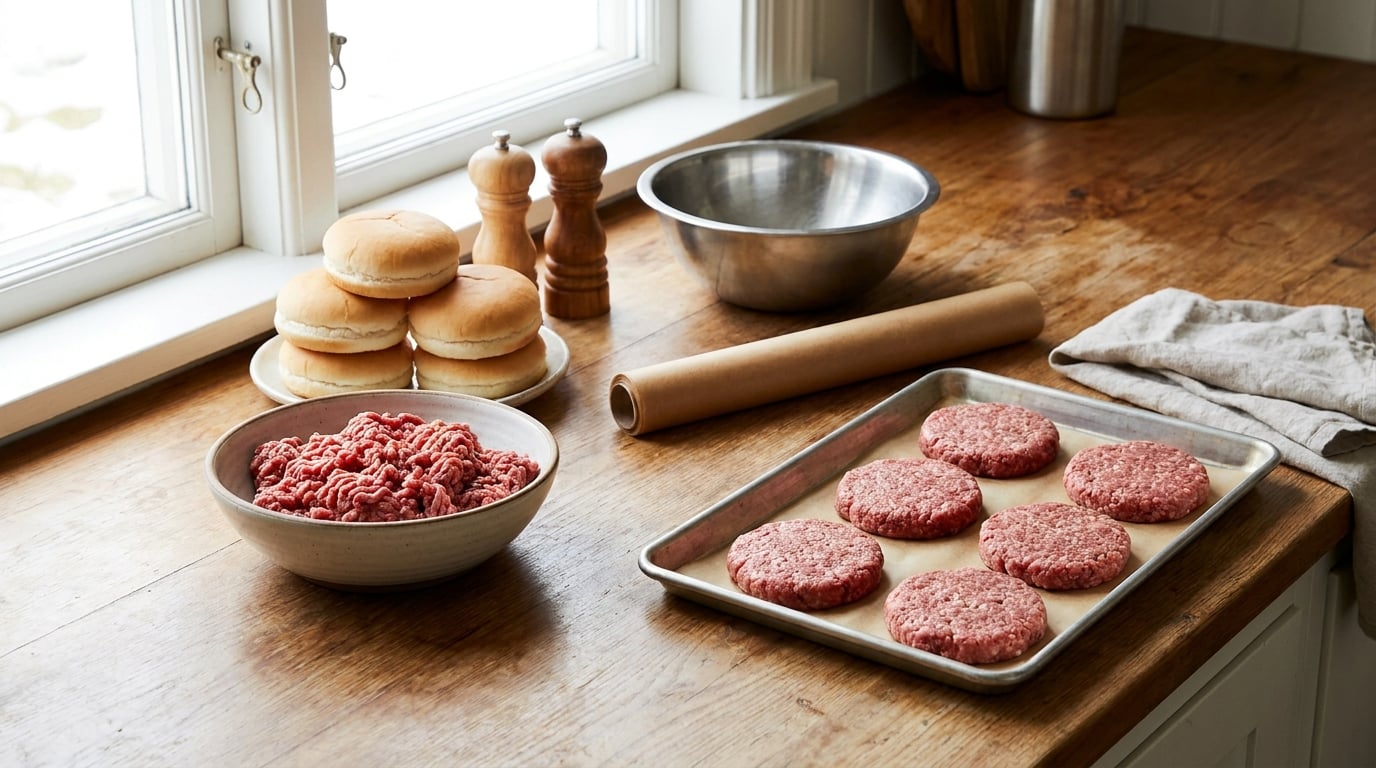
To make burger patties ahead of time, shape seasoned ground beef gently, keep the patties in a single layer with parchment paper between them, then refrigerate them for 1 to 2 days or freeze them for up to 3 months. The whole prep takes about 20 minutes, and you end up with raw patties that cook in 4 to 6 minutes a side whenever you want burgers.
Forming patties is the messy, hands-on part of homemade burgers, so doing it in one batch pays off fast on a weeknight. Freeze a family-size stash once and you skip both the shopping and the shaping; chill a couple days ahead and you are ten minutes from dinner instead of half an hour.
I keep a freezer bag of patties going at all times now. The trick that made it stick was freezing them in single-meal portions rather than one big bag, and pressing a dimple in the middle of each one.
Table of Contents
- How to Make Burger Patties Ahead of Time: What You Need
- Step-by-Step: Prepare, Chill, and Store Burger Patties
- Common Mistakes When Making Burger Patties Ahead of Time
- Frequently Asked Questions
- Can I make burger patties ahead of time and freeze them?
- How long can burger patties stay in the refrigerator before cooking?
- Should I thaw burger patties in the refrigerator before cooking?
- Can I season burger patties before freezing them?
- How do I prevent burger patties from sticking together in the freezer?
- Can I cook burger patties from frozen without thawing them first?
How to Make Burger Patties Ahead of Time: What You Need
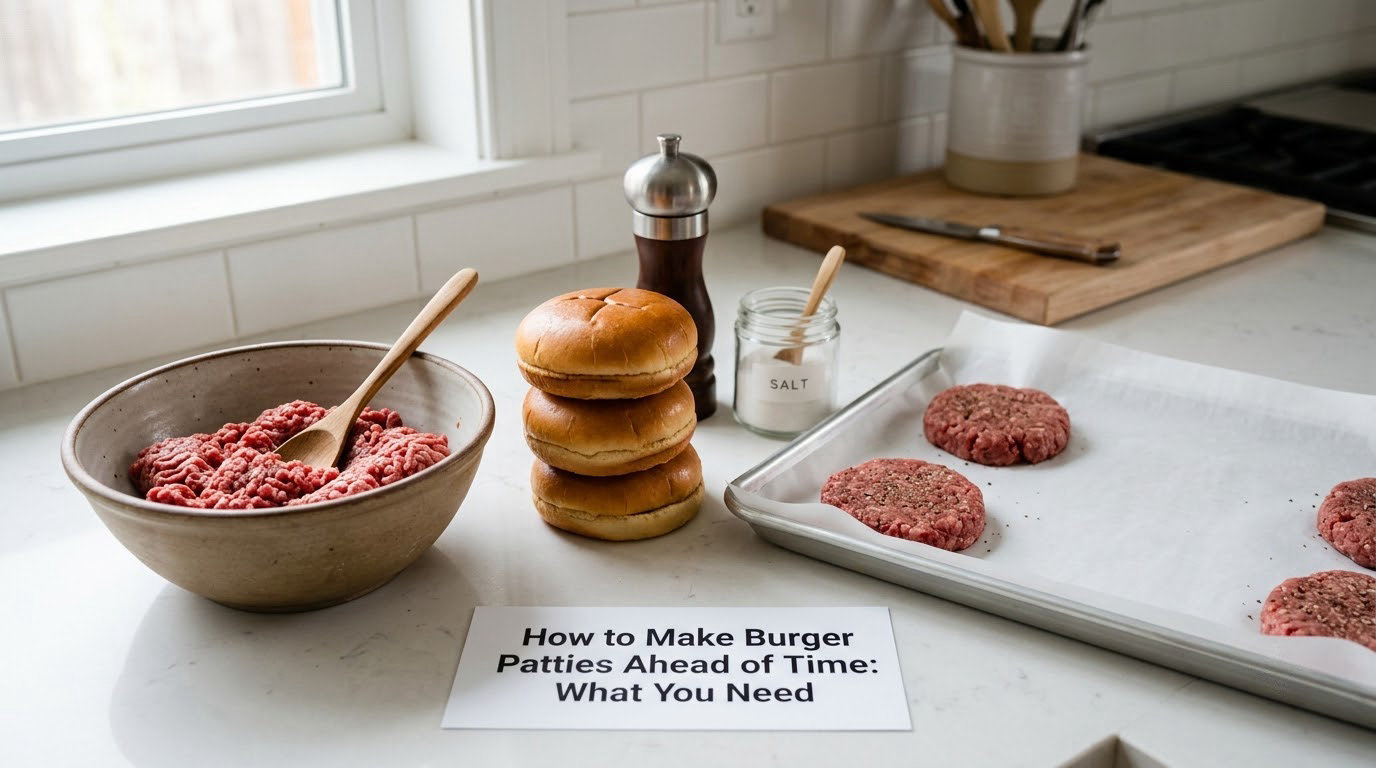
You do not need any special equipment for this. Everything below comes out of a normal drawer or the meat aisle.
Ingredients
- Ground beef: 80/20 blend for juiciness, or 90/10 if you prefer a leaner patty. Lean meat dries out faster, so add a splash of milk or Worcestershire sauce if you go lean.
- Salt and black pepper: about 1 teaspoon salt and 1 teaspoon pepper per pound of beef. Salt the meat mixture, not the finished patty.
- Optional dry rub: paprika, garlic powder, onion powder, brown sugar or a burger seasoning blend. This is what you mix in and what you dust on the outside.
- Optional binder: one egg, a tablespoon of breadcrumbs, or a tablespoon of Worcestershire sauce. See below for how a binder behaves after freezing.
- Optional extras: grated cheese, cooked bacon, jalapeno, or a spoonful of soft cheese such as blue cheese. These survive freezing fine.
Equipment
- A rimmed baking sheet or cookie sheet, plus parchment paper or wax paper
- A bowl and a light hand for mixing
- A kitchen scale, or a quarter-pound scoop for consistent portions
- Freezer bags, a rigid airtight container, or a vacuum sealer
- A marker and masking tape for labels
- An instant-read thermometer, which is the only reliable way to know a patty is done
How many patties to make
Plan roughly 1/3 pound (150 g) of raw beef per adult, which lands you at a comfortable 6-ounce patty plus a little shrinkage margin. Kids usually eat one small patty, and if you are serving fries, slaw and a full bun spread, drop closer to 1/4 pound per person.
A 2-pound batch makes about 10 to 12 patties. That is a good size for a family of four with a couple of days of lunches in the mix, and it is small enough that you are not committing to a freezer you forget about.
Step-by-Step: Prepare, Chill, and Store Burger Patties
Mix the Burger Mixture Without Making Dense Patties
Mix the seasoning into the raw beef with your fingertips, and stop as soon as the color is even. Overworking the meat develops a tough, bouncy texture that no amount of resting will fix, and make-ahead patties suffer from it more than fresh ones because the salt has all week to draw the moisture out.
A good rule: if the meat starts sticking to itself in a stretchy, gluey mass, you have gone too far. Scrape it back together, add the rest of the seasoning, and move on.
Split your seasoning rather than dumping it all in at once. Mix about three quarters of the salt, pepper and dry rub into the meat, and hold back the rest to dust on both sides of each patty after shaping. The surface seasoning is what gives you a crust and a visible sear; seasoning that is only mixed in flavors the inside.
If you add a binder, one egg or a tablespoon of breadcrumbs per pound is plenty. A raw-egg binder freezes safely, and the egg sets during cooking to hold leaner or turkey patties together. Keep egg-based patties a little thinner in the freezer and give them a minute or two more in the pan than you would a plain beef patty, since the frozen center takes longer to come up to temperature.
Shape Uniform Patties for Even Cooking
Divide the meat into 1/4- to 1/3-pound lumps, roughly the size of a baseball. Weigh them if you have a scale; even weight matters more than a perfect shape because a thick patty cooks unevenly and a thin one dries out before the middle is done.
Press each lump into a patty about three-quarters of an inch thick and slightly wider than your bun, since patties shrink roughly a quarter of their width as they cook. Make them round rather than square, because the corners are where a square patty burns first.
Press a shallow dimple about half an inch wide into the center of every patty with your thumb. The heat makes the middle of a flat patty dome upward, and the dimple cancels that out so you get a burger that sits flat in the bun and cooks edge to edge.
Handle the finished patties by the edges, and dust a little flour or cornstarch on the surface if the mixture is sticky. If the meat cracks at the rim as you shape it, you mixed it too long or the batch is too lean; add a tablespoon of water and knead it back together before reshaping.
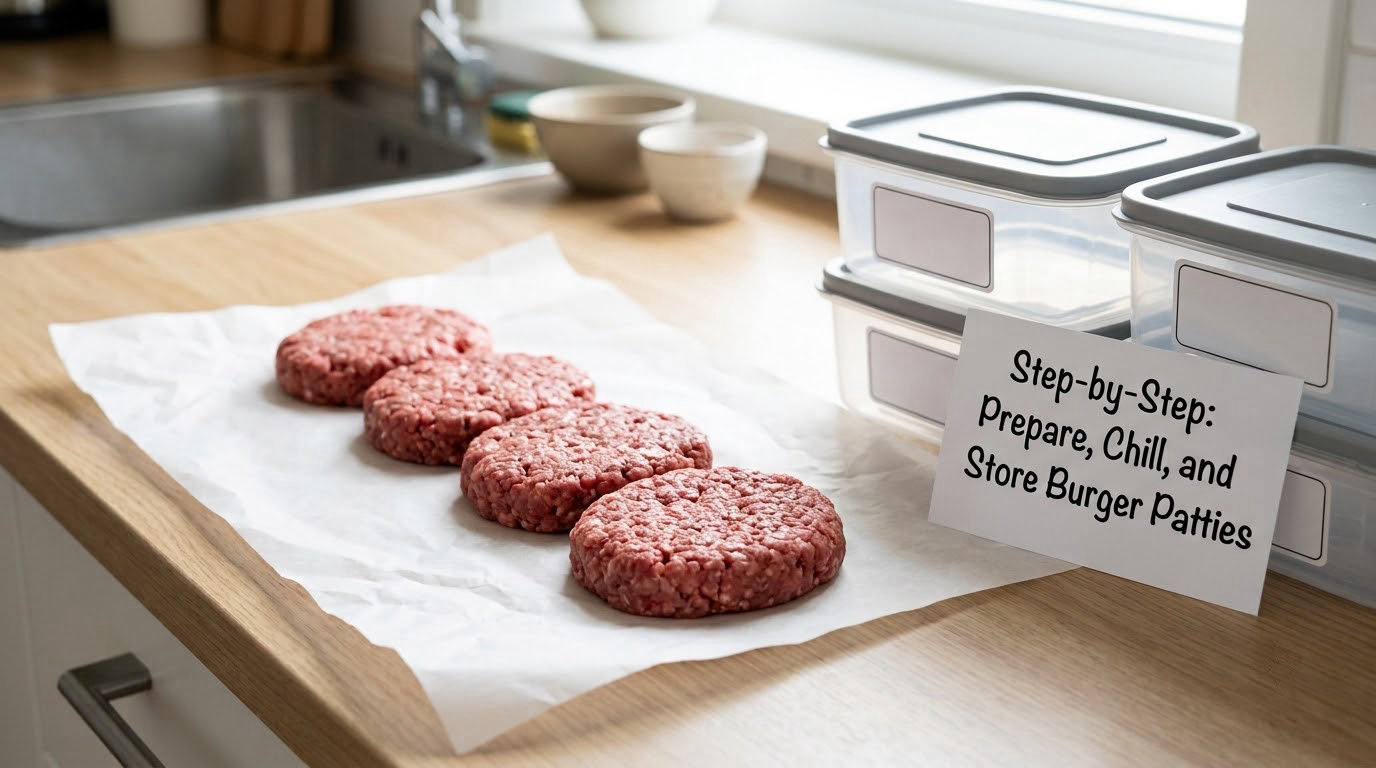
Leave the patties in a single layer on a lined sheet pan. Do not queue them on top of one another while you finish the batch, because a patty that has rested 20 minutes while you shaped the last ten loses moisture and picks up a tacky surface that sticks to paper.
Chill or Freeze the Patties Immediately
Once the last patty is shaped, they go straight into storage. Do not leave shaped raw patties sitting on the counter, and do not cover and refrigerate them in a stack that you did not separate.
For a short hold, lay the patties in a single layer in a covered container lined with parchment and refrigerate for 1 to 2 days. Beyond that, refrigeration is not a safety margin I would rely on for ground meat.
For longer storage, freeze them flat first. Arrange the patties on the lined sheet pan with a small gap between each one, put the pan in the freezer uncovered, and leave it until they are hard to the touch, usually 30 to 60 minutes. Then transfer them to a freezer bag or airtight container, pressing out the air, and add a piece of masking tape to the bag with the contents, the date and a cook-by note.
Freeze patties in a single layer whenever you can, with parchment between rows if you must stack. Ice crystals form wherever two surfaces touch, and those crystals are what turn a patty into one solid block you have to hack apart with a knife.
One strategy I like for mixed households is to shape half the ground meat and keep the rest loose in the freezer. The patties cover the nights you need a fast burger, and the loose meat covers tacos, chili, and spaghetti sauce later in the week.
Here is how long patties actually hold:
| Storage method | How long it lasts | Notes |
|---|---|---|
| Raw patties, refrigerator | 1 to 2 days | Single layer in a covered container |
| Raw patties, freezer | 2 to 3 months for best quality | Freeze flat, then bag and label |
| Cooked patties, refrigerator | 3 to 4 days | Cool quickly, then cover and chill |
| Cooked patties, freezer | 2 to 3 months | Freeze in a single layer before bagging |
At the three-month mark your patties are still perfectly safe if the freezer held 0°F the whole time, but the surface may have picked up a gray cast or a freezer-burn smell. Quality, not safety, is the limit.
Cook Chilled or Frozen Patties
Thaw in the refrigerator, never on the counter. Move the patties from the freezer to a dish in the fridge and give them 8 to 12 hours, or overnight for a thicker patty. Counter thawing puts raw ground meat in the food-safe danger zone for hours, and the difference between that and an overnight fridge thaw changes the texture of everything you cook for the rest of the week.
Cooking straight from frozen works fine. It just needs more heat, a little more time, and a lid or foil early on to drive heat to the center.
- Skillet: preheat a heavy cast-iron or stainless pan over medium-high, add a thin layer of oil, and lay patties down with at least an inch of space between them. Cook frozen patties 5 to 6 minutes per side, pressing firmly with a spatula for the first 20 seconds. Chilled patties take 4 to 5 minutes per side.
- Grill: preheat to medium-high over a two-zone fire. Put frozen patties over direct heat for 5 to 6 minutes, move them to the cooler side to finish, and cover with the lid of a grill or an inverted pan so the top steam-cooks. Thawed patties go straight over the coals, 3 to 4 minutes per side.
- Air fryer: 400°F for 8 to 10 minutes, flipping once at the 5-minute mark, with no added oil if you sprayed the patties lightly. Pull it a minute early and check the center, because air fryers cook unevenly across a basket.
Ground beef patties are done at 160°F (71°C) on an instant-read thermometer. Ground turkey and chicken patties need 165°F (74°C). A clear juice is not a doneness signal, because burger juices run clear well before the middle is at temperature.
If you are cooking for a party, pre-cooking works better than most people expect. Brown the patties in batches earlier in the day, then set them on a rack over a sheet pan and hold them in a 200°F (93°C) oven for up to two hours. The rack is what stops the bottoms from steaming and going soft. Never hold cooked patties on a plate under foil, which traps condensation and wrinkles the crust.
Cooked patties that have been fully cooked and cooled reheat to 165°F (74°C). Expect a slightly tighter, denser patty than a fresh one, and cover the pan with a lid for the first few minutes to trap steam and soften the surface.
Common Mistakes When Making Burger Patties Ahead of Time
Most disappointing make-ahead patties come down to a handful of small, fixable decisions.
Overmixing the meat
Mixing until the beef turns pasty and sticky is the number one reason homemade patties turn out rubbery. Use your fingertips, stop at even color, and accept a slightly uneven-looking batch.
Stacking patties without separators
Piling patties directly on top of one another in a container is the fast way to end up with one frozen brick. Freeze the first layer flat until firm, then use parchment or wax paper between every layer. Wax paper is what most home cooks reach for, and it works exactly as well as parchment for this.
Leaving patties out while you finish the batch
Shaping ten patties while the first ones sit at room temperature is a slow leak of both moisture and safety margin. Freeze the finished ones or move them to the fridge while you keep working. A single layer of patties on a lined tray waiting 20 minutes is fine; waiting 45 minutes in a warm kitchen is not.
Freezing patties far longer than three months
A frozen patty does not become dangerous, but past about three months the ice crystals have worked the surface and the patty cooks dry. Label the bag with a date and use it. Freezer organization matters here: a labeled bag gets eaten, an unlabeled one gets rediscovered two years later.
Seasoning only the surface, or only the mix
Seasoning everything on the outside leaves the inside of the patty bland. Seasoning only the mix leaves you with a pale, dull crust. Do both, and add the salt before shaping so it distributes.
Cooking frozen patties as if they were thawed
A frozen patty dropped on a cold pan will stick and the center will still be raw. Preheat the pan properly, leave real space between patties so the hot metal reaches them, and add a couple of minutes per side.
Forgetting to thaw
Even a few hours in the fridge makes a noticeable difference in the middle of the patty. If you forgot, cook from frozen and give it the extra time rather than trying to speed it up on the counter, which just warms the outside while the center stays cold.
Frequently Asked Questions
Can I make burger patties ahead of time and freeze them?
Yes, and freezing them raw is the better option. Shape and season the patties, freeze them flat on a lined sheet pan until firm, then move them to a freezer bag with parchment between layers and a label showing the date. Frozen raw patties keep their texture better than cooked ones and take roughly 5 to 6 minutes per side in a hot skillet.
How long can burger patties stay in the refrigerator before cooking?
One to two days is the limit for raw patties kept at 40°F (4°C) or below. Keep them in a single layer in a covered container, not stacked. If you need more than a couple of days, freeze them instead, because ground meat in the refrigerator loses moisture and quality quickly.
Should I thaw burger patties in the refrigerator before cooking?
Thawing in the refrigerator is the safest and gives the most even cook, and 8 to 12 hours or overnight is enough for a standard patty. Never thaw raw patties on the counter. Cooking from frozen works too, but add two minutes per side and make sure the center reaches 160°F (71°C).
Can I season burger patties before freezing them?
Yes, and you should. Mix most of the salt, pepper and dry rub into the meat before shaping so the seasoning works into the patty, then dust the remaining seasoning on both sides after shaping. Seasoned patties freeze well for up to 3 months, though the surface seasoning softens slightly.
How do I prevent burger patties from sticking together in the freezer?
Freeze the patties flat on a lined sheet pan first, spaced apart, until they are hard to the touch, usually 30 to 60 minutes. Then transfer them to a freezer bag or airtight container with a sheet of parchment or wax paper between each layer. Air left in the bag also causes sticking, so press it out before sealing.
Can I cook burger patties from frozen without thawing them first?
You can, and most cooks do it for weeknight burgers. Preheat a skillet or grill to medium-high, leave space around each patty, and cook frozen patties 5 to 6 minutes per side. Press down for the first 20 seconds to seal the crust, and confirm 160°F (71°C) with a thermometer before serving.
Start this week with a single pound of beef: season it lightly, shape four quarter-pound patties with a thumbprint in the middle, and freeze them flat for an hour before bagging. Once you have that rhythm, a dozen patties at a time takes about the same effort.