
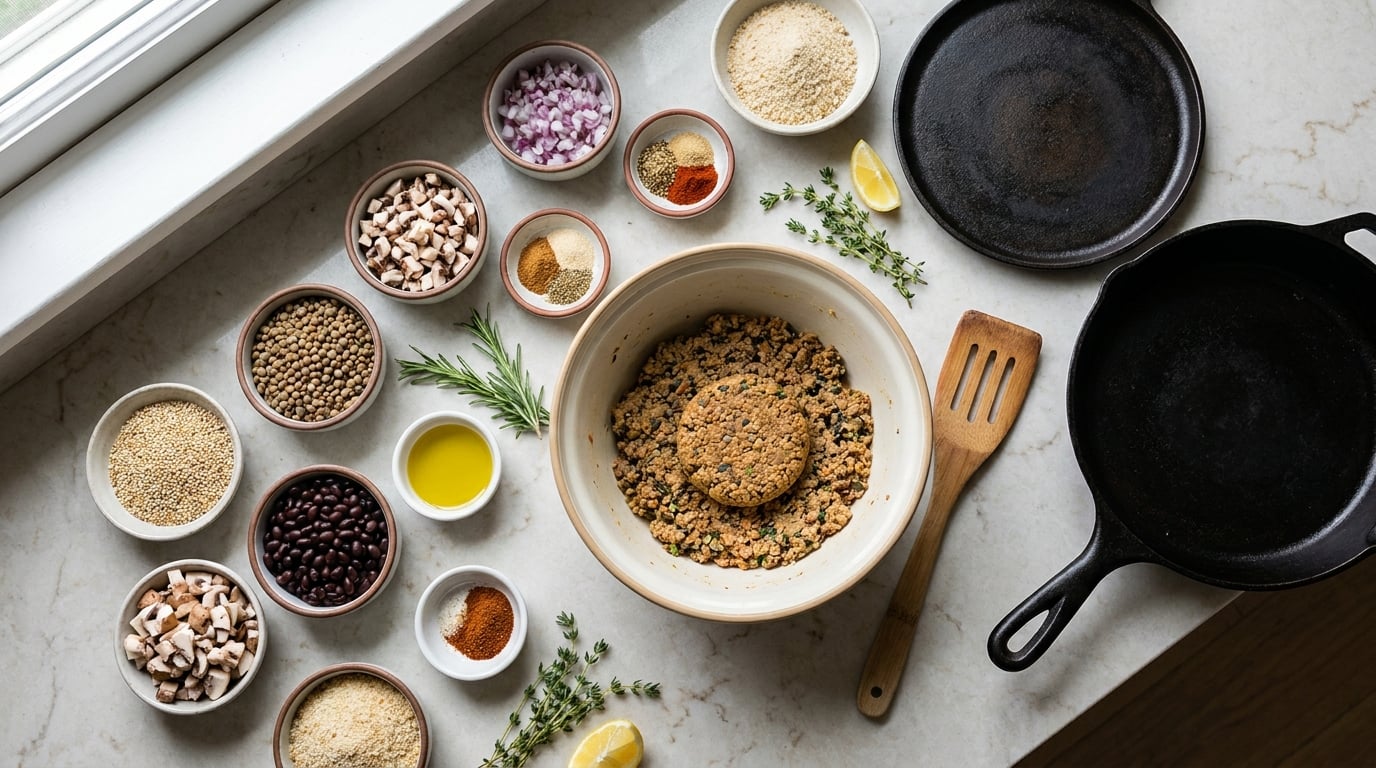
Here is the short version of how to cook plant based burger patties: get a heavy skillet properly hot, wipe on a thin film of high-heat oil, lay the patties down, and leave them alone until a deep brown crust forms. One flip, about four to six minutes a side, then a temperature check at 165F (74C) before they go anywhere near a bun. Fifteen minutes start to finish, including the heat-up.
That is the whole trick, and it runs against the instinct most of us have. Plant-based patties are leaner than beef, so a slow, gentle cook gives you something pale, dry and crumbly instead of anything browned. The sear is not a finishing touch. It is where the flavor comes from, and without it no amount of topping will rescue the patty underneath.
Four things decide whether these turn out well: a mixture that holds together, a patty of even thickness, a surface hot enough to brown before it steams, and the patience to leave it in place. Get those right and the method below is almost automatic.
| Method | Heat | Time per side | Total time | Note |
|---|---|---|---|---|
| Cast iron skillet or griddle | Medium-high | 4-6 minutes | 10-12 minutes | Best crust of the four methods |
| Grill | Medium-high, two zones | 4-5 minutes | 8-10 minutes | Oil the grates, close the lid for the second side |
| Oven | 400F / 200C | 12-14 minutes | 24-28 minutes | Flip once at the halfway mark |
| Air fryer | 375F / 190C | 5-6 minutes | 10-12 minutes | Single layer only, flip at 5 minutes |
The skillet wins on consistency because you control the heat with a knob, and it is what I use most weeks. The grill wins on smoke. The oven is the one to use when the patties are thick homemade ones and you want the middle cooked through without drying the outside.
Table of Contents
- What You Need
- How to Cook Plant Based Burger Patties Step by Step
- Common Mistakes
- Frequently Asked Questions
- Is a cast iron skillet or a grill better for plant based burger patties?
- Can you cook plant based burger patties from frozen?
- How do you season plant based patties so they taste meaty?
- Is it safe to eat a plant-based burger patty that is still slightly pink in the middle?
- How do I stop plant based burger patties from turning out dry?
- Conclusion
What You Need
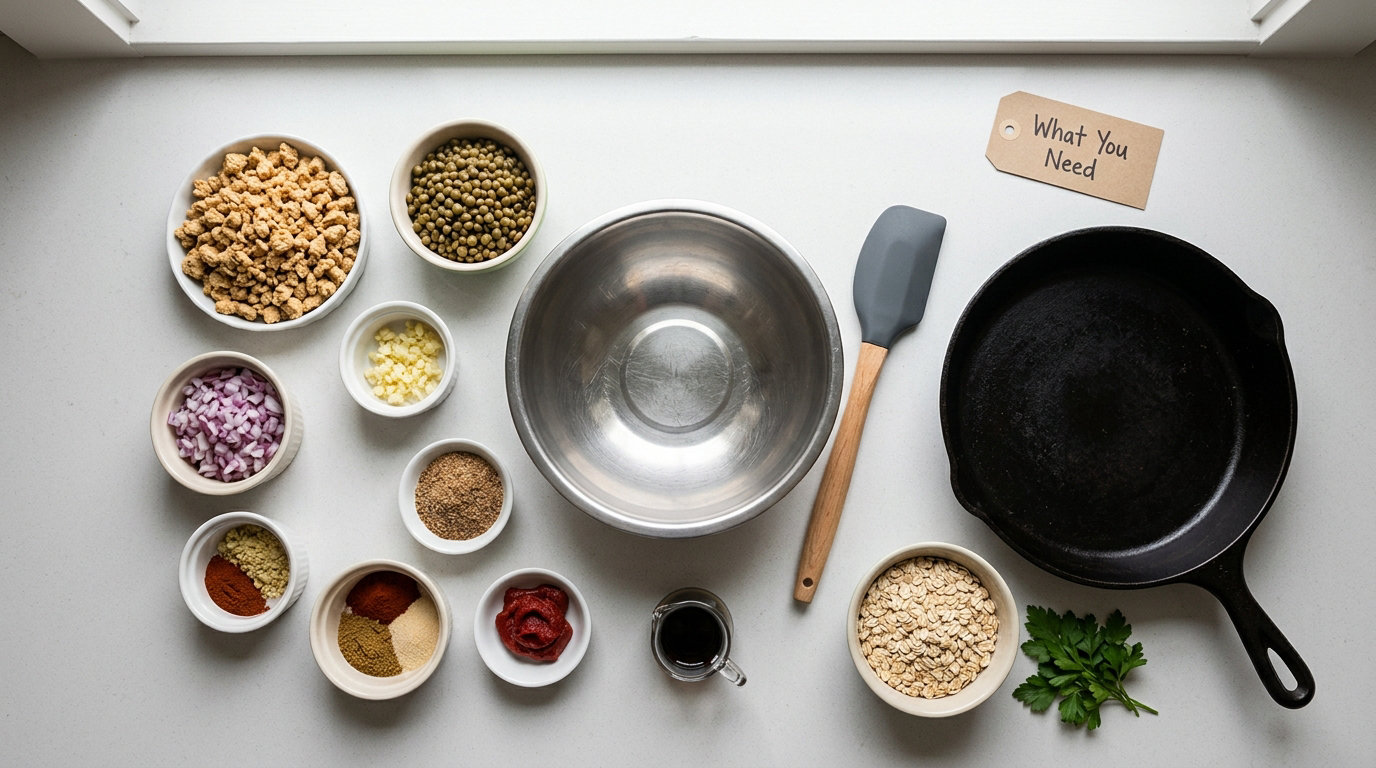
You need far less than a store shelf suggests. This covers four patties, and the ingredient list works for store-bought patties too, except that those come seasoned already and need nothing more than salt and a hot pan.
The base
Two cups of something with structure: cooked black beans or lentils mashed lightly, finely chopped portobello mushrooms, crumbled tofu or tempeh, or textured vegetable protein hydrated according to the packet. Beans give a firm bite, mushrooms give a deeper savory note, and TVP holds together better than anything else here, which matters if the patties are going anywhere near a grill.
The binder
A third of a cup of something that glues the mix. Plain breadcrumbs are the reliable default. Oat flour works and adds a nutty note. Ground flax and chia swell when they meet water, so mix two tablespoons of ground flax with four tablespoons of water and let it stand about ten minutes before folding it in. Aquafaba, the liquid in a can of chickpeas, is a good egg substitute if you need extra binding without more starch.
The flavor
Diced onion and two crushed garlic cloves, one teaspoon of smoked paprika, half a teaspoon of garlic powder, a tablespoon of soy sauce or a teaspoon of vegan Worcestershire, and salt and pepper. A teaspoon of miso dissolved in the wet ingredients adds a rounded savoriness that reads as meaty. A spoonful of nutritional yeast adds something close to the flavor of cooked cheese, which is what many people are actually hunting for.
Mushrooms and other high-moisture vegetables need attention first. Grate zucchini or similar vegetables, then squeeze them in a clean towel until they are dry to the touch. Skip this and the patties steam instead of fry, and no amount of cooking time fixes that.
The equipment
A heavy skillet, a griddle or a grill, a wide thin spatula, a small bowl of water for the texture test, and an instant-read thermometer. The thermometer is the one people skip and then wonder about. A patty that looks done on the outside can still be cool in the middle, and you cannot see that.
For doneness, press the probe into the thickest part of the patty without touching the pan and read it. 165F (74C) is the target for plant-based patties, and the manufacturer’s package instructions take priority when they differ. Rest the patty two or three minutes after it comes off the heat so the moisture redistributes rather than running out onto the plate.
How to Cook Plant Based Burger Patties Step by Step
1. Prepare the patty mixture
Combine your base, the binder, the aromatics and the seasonings in a bowl and mix with your hands until evenly distributed. You are looking for every bite to look the same, which means breaking down the beans or mushrooms rather than leaving large chunks.
Stop while it still looks slightly loose. Overworked mixture turns dense and pasty, and you cannot undo it once it is shaped. Test it the way you would test dough: squeeze a walnut-sized piece in your palm. If it holds its shape without crumbling or smearing, you are done. If it crumbles, add a tablespoon more binder. If it sticks to your hand, add a tablespoon more base or a spoonful of breadcrumbs and mix gently.
2. Form evenly sized patties
Divide the mixture into four equal portions and press each into a patty a little wider than your bun, around a quarter inch thick and roughly the width of your palm. Uniform thickness is the single most important thing here. A patty that is twice as thick in the middle takes twice as long to cook through, so the outside burns before the center gets there.
Press the center of each patty with your thumb to leave a shallow indentation. That small dip stops the patty from cooking like a dome and shrinking away from the bun, and it also gives you an obvious place to check the temperature. Scrape the edges clean so nothing hangs loose and catches on the pan.
3. Chill the patties
Put the shaped patties on a tray and refrigerate them for 30 minutes. Chilling firms the fat and the starch, which is what lets a plant-based patty hold together through a flip instead of breaking into pieces.
They can also rest covered in the fridge for a couple of days before cooking, which makes homemade patties a genuinely easy make-ahead item. Do not freeze raw patties stacked without parchment between them; they fuse into one solid block and you will be chiseling them apart later with a knife.
4. Heat the skillet or grill until it is properly hot
Set a cast iron skillet or griddle over medium-high heat and give it a full two or three minutes to come up. Cast iron takes longer than most people allow, and that waiting is the difference between a crust and a grey patty.
Without a thermometer, judge it by dropping a few drops of water onto the surface. They should skitter across and evaporate almost immediately rather than sit there bubbling. When the pan is ready, wipe on a thin film of a high smoke point oil, and only then add the patties. Oil added to a cold pan is wasted oil.
5. Sear each plant based burger patty without moving it
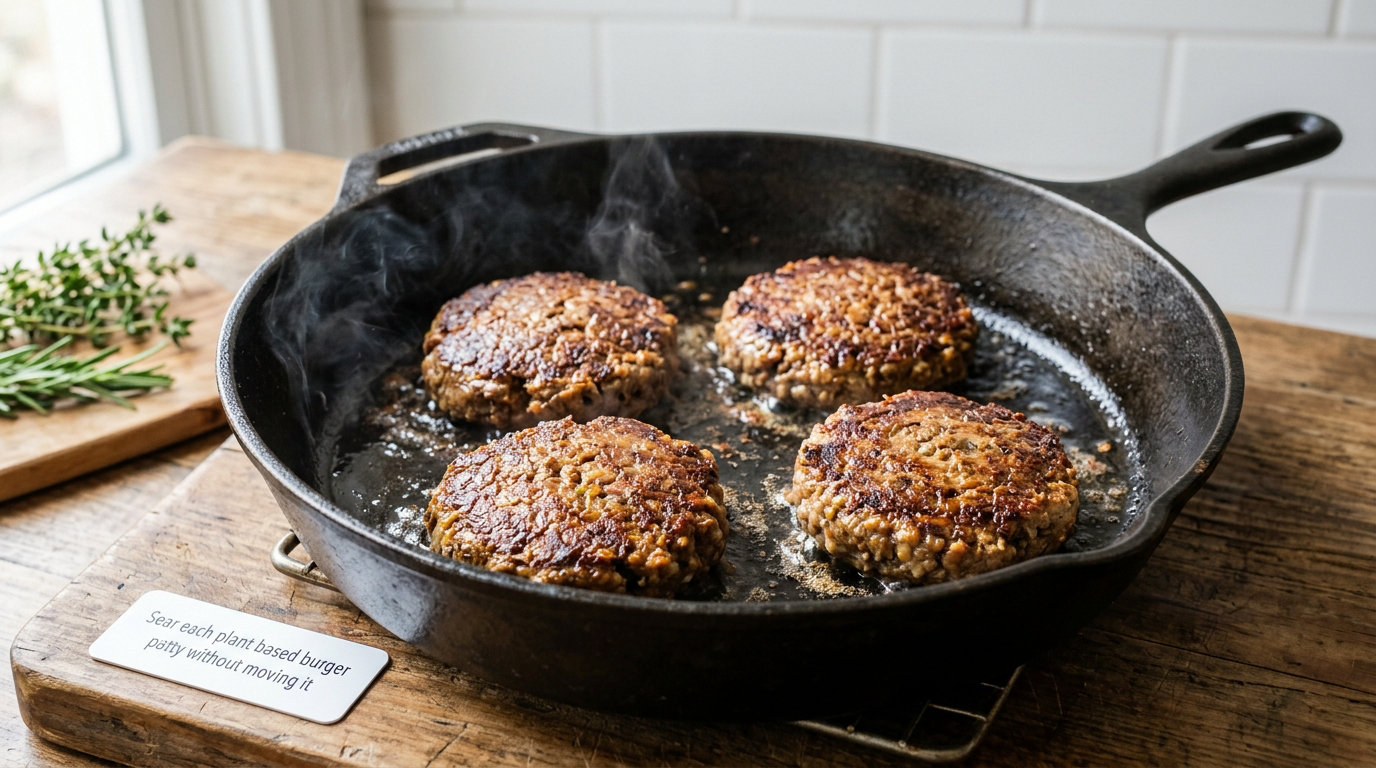
Lay the patties down away from you, leaving a finger’s width between each one. Crowding drops the temperature of the whole pan and traps steam, and a steamed patty never browns. Cook in batches if you have to.
Now leave them alone for four to six minutes. This is the part that feels wrong. The patty will stick at first, and that is normal, because the starch is still setting. When the surface is a deep uniform brown and releases from the pan with a gentle nudge, the crust has done its job and the patty will hold together. Flip once with a wide, thin spatula, slid all the way under and lifted rather than scooped.
Cook the second side for three to four minutes rather than six. The second side meets a hot pan instead of a cold one, so it browns faster and the middle is usually already cooked through. Pull them at 165F (74C) on the thermometer. Beyond that, plant-based patties lose their moisture quickly because they carry so much less fat than beef, and an extra minute is the difference between juicy and chewy.
6. Check the center and rest the patties
Press the thermometer into the thickest part, ideally in the indentation you made earlier, and keep the probe off the pan and out of the crust. 165F (74C) is the safe target for plant-based patties, and follow the package directions if the brand states something different.
Here is the part people get wrong: a pink center is not automatically a problem. Beetroot and other natural colorants in many plant-based patties give a rosy tint that has nothing to do with how well done the patty is, and a brand made with pea protein can stay pink-looking well past safe temperature. Color is not a reliable doneness test for these products. The thermometer is.
Rest the patties on a plate for two to three minutes. The juices need a moment to settle back into the patty instead of running across the bun.
7. Serve the patties right away
Assemble while they are hot. Toast the bun in the same skillet for a minute with a little butter or oil, then spread on a sauce that does not soak through: mayonnaise, aioli, a thick salsa, or a mustard and vinegar mix.
Add the patty, then toppings that add moisture and crunch rather than more weight. Grilled onion, pickles, shredded lettuce, tomato, melted cheese, or a spoonful of caramelized onion all work. Skip a thin watery tomato slice on a patty that is already on the moist side. Lettuce wraps and grain bowls are good alternatives when the patty is the point of the meal.
Common Mistakes
Most disappointing plant-based patties trace back to one of seven things. The good news is that every one of them is a fixable technique problem, not a problem with the patty itself.
- Moving the patty before it releases. A patty that tears when you try to flip it is telling you the crust is not set yet. Give it the full four to six minutes on the first side. If it still sticks badly, your pan was not hot enough.
- Skipping the preheat. A lukewarm skillet steams the patty instead of browning it, and you get a pale, wet result. Wait for the water-drop test to pass, every single time.
- Crowding the pan. Four patties touching each other drop the surface temperature and trap moisture underneath. Space them out or cook in two batches.
- Overcooking. This is the mistake plant-based patties punish hardest. Lean mixes have little fat to render, so keep it to four to six minutes on the first side and three to four on the second, and trust the thermometer over the clock.
- Flipping with a fork. The tines pierce the patty and pull off the crust you just built. Slide a wide, thin spatula all the way underneath and lift in one motion.
- Shaping and cooking immediately. A warm, freshly formed patty is soft and tears under the spatula. Thirty minutes in the fridge firms it enough to survive a flip or a trip to the grill.
- Wetting out the base. Mushrooms, zucchini and other high-moisture vegetables need squeezing dry. Soggy mix makes soggy patties, and they will never crisp.
Two habits pay off more than any seasoning trick. Salt the patties lightly on both sides just before they hit the heat, and put sauce on the bun rather than on the patty, so the crust stays crisp instead of dissolving under a wet spread.
If you are cooking for a crowd, the skillet and griddle are your friends: you can hold several patties warm in a low oven without drying them out the way a microwave does, and it takes about ten minutes to sear a full round.
Frequently Asked Questions
Is a cast iron skillet or a grill better for plant based burger patties?
A cast iron skillet is easier to control and usually gives the more even crust, which makes it the better choice for a weeknight. A grill adds smoke flavor and is the right call for a cookout, as long as you oil the grates and use a two-zone fire so you can move a patty to indirect heat if it browns too fast. Both land on four to six minutes per side at medium-high heat.
Can you cook plant based burger patties from frozen?
Yes, and for thick commercial patties it is often the more reliable method, since they can be too soft to handle when thawed. Cooking from frozen usually needs one or two extra minutes a side. Thaw them in the fridge instead if the patty is thin or homemade, because a thawed patty is much easier to season and will hold its shape better on the grill.
How do you season plant based patties so they taste meaty?
Build flavor in layers rather than relying on salt. A tablespoon of soy sauce or a teaspoon of vegan Worcestershire in the mixture adds salt and a savory depth, smoked paprika adds a hint of fire, and a teaspoon of miso or nutritional yeast adds the rounded, cooked note people are often chasing. Finish with salt and pepper on both sides just before they hit the pan.
Is it safe to eat a plant-based burger patty that is still slightly pink in the middle?
Do not judge these patties by color. Beetroot and other natural colorants can leave the center rosy even when the patty is fully cooked, so a pink appearance is not proof of undercooking either way. Use an instant-read thermometer and aim for 165F (74C) in the thickest part, and follow the package directions when the brand states its own target.
How do I stop plant based burger patties from turning out dry?
Take them off the heat earlier than you would a beef patty. These mixes carry far less fat, so there is nothing left to render and the texture turns rubbery fast once the water is gone. Check the temperature rather than the clock, pull them at 165F (74C), rest them two or three minutes, and let the toppings and sauce supply the moisture you skipped.
Conclusion
If you do one thing differently, chill the patties. Form them to an even thickness with an indented center, give them 30 minutes in the fridge, and everything after that gets easier: they hold together on the spatula, they brown instead of steaming, and they cook to 165F (74C) without drying out.
That is how to cook plant based burger patties so they taste like someone planned the meal. Mix until evenly combined but never overworked, heat the surface until a drop of water skitters across it, cook four to six minutes on the first side without touching the patty, flip once, and check the temperature rather than the clock. Follow it and the skillet method takes about a quarter of an hour.