
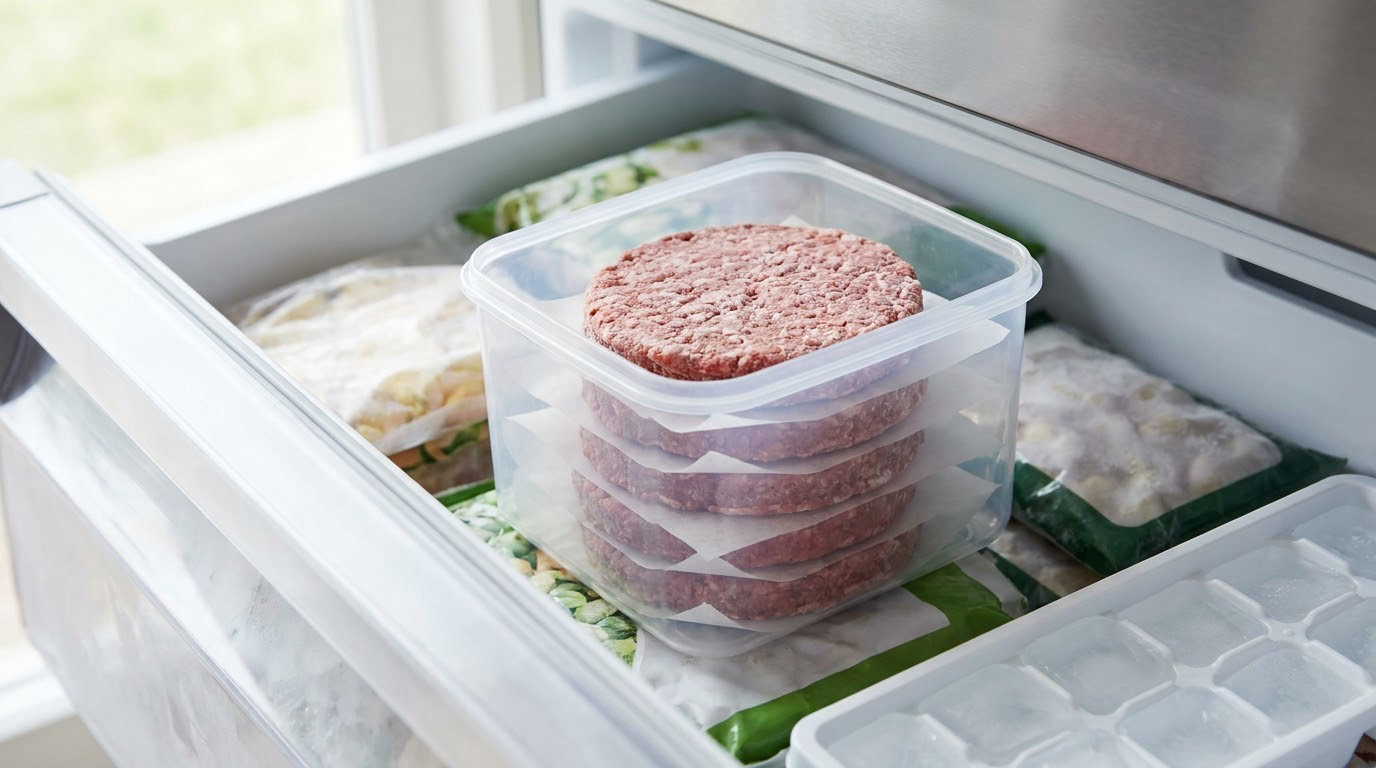
If you only want the number: raw burger patties stay at their best for 3 to 4 months in a freezer held at 0°F (-18°C), and cooked burgers hold up just as long. Frozen solid, they stay safe far longer than that, but ice crystals slowly push out moisture, so the flavor fades long before the safety does.
The gap between “safe” and “good” is where most of the confusion lives. Search results throw around everything from 3-4 months to 3-6 months to “indefinitely,” and none of those contradict each other, they just answer different questions.
Spoiling requires warmth. Bacteria need roughly 40°F to 140°F (4°C to 60°C) to multiply, and at 0°F the growth that causes spoilage stops entirely. That is the safety half of the answer, and it holds as long as your food stays frozen solid.
Quality is a different story. Water in the meat forms ice crystals that expand, rupture cell walls and push juices toward the surface. Once exposed, that moisture evaporates in the dry freezer air. The result is freezer burn: a dry, greyish, papery patty that tastes flat and loses its juiciness. It never made anyone sick, but it will not win anyone over at the grill either.
So the practical answer to how long can burgers stay in the freezer is this. Plan to eat raw patties within 3 to 4 months, treat anything past that as a backup meal rather than a cookout centerpiece, and stop worrying about safety as long as the meat is solid and the packaging is intact.
Table of Contents
- How Long Can Raw Burger Patties Stay in the Freezer?
- How Long Can Cooked Burgers Stay in the Freezer?
- Raw vs. Cooked Burger Storage Times
- How to Freeze Burgers Without Freezer Burn
- How to Thaw Frozen Burgers Safely
- Signs Frozen Burgers Have Gone Bad
- How to Tell When a Burger Is No Longer Good
- Frequently Asked Questions
- Can burgers stay frozen for 6 months?
- How long do cooked ground beef and cooked burger patties last in the freezer?
- Does freezing a burger make it unsafe if it was left out too long?
- Can I freeze burger patties with cheese, lettuce or sauce?
- What is the best way to thaw frozen burgers?
- How can I tell whether a frozen burger is still good?
- What to Do First in Your Freezer
How Long Can Raw Burger Patties Stay in the Freezer?
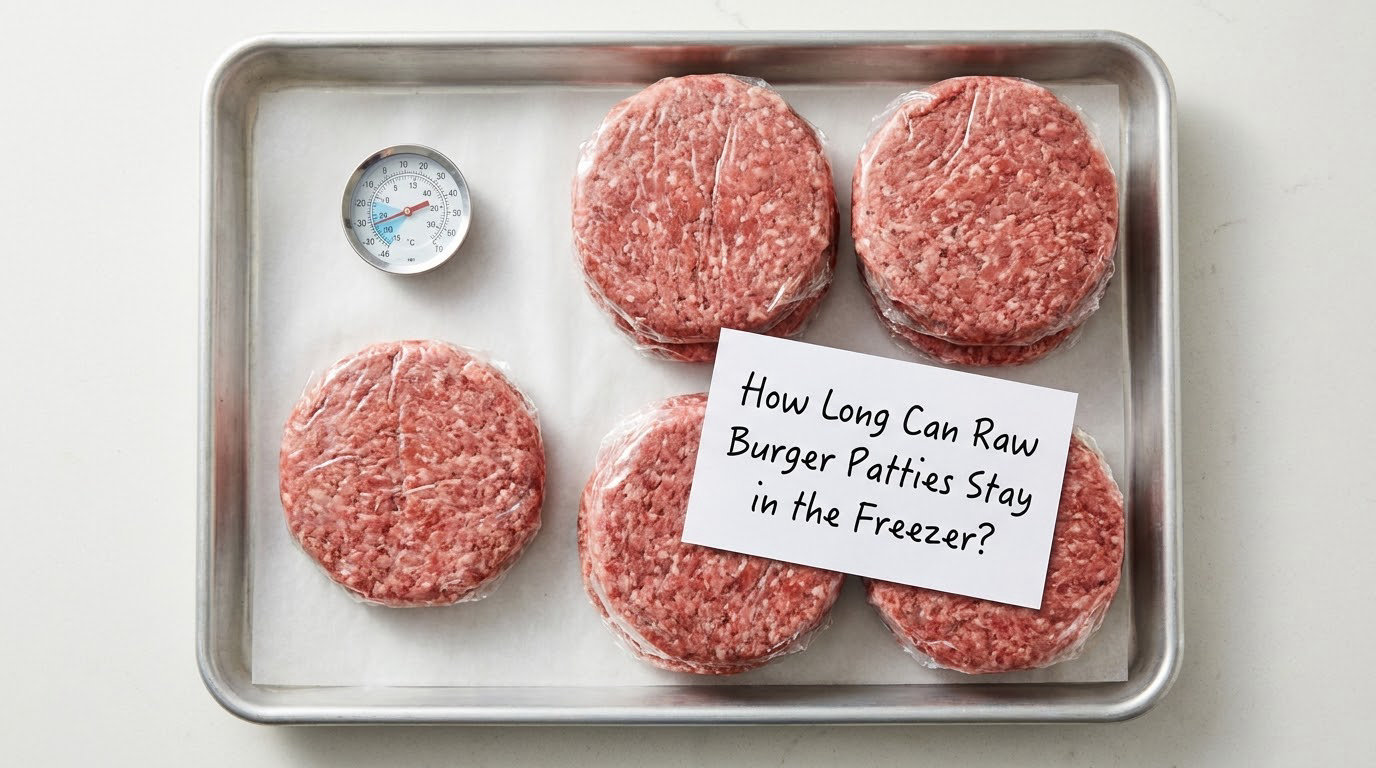
Raw ground beef and homemade hamburger patties are best used within 3 to 4 months of freezing. After four months they are still perfectly safe to eat, just drier and less flavorful.
Store-bought patties last longer because of how they are made. Commercially flash-frozen patties are partially frozen, formed and then frozen again quickly, which produces smaller ice crystals and less cell damage. Vacuum-sealed and cryovac-packed patties can hold peak quality for 4 to 12 months, which is why they carry a longer best-by date on the box.
What does the date on the package actually mean?
That question comes up in nearly every forum thread about frozen meat. A packed-for date on a tray of beef is guidance for the store and for you about quality, not a safety cutoff. The USDA’s rule of thumb is that food is safe after any date as long as it was stored at 0°F or below and stayed frozen.
Freezing does not reset the clock, but it does pause it. If you bought ground beef that was already past its date and froze it the day it came home, you have bought yourself a full 3-to-4-month quality window. If it sat in the fridge for a few days first, freezing cannot rescue it.
How Long Can Cooked Burgers Stay in the Freezer?
Fully cooked burgers and cooked ground beef keep their best quality for 3 to 4 months frozen. Many home cooks get more out of them than that, but the texture of a reheated cooked patty degrades faster than a raw one because it has already lost moisture during cooking.
Sauces and toppings change the picture. A burger wrapped naked in foil dries out noticeably by month four. One with ketchup, barbecue sauce or cheese sealed against the surface holds moisture better, though cheese and creamy sauces can go a bit grainy or split when frozen and reheated.
Assembled burgers with lettuce, tomato, onion and pickles do not freeze well. The vegetables turn watery and limp when thawed, and the bun goes soggy. Freeze the patties separately and add the fresh toppings after thawing.
One thing freezing will not do is fix food that was already in trouble. A burger that sat on a counter until it dried out, or one cooked and left to cool at room temperature for hours, has already grown bacteria. Freezing kills nothing. If you are unsure how long a burger sat out, throw it away rather than banking on the freezer.
Raw vs. Cooked Burger Storage Times
The refrigerator side of the chain matters as much as the freezer, because most freezer problems are actually refrigerator problems. Something got forgotten, thawed and refrozen, and now you have no idea how long it has really been cold.
| Burger type | Refrigerator (40°F / 4°C) | Freezer (0°F / -18°C) | Safety vs. quality |
|---|---|---|---|
| Raw ground beef, loose | 1 to 2 days | 3 to 4 months for best quality | Safe indefinitely frozen; quality drops after 3 to 4 months |
| Raw homemade patties | 1 to 2 days | 3 to 4 months for best quality | Same timeline; patty shape gives more surface area to burn |
| Store-bought flash-frozen patties, sealed | Keep frozen; 1 to 2 days if thawed in the fridge | 4 to 12 months | Flash freezing and vacuum sealing push quality out well past the beef window |
| Cooked burgers or cooked ground beef | 3 to 4 days | 3 to 4 months | Safe indefinitely frozen, but reheated texture declines sooner |
| Assembled burger with lettuce, tomato, sauce | 1 to 2 days | Not recommended | Fresh toppings turn watery; freeze the patty only |
| Turkey or veggie patties | 1 to 2 days | 3 to 4 months | Turkey follows poultry timelines; veggie patties dry out fastest |
For the refrigerator half of the picture, our guide to how long ground beef lasts in the fridge covers the labels and temperatures in more detail.
How to Freeze Burgers Without Freezer Burn
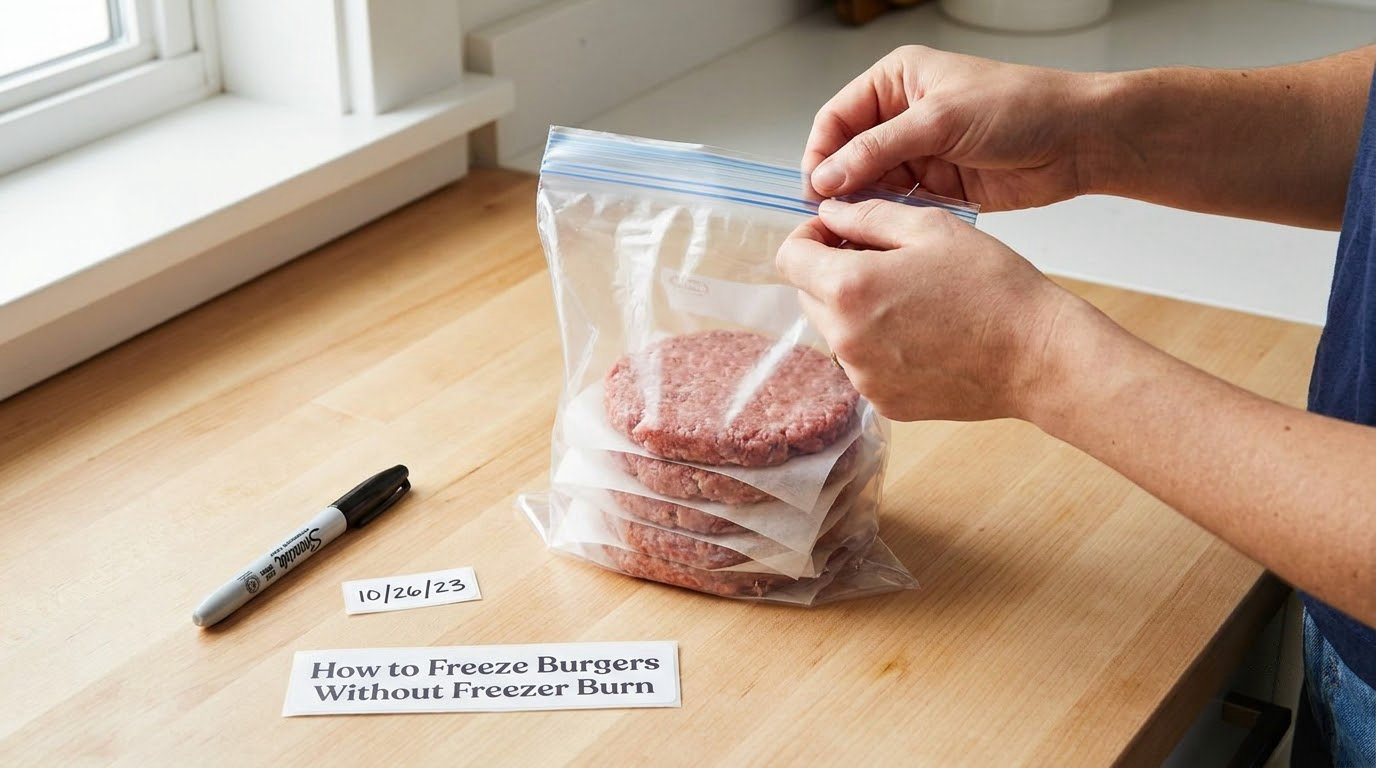
Freezer burn is entirely about air and moisture. Cut off the air exposure and your patties will hold near-peak quality well past four months. Here is the method I use.
Step 1: Cool cooked burgers completely
Burger cooked straight from the freezer will steam, and steam turns to condensation inside the bag. That trapped water causes the same damage as freezer burn. Cool patties on a rack or a plate in the fridge first.
Step 2: Separate patties with parchment
Stack four or five patties, lay a sheet of parchment paper over them, and keep repeating. The parchment keeps patties from sticking together and from stealing each other’s surface moisture. Our fuller guide to freezing patties without freezer burn has the wrapping variations compared.
Step 3: Squeeze the air out
For freezer bags, press the top of the bag down flat until no air remains, then seal it. Air pockets are where ice crystals form. Vacuum sealing does the same job better, which is why a sealed patty outlasts a loosely bagged one.
Step 4: Portion and label
Freeze in batches of 10 to 12 patties, roughly two per person for a cookout. Write the date and the count on the bag with a marker. Labeling is the fix for freezer archaeology, the thing where you find a package at the bottom and have no idea how long it has been there.
Step 5: Freeze flat, then stack
Lay bags flat on a sheet pan so they freeze quickly, then move them upright or stacked with dividers once hard. Freezing fast means smaller crystals and less damage.
Step 6: Check your freezer actually holds 0°F
Plenty of home freezers idle at 10°F to 20°F without ever reaching zero, and that is the single biggest reason patties go bad in the freezer. An inexpensive appliance thermometer sitting in the middle of the freezer tells you the truth in about five minutes.
How to Thaw Frozen Burgers Safely
Thawing in the fridge is slower and messier, but it is the method that keeps texture closest to fresh. The other two are fast; you pay for the speed in uneven cooking.
| Method | Time per patty | Best for |
|---|---|---|
| Refrigerator, in a sealed container or bowl | 12 to 24 hours for a thin quarter-pounder | Overnight prep for a planned cook, best texture |
| Cold water, sealed in a leak-proof bag, water changed every 30 minutes | 30 to 60 minutes | Same-day cooking without a full overnight wait |
| Microwave, on a plate at 50% power | 2 to 3 minutes per patty | Cooking straight through afterward, never for raw patties you intend to finish rare |
| No thawing at all | Grill or sear 3 to 4 minutes per side | Patties up to about a quarter inch thick, cooked from frozen |
Thawing in a microwave leaves the outside warm and the center still frozen, which pushes a raw patty into the danger zone while the middle thaws. If you go that route, cook the patty immediately and do not put it back in the fridge.
Signs Frozen Burgers Have Gone Bad
This is where the safety answer turns practical. A patty that never thawed cannot spoil, so visible signs are unreliable while it is frozen. Most spoilage only becomes obvious after thawing, which is why the packaging matters as a clue.
What to look for while still frozen
A torn, punctured or split bag is the clearest signal something went wrong. Ice crystals heavy enough to form a solid white block over a patty mean air and moisture got in and froze. Heavy frost on the inside of the lid of a freezer is a sign the whole freezer is running dry, which speeds up freezer burn across everything in it.
What to check after thawing
Burger that has spoiled gives off a sour, ammonia-like or otherwise unpleasant odor. It feels slimy or sticky instead of firm. The color may look greyish or duller than fresh beef, and the surface may have a dry, opaque, parchment-like patch where freezer burn took the moisture out.
If any of that shows up, throw it out. Do not taste a questionable burger to check, because the flavors that make spoilage obvious are exactly the ones you cannot taste until it is too late to stop. When in doubt, discard.
Freezer-burned patties that smell and feel normal are still fine to eat. They just cook better broken up than served whole. Crumble them into chili, meat sauce, sloppy joe or a taco filling where sauce supplies the moisture.
How to Tell When a Burger Is No Longer Good
Freezer storage is only the last link in a chain, and each link has to hold. If a patty spent a morning thawing on the counter before it went back into the freezer, the freezer cannot undo that.
The danger zone
Bacteria multiply quickly between 40°F and 140°F (4°C and 60°C). Two hours in that range is the usual limit, and one hour if the day is above 90°F (32°C). This applies to the drive home from the store, the counter while the grill heats up, and the table at the end of a long dinner. Put the raw patties back in the fridge or the freezer, not on the counter.
Cook to 160°F (71°C)
Ground meat is different from a steak because bacteria are mixed through it rather than sitting on the surface. Cook burger patties until the center reaches 160°F (71°C) measured with a thermometer in the thickest part, and do it for ground beef, turkey and sausage alike. Color is not a reliable indicator, which matters even more on patties that were partly cooked from frozen.
Refreezing and cross-contamination
Patties thawed in the refrigerator can be refrozen without cooking, though some quality is lost each time. Patties thawed in a microwave or cold water must be cooked before they go back in the freezer. Keep raw patties on a tray below cooked food so juices never drip onto something already ready to eat, and wash hands and surfaces after handling raw beef.
Keep a dated freezer inventory and most of these questions answer themselves. If you are not sure about something in the freezer, the honest answer is that you cannot know its age, and unknown age deserves the bin rather than the grill.
Frequently Asked Questions
Can burgers stay frozen for 6 months?
Yes, as long as they were frozen promptly and the package is intact. They are certainly safe after 6 months at 0°F or below, but expect a drier patty with flatter flavor because the quality window for raw ground beef is 3 to 4 months. Commercially flash-frozen, vacuum-sealed patties are the exception, since they hold peak quality for 4 to 12 months.
How long do cooked ground beef and cooked burger patties last in the freezer?
Cooked burgers and cooked ground beef keep their best quality for 3 to 4 months in the freezer, and stay safe indefinitely while frozen solid. They lose quality a little faster than raw patties because they already lost moisture during cooking. Cool them fully, separate them with parchment, seal out the air and label the bag with the date.
Does freezing a burger make it unsafe if it was left out too long?
No. Freezing stops bacteria from multiplying but does not kill the ones that already grew, so freezing cannot make unsafe food safe. If a raw burger sat in the 40°F to 140°F range for more than two hours, or a cooked one was left at room temperature while dinner ran long, throw it out rather than freezing it for later.
Can I freeze burger patties with cheese, lettuce or sauce?
Freeze the patties without the fresh toppings. Lettuce and tomato turn watery when thawed and the bun goes soggy. Cheese freezes fine but can turn grainy when reheated, and a thick sauce actually helps by sealing moisture against the meat. Assemble the finished burger after you thaw and cook the patty.
What is the best way to thaw frozen burgers?
The refrigerator gives you the best texture but takes 12 to 24 hours for a thin patty. Cold water in a leak-proof bag takes 30 to 60 minutes with the water changed every half hour. The microwave is fastest but leaves the outside warm and the center frozen, so cook it straight away. Never thaw on the counter.
How can I tell whether a frozen burger is still good?
Look at the packaging first. A torn or punctured bag, a solid block of ice crystals over the patty, or heavy frost on every surface inside the freezer lid all point to air and moisture getting in. After thawing, an unpleasant odor, a slimy surface or grey, dry, opaque patches mean discard it. Never taste a questionable burger to test it.
What to Do First in Your Freezer
Date every bag you freeze and treat 3 to 4 months as your cooking window. Put an appliance thermometer in the freezer to confirm you are at 0°F, wrap patties with parchment and pressed air, and pull anything older than a year forward for dishes where sauce does the work instead of the grill. If you are reheating a cooked burger rather than cooking a raw one, our leftover burger reheating guide keeps it from turning rubbery.
Last updated in 2026. General food-safety information only; if you are managing a health condition, ask a doctor or a registered dietitian for guidance specific to you.