
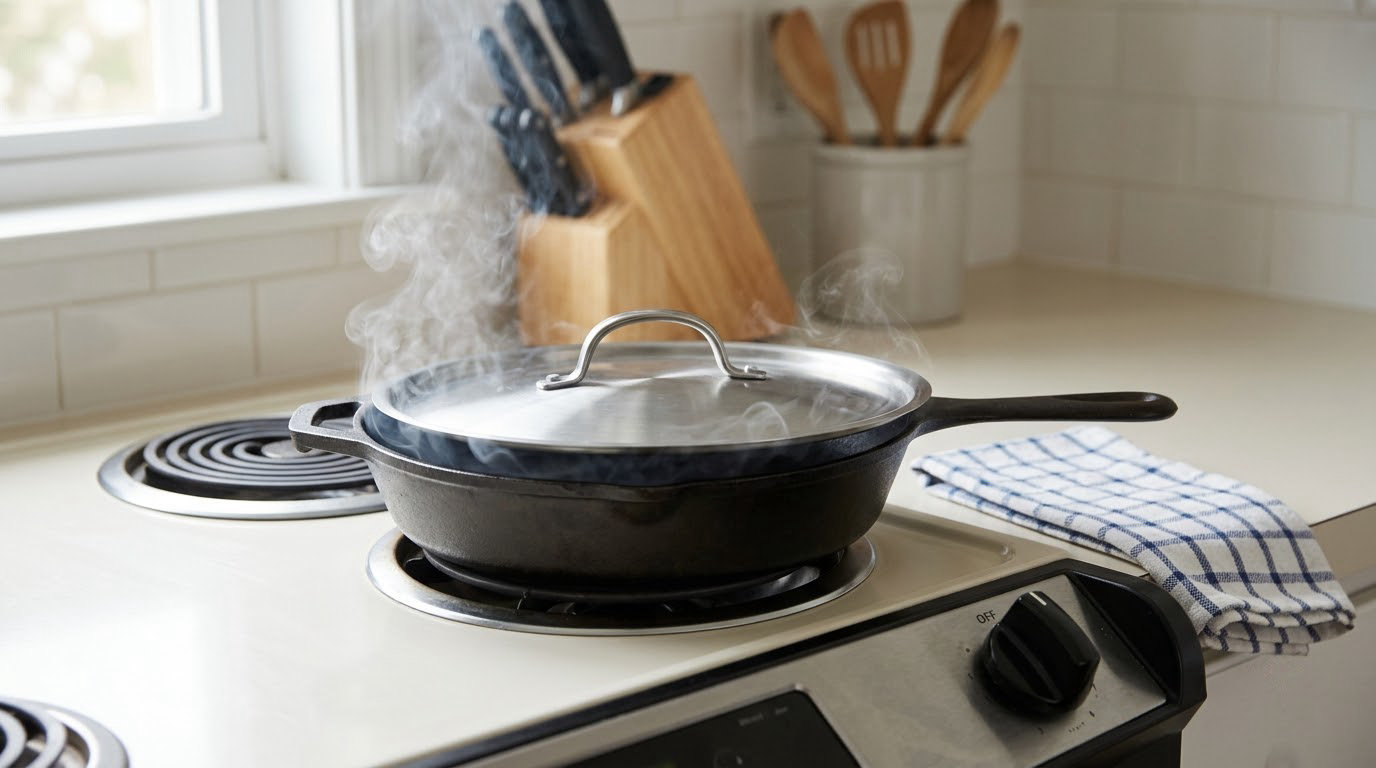
A grease fire goes out the same way any fire does: you take away fuel, heat, or oxygen. Turn off the burner, slide a metal lid or baking sheet over the pan from the side, and leave it there until the pan is completely cool. Never use water — that one instinct is what turns a skillet flare-up into a kitchen fire.
You get maybe ten seconds of clear-headed decision time, which is why this needs to live in your head before it ever happens. The steps below are ordered by what a home cook can realistically reach in that window.
Table of Contents
What You Need
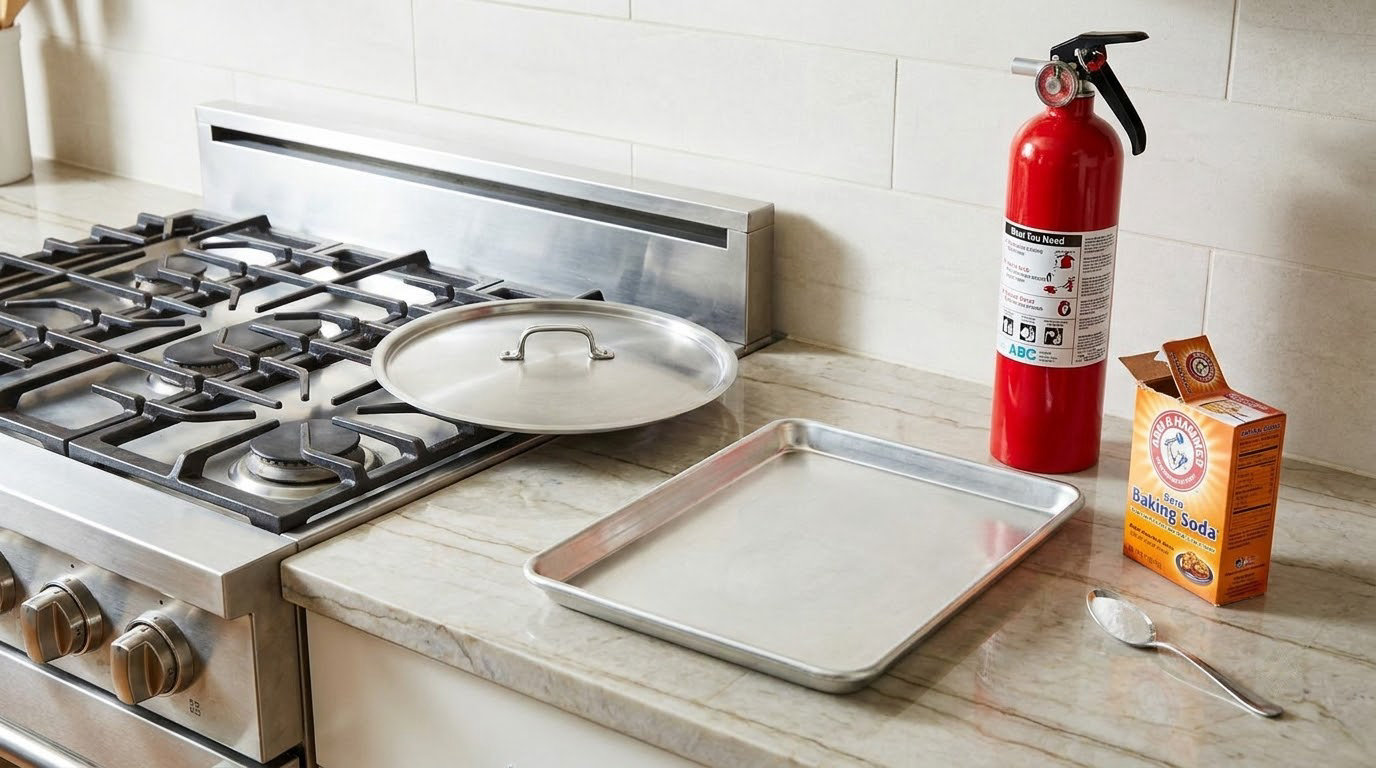
Three things work on a small grease fire, and having them within arm’s reach of the stove matters more than anything else. A flat metal lid or a rimmed baking sheet that fits the pan. A full box of baking soda. And a kitchen fire extinguisher you actually know the location of.
Most households have none of the three in the kitchen, which is why people end up improvising with a wet dish towel. Keep one lid per burner within reach, and treat the extinguisher as a purchase for next month rather than something to find during a fire.
Two more items help you read the situation early. A smoke alarm near the kitchen but not directly over the stove catches most grease fires before they reach the pan’s rim. A pair of oven mitts that are dry and within reach lets you handle a hot lid without dropping it.
You’ll also want a clear path out. When I look at a kitchen fire risk, it’s less about the burner and more about whether the door to the hallway is blocked by a chair or a stack of grocery bags. Fix that now, while nothing is burning.
Prep work counts as equipment too. Patting meat dry before it goes in the pan, and not filling a skillet more than a third to a half full, both reduce the odds you ever need this guide. When you’re thawing meat for a fry or a sear, how to thaw ground beef fast and safely matters less than drying it thoroughly before it hits hot oil.
Step-by-Step
How to Put Out a Grease Fire Safely with a Lid
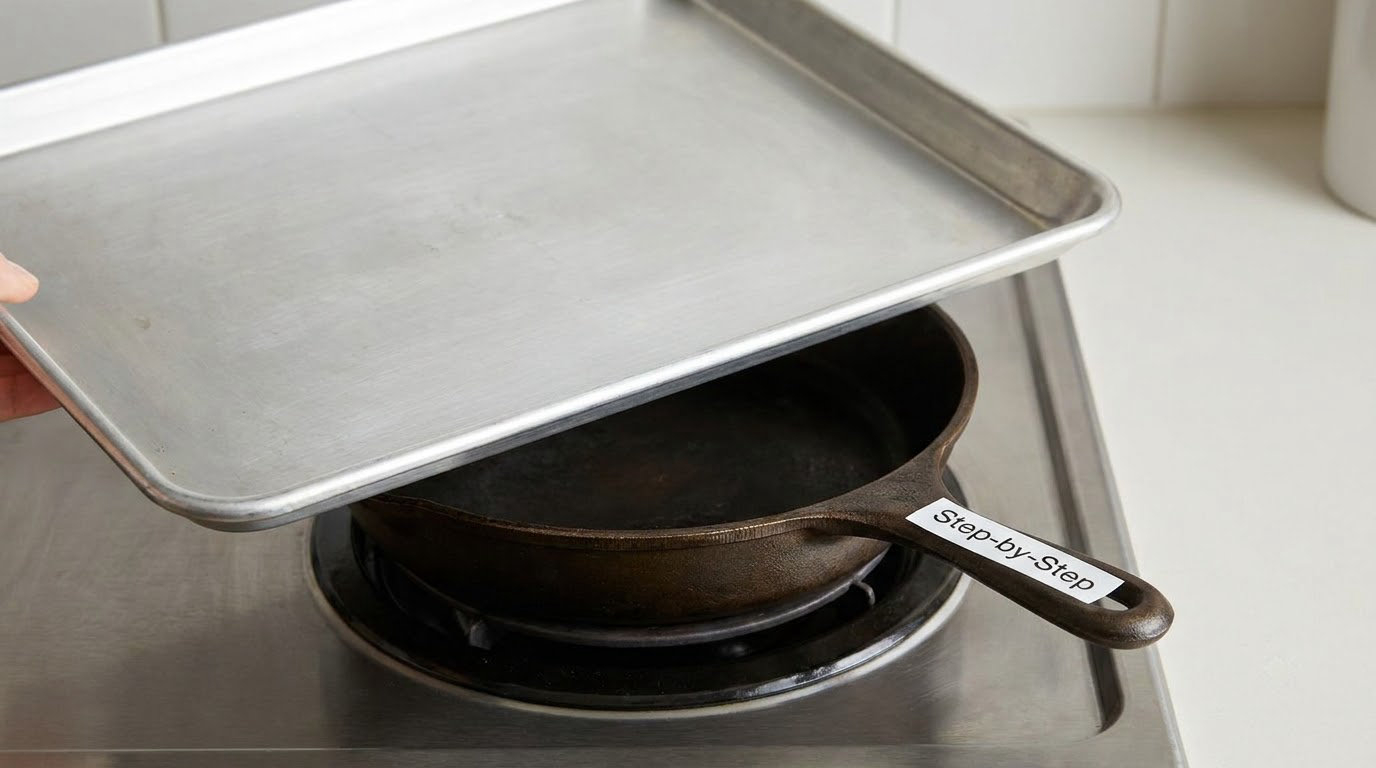
Slide the lid on from the side, then leave it in place. That’s the whole technique, and it’s why a grease fire is survivable in a home kitchen.
First, turn off the burner if you can reach the knob without leaning over the pan. Heat off plus oxygen blocked means the fire has nothing left to grow on.
Then slide the metal lid or baking sheet over the pan horizontally, from the side, at a shallow angle. Don’t drop it straight down from above, and don’t reach across the flames. If the lid is a glass one, skip it entirely — thermal shock shatters tempered glass over a hot pan, and the pieces land in burning oil.
Leave the lid where it is. Then wait. A covered pan of hot oil will stay hot for a long time, and lifting the lid early lets oxygen back in at exactly the wrong moment. Most re-ignition flare-ups people describe happen because someone lifted the cover out of curiosity after thirty seconds.
Only lift it once the pan is cool enough to touch with the back of your hand held near it, which realistically means waiting well over an hour. If you lifted it and flames came back, put it straight back down and get out.
How to Put Out a Grease Fire Safely with Baking Soda
Baking soda works, but only on a genuinely small fire, and only in a quantity that surprises most people.
Dump a large amount of it — enough to completely blanket the surface of the oil, not a spoonful sprinkled on top. The weight and the carbon dioxide it gives off as it heats do the smothering, and both take real volume to work.
Approach from the side, stand back a couple of feet, and throw it rather than leaning over the pan. If the flames do not drop within a few seconds of the surface being covered, this is not a baking-soda fire anymore. Get out.
Salt works the same way and is fine in a pinch. Table salt is inert, it weighs more than the oil, and you can use what you have on the counter. Neither is a substitute for a lid on a deep fryer or a fire that’s already climbing the side of the pan.
Be precise about which powder you grabbed. Baking soda is sodium bicarbonate. Baking powder contains leavening agents that break down into gas and can ignite in a grease fire. Flour and sugar are finely divided combustible powders that can aerosolize and flash. Same shelf, completely different outcome.
How to Put Out a Grease Fire Safely with an Extinguisher
A kitchen-rated extinguisher is the right tool once a lid and baking soda are no longer enough. Most homes own an ABC unit in the garage, and ABC does work on grease — it’s the wet chemical Class K units that are specifically made for commercial cooking oil, and an ABC is a perfectly reasonable thing to reach for at home.
Pass a Class A water-only extinguisher. Water is exactly what you cannot put on a grease fire.
Stand back. Aim at the base of the flames. Squeeze the handle. Sweep side to side. That sequence — Pull, Aim, Squeeze, Sweep — is worth memorizing once so you don’t have to think about it later.
Spray the flames, not the burning oil surface itself, and keep moving. If one extinguisher empties and the fire is still going, stop. You do not get a second attempt at this, and you have now spent your escape time on an improvised fight. Get out, close the door behind you, and call 911 from outside.
Common Mistakes
Using water. This is the one that ruins kitchens. Water is denser than oil, so it sinks to the bottom of the pan, flash-vaporizes into steam, and throws a column of burning grease into the air. There is no small version of this.
The fix is to make the lid the automatic response. If your hand is reaching for anything under the sink when oil catches, you have trained the wrong reflex.
Moving the pan. Carrying a burning skillet to the sink or out the back door splashes burning oil across the floor and onto you. Commenters on cooking forums describe this one in painful detail. Leave the pan where it is and cover it.
Using a wet dish towel. This is outdated advice that keeps getting repeated at family kitchens, and it’s dangerous twice over. Water dripping off the towel triggers the same vaporization explosion, and draping the towel over the pan can knock it off the burner.
Using flour, sugar, or baking powder. All three are dry and all three can ignite violently when they hit burning oil. Only baking soda and salt are safe from the pantry.
Lifting the lid too soon. Curiosity costs you the fire. If it goes out and comes back, you’re now standing over a flame instead of a covered pan.
Taking the fire outside. Unless the pan is small, shallow, and already covered, moving it puts you between the burning oil and the exit.
Ignoring the fire in an oven or microwave. If the fire is inside an appliance, the rule changes completely: keep the door closed and call 911. Opening it feeds oxygen straight to the flames. An air fryer or convection oven gets the same treatment — the door stays shut.
When to Evacuate and Call Emergency Services
Get out and call 911 from outside the building if any of these are true. There is no version of this where you should stay and negotiate.
Flames are spreading across the counter, up a cabinet, or into the range hood. Smoke is filling the room or coming under the door. The fire is in the ductwork or the hood filter area, which can hide a second fire front you can’t see.
You have no suitable cover, no extinguisher, or you’re not sure which pan it’s in. Uncertainty is a good reason to leave, not a bad one.
The oil is deep in a fryer or a Dutch oven and you can’t fully cover it. Deep-fryer fires are a genuine emergency rather than a DIY task.
As you leave, close the kitchen door behind you. Pull the door closed, don’t leave it open to ventilate — a closed door slows the fire’s oxygen supply and keeps smoke out of the rest of the house. Call 911 from the sidewalk and say grease fire, stovetop or range, and whether anyone is inside.
A grease fire will not quietly burn itself out. It has fuel, heat, and a steady supply of air, and if it’s still going a few seconds after you cover it, it’s bigger than you.
Frequently Asked Questions
Can I put water on a grease fire?
No. Water is denser than cooking oil, so it sinks to the bottom of the pan, flash-vaporizes into steam, and expands rapidly into a fireball of burning grease. A pan fire becomes a ceiling fire in seconds. Turn off the burner and slide a metal lid or baking sheet over the pan instead, leaving it in place until everything is completely cool.
Should I move a pan that is on fire?
No, unless the pan is small, shallow, and already fully covered, and even then most fire departments advise against it. Moving a burning skillet splashes hot oil onto the burner, the floor, and often your arm or leg. Leave the pan where it sits, turn off the heat, and cover it. If it is too large to cover, that is your cue to leave and call 911.
What should I do if I do not have a metal lid?
Use a flat metal baking sheet or rimmed baking pan, slid on from the side. Anything metal that fits the pan and can smother it will work. Do not use a glass lid, which can shatter from thermal shock, and do not improvise with paper, cardboard, plastic, or a damp towel. If nothing metal is available, turn off the heat, throw a large amount of baking soda or salt over the surface, and be ready to leave.
Does baking soda put out a grease fire?
On a genuinely small fire, yes. Baking soda smothers the surface by weight and releases carbon dioxide as it heats. Use a large quantity, enough to fully blanket the oil rather than a spoonful. It is not a substitute for a lid, and it will not handle a deep fryer, a spreading fire, or flames climbing the side of the pan. Baking powder, flour, and sugar are not safe substitutes.
What type of fire extinguisher is best for cooking oil?
A Class K wet chemical extinguisher is designed for cooking oil, and it is what commercial kitchens use. At home, an ABC extinguisher works on a grease fire and is far better than having nothing, since it also covers the ordinary home emergencies. Never use a Class A water-only extinguisher. If the fire does not respond to one extinguisher, get out and call 911.
When should I call the fire department instead of handling a grease fire?
Call it any time the flames spread beyond the pan, smoke fills the room, the fire reaches the range hood or cabinets, you have no cover or extinguisher, or you are simply unsure. Do not wait to see whether it settles. If the fire is inside an oven or microwave, keep the door closed and call immediately. Leave by the nearest exit, close the door behind you, and call from outside.
Covering a grease fire safely comes down to one reflex: turn off the burner, slide metal over the pan from the side, and leave it until everything is cold. If the flames climb the sides, spread, or reach the hood, you are past the point of DIY — close the kitchen door behind you and call 911 from outside.
Before you need any of this, dry your meat properly before it hits the oil, keep a lid within reach of every burner, and put an extinguisher in the kitchen instead of the garage. Thawing ground beef safely is worth a look too, since most kitchen fires start with a pan that was overfilled or overcooked.