
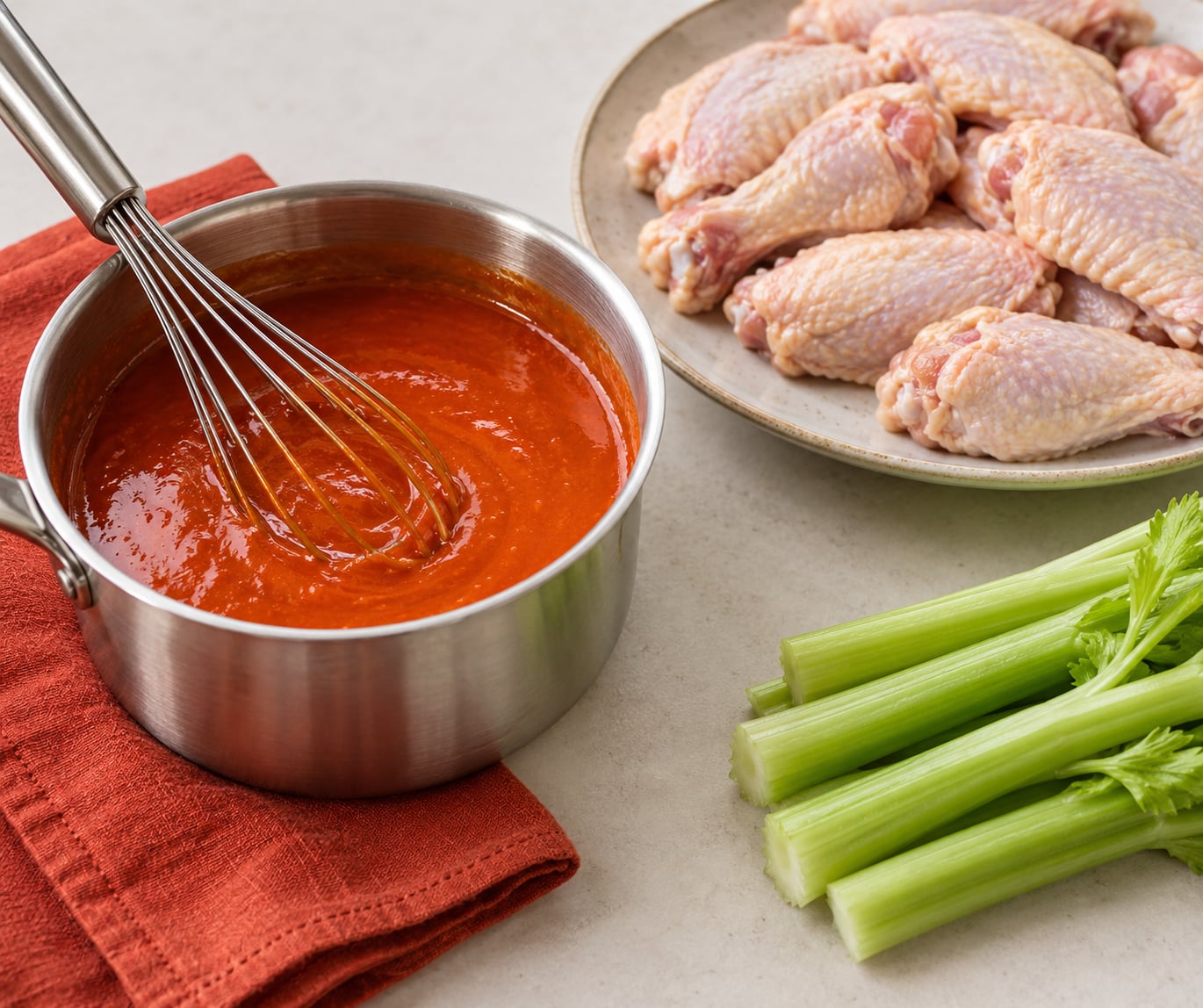
Buffalo wing sauce is cayenne pepper hot sauce whisked with melted butter and sharpened with white vinegar, and it takes about five minutes to make. How you make buffalo wing sauce decides everything: whether it clings to a wing like a restaurant batch or slides straight off into the bottom of the bowl.
I make mine the vinegar-first way, simmering the vinegar and hot sauce together before the butter goes in. That extra two minutes concentrates the acid, so the finished sauce tastes rounder and holds together better than the cold-whisk version most recipes push.
Table of Contents
- What You Need
- Step-by-Step: How to Make Buffalo Wing Sauce
- Common Mistakes
- Frequently Asked Questions
- How can I make Buffalo wing sauce hotter without making it too spicy?
- Can I make Buffalo wing sauce ahead of time?
- How long does homemade Buffalo wing sauce keep in the refrigerator?
- Should I add the butter while the sauce is boiling?
- What can I serve with Buffalo wing sauce besides chicken wings?
- Why is my Buffalo wing sauce greasy or separated?
What You Need
The whole sauce rests on two ingredients: hot sauce and butter. Everything else sharpens it. For a standard batch that coats about two pounds of wings:
- 1/2 cup cayenne pepper hot sauce, Frank’s RedHot Original is the classic choice
- 1/4 cup unsalted butter, cut into cubes
- 1 tablespoon white distilled vinegar
- 1 teaspoon Worcestershire sauce
- 1/2 teaspoon garlic powder
- 1/4 teaspoon cayenne pepper
- 1/8 teaspoon salt, then taste before adding more
- 1 teaspoon honey or agave, optional for a rounder finish
That is a 2-to-1 ratio of hot sauce to butter by volume. Doubling the recipe for a party is straightforward: a full cup of hot sauce and a half cup of butter covers roughly four pounds of wings.
A small saucepan, a whisk and a heatproof bowl are all the tools you need. A whisk beats a spoon here, because it breaks the butter into the hot sauce faster and keeps the emulsion tight. Microplane a fresh garlic clove in at the end if you want more punch than garlic powder gives.
On heat level, the hot sauce brand does most of the work. Frank’s RedHot Original sits at a moderate 5 out of 10 and tastes mostly of vinegar and cayenne. Crystal is cleaner and hotter, closer to an 8. Valentina brings fermented depth and a moderate kick, and Sriracha is sweet enough to read as a different sauce entirely. Tabasco works but leans into vinegar, so it pushes the final sauce more sour than hot.
Two substitutions change the result in useful ways. Swap unsalted butter for a neutral oil and the sauce stays vegan but turns thinner and sharper, closer to a marinade. Swap honey for nothing and the sauce stays low-carb and lets the vinegar lead. Neither is wrong, they just make different sauces.
Step-by-Step: How to Make Buffalo Wing Sauce
How to Make Buffalo Wing Sauce: Mix the vinegar base
Pour the hot sauce, vinegar, Worcestershire, garlic powder, cayenne and salt into a small saucepan. Whisk for about fifteen seconds until the colour is completely even, with no streaks of dry spice sitting on the surface.
You did not heat anything yet, and that is the point. Mixing the seasonings into the vinegar base first means the salt and garlic dissolve rather than hitting the wings in gritty pockets later. If you are making mild buffalo sauce, stir in a teaspoon of honey now, before any heat, because honey needs liquid and time to dissolve.
Simmer the sauce until slightly reduced
Bring the mixture to a bare simmer over medium heat and hold it there for two to four minutes. You are not trying to cook it through, you are reducing the vinegar by roughly a fifth so the acid tastes rounder.
Small bubbles breaking the surface steadily is the sign you want. If the sauce spits and foams hard, your heat is too high; pull it down until it barely moves. Stir once in a while, especially in the first minute, because cayenne settles fast and scorches against the pan bottom, which turns the whole batch bitter.
Finish the sauce with cold butter
Take the pan off the heat and let it sit for sixty seconds. Put the butter cubes in a heatproof bowl, add the hot vinegar base over them, and whisk hard from the centre outward until every cube disappears and the sauce turns glossy.
The butter must meet a mixture that has stopped steaming, not one that is boiling. Boiling liquid and cold fat is the fastest route to a broken, greasy sauce with an oily ring sitting on top. If you have no bowl, set the pan in an ice bath for two minutes first.
Some cooks add a pinch of xanthan gum, or half a teaspoon of Dijon mustard, right before the last few whisks. Both carry active emulsifiers that hold the fat in suspension, so the sauce stays smooth even after it sits in the fridge.
Adjust the heat, salt and thickness
Taste it now, with a wing if you have one, because the sauce is thinner and hotter than it will be in five minutes. Add hot sauce a teaspoon at a time for more heat, or a spoon of melted butter to calm it down.
For thickness, this is the step most recipes skip. Melted butter is liquid fat, so a sauce mixed seconds ago will look thinner than it is. Give it ten minutes on the counter and it firms up on its own, because the butter fat starts to set. If you want it thicker right now, whisk in one more tablespoon of cold butter, a small spoon of cornstarch slurry, or a pinch more xanthan gum.
Toss the wings in a large bowl, pour the sauce over, and fold for about a minute until every piece is coated. Serve it with celery stalks and a cool dip. Ranch and blue cheese are the usual pairings, and if you like something a little sweeter next to the heat, our honey mustard dipping sauce does the same job on a different note.
If the sauce keeps splitting no matter what you do, a store-bought burger sauce base behaves well as a thickener. The five-minute burger sauce method uses the same whisk-and-emulsify logic, so the technique transfers directly.
Common Mistakes
Boiling the vinegar base. A hard boil scorches the cayenne and drives off the aromatics, leaving a bitter sauce that thins as it cools. Keep it at a lazy simmer with tiny bubbles for two to four minutes and stir near the start.
Adding butter while the pan is still hot. This is the number one reason home cooks report oily, separated sauce. Fat dropped into near-boiling liquid cannot emulsify, so it pools. Sixty seconds off the heat solves it.
Judging the thickness too early. Freshly mixed buffalo sauce always looks runnier than the finished version because the butter has not set yet. Wait ten minutes before you add thickener or decide the batch failed.
Reaching for extra hot sauce to fix flat flavor. It makes the sauce hotter without making it better. Add acid, salt or butter instead, and you get depth rather than pain. One of the recurring debates on cooking forums is whether Frank’s is the only valid choice, and the honest answer is that any vinegar-forward cayenne sauce works once you adjust the salt.
Over-salting. Bottled hot sauce already carries salt, and vinegar amplifies it. Start with the eighth teaspoon, taste, then add more. You cannot take salt back out, but you can stretch the batch with a spoon of hot sauce.
Leaving the acid unbalanced. If the finished sauce tastes only hot and rich with no brightness, add a few drops of vinegar. If it tastes sharp with no body, a tablespoon of butter fixes it in seconds. People who want a different flavor profile entirely often start from our comeback sauce copycat recipe and then hot it up.
Store the sauce in an airtight container in the fridge for up to a week, or freeze it in a freezer-safe container for a few months. From the fridge it goes straight into a small saucepan over low heat, whisking until it comes back together, and a splash of hot sauce or water brings it back to dipping consistency. Whisk it again after thawing, because the butter separates a little on the way down.
Frequently Asked Questions
How can I make Buffalo wing sauce hotter without making it too spicy?
Add heat with a second hot sauce rather than more of the same. A tablespoon of Crystal or Valentina stirred into a finished batch raises the temperature without pushing the vinegar edge that makes Frank’s alone feel sharp. You can also add a quarter teaspoon of cayenne pepper or a pinch of chili powder. Taste between additions, because a tablespoon more vinegar can tame the whole bowl in seconds.
Can I make Buffalo wing sauce ahead of time?
Yes, and most people should. The sauce keeps in an airtight container in the fridge for up to a week, which makes it a good make-ahead item for a wing night. Make it a day or two ahead so the flavors have time to settle and marry. Reheat a serving in a small saucepan over low heat, whisking until smooth, and thin it with a splash of hot sauce if it tightened up in the fridge.
How long does homemade Buffalo wing sauce keep in the refrigerator?
About a week is the safe window for a homemade batch made with butter and vinegar, stored in an airtight container and kept at or below 40°F. Use a clean spoon rather than dipping a wing back into the jar, since that is what introduces the bacteria that shortens the life. In a freezer-safe container it holds for a few months, then needs a quick whisk after thawing.
Should I add the butter while the sauce is boiling?
No. Butter needs a hot but not boiling liquid to emulsify. If you pour cold butter cubes into a rolling boil, the fat cannot disperse and you get the greasy separated sauce people complain about most. Take the pan off the heat, wait about sixty seconds for the bubbling to calm down, then whisk the butter into the vinegar and hot sauce base until the mixture turns glossy.
What can I serve with Buffalo wing sauce besides chicken wings?
Buffalo cauliflower, air fryer wings and oven-baked wings are the obvious three, but the sauce works on plenty more. Try it on tofu, sweet potato fries, crispy pork rinds, shrimp, black bean burgers, smoked macaroni balls or a flatbread pizza. Celery stalks and carrot sticks belong on the table for the crunch. A cool blue cheese dressing or a tangy slaw cuts the heat better than ranch does.
Why is my Buffalo wing sauce greasy or separated?
Two causes cover almost every case. First, the butter went in while the liquid was still too hot, so the fat pooled instead of emulsifying. Second, the sauce sat for hours without anything holding it together. To fix a broken batch, warm it gently in a saucepan and whisk hard, or start again with a tablespoon of cold butter whisked into the warm sauce. A pinch of xanthan gum or half a teaspoon of Dijon stops it splitting next time.
Start with half a cup of hot sauce and a quarter cup of unsalted butter, simmer the vinegar base for three minutes, then whisk the butter in off the heat. Taste it, wait ten minutes before you judge the thickness, and toss it through your wings while it is still glossy.