
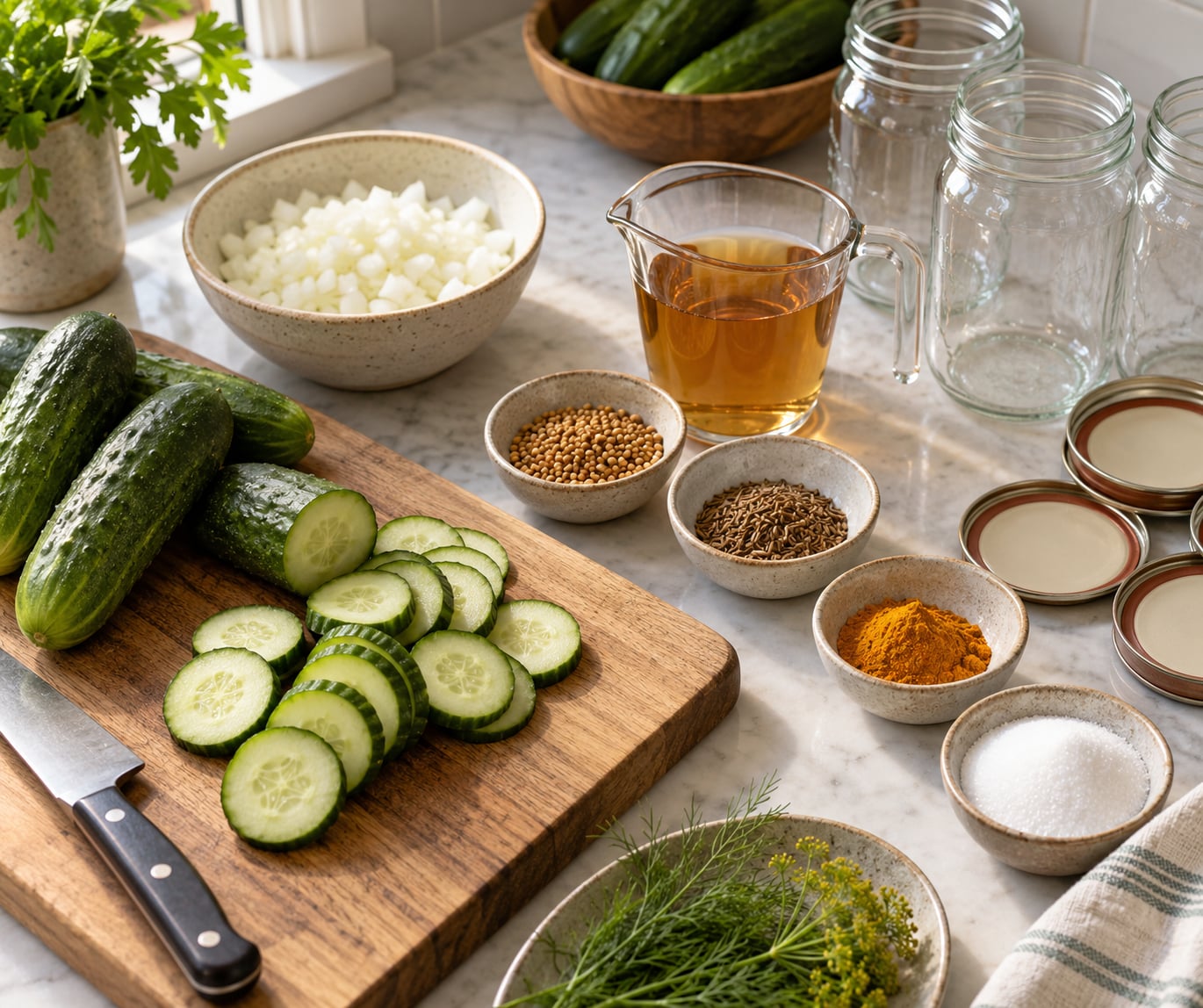
How to make sweet pickle relish at home: salt chopped cucumbers for 3 hours, drain them, then simmer them briefly in a hot brine of vinegar, sugar, mustard seed and celery seed. Pack it into jars and either refrigerate it or water-bath can it. It takes about half an hour of actual work plus the salt cure, and the crunch is worth the wait.
Store-bought sweet relish is mostly sugar, corn syrup and yellow dye, and it arrives already soft. Homemade relish is the opposite: sharp vinegar up front, a clean snap when you bite it, and no preservatives at all. You also decide how sweet it is, which is the one thing nobody lets you do from a jar.
The batch below makes about 5 pints (roughly 2.4 kg / 5 lb of prepared relish) from about 3 kg of raw cucumbers. Pickling cucumbers work best, but any firm, seedless slicing cucumber will do. Stay away from English cucumbers with the wax coating, and skip the seeded slicers, which go soft fast.
What You Need
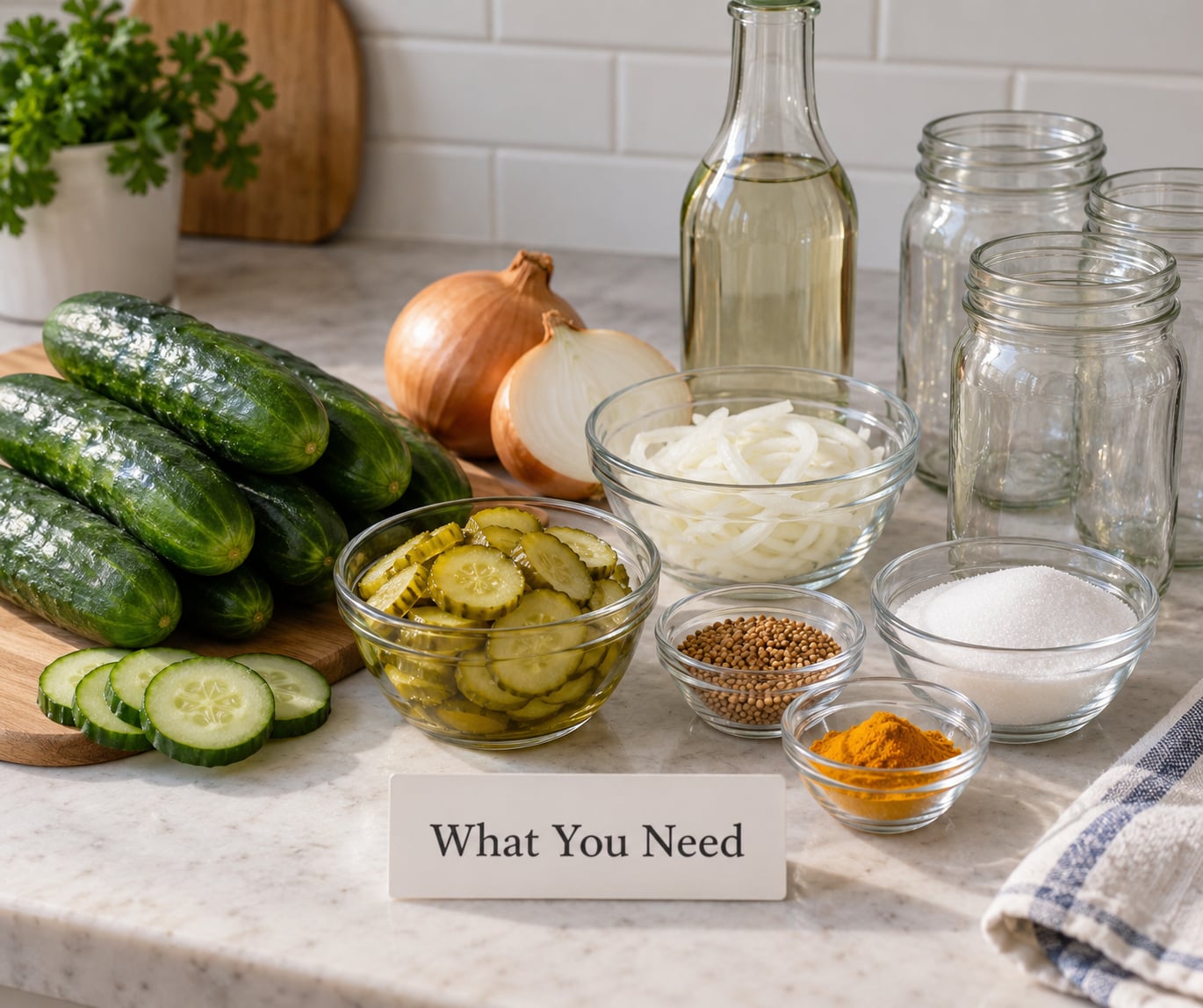
Here is the ingredient list for one large batch. Quantities are given US first, metric second.
- 7 cups diced pickling cucumbers (about 1.5 kg / 3 lb, unwashed)
- 1 cup diced sweet onion (150 g)
- 1 red bell pepper, diced (about 150 g)
- 1 green bell pepper, diced (about 150 g)
- 1/2 cup pickling or kosher salt (75 g), divided
- 2 cups cider vinegar at 5 percent acidity (470 ml)
- 3 to 3 1/2 cups granulated sugar (680 to 800 g)
- 2 tablespoons mustard seed
- 2 tablespoons celery seed
- 1/2 teaspoon turmeric, optional, for color
- 2 cups cold water for the salt cure
Ice is better than tap water for the cure. Use about 4 cups (1 litre) of ice cubes, which is what pulls the water out of the cucumbers fastest and gives you the crispest result.
Two ingredients decide the whole recipe. The vinegar must be 5 percent acidity, and the salt must be pickling or kosher salt, never plain iodized table salt. Iodized salt has additives that turn cloudy and bitter over time. If you only have table salt, use half the amount by weight and accept a slightly softer result.
For the flavor dial, start at 3 cups of sugar and taste the finished relish after 24 hours. Some cooks use less than 2 cups and lean on the vinegar; others go to 4 and make a dessert-like relish. Adding a tablespoon of pickling hot sauce or a sliced jalapeno shifts the whole thing warm instead of sharp.
Equipment is simple: a large nonreactive pot, a sharp knife, a fine-mesh sieve or a colander lined with cheesecloth, and jars if you are canning. A kitchen scale is not required, but a cheap one saves guesswork, because pickling salt by volume packs differently than people expect.
A food processor will make this job faster and the results worse. Pulsing crushes the cell walls and the cucumbers turn to mush during the simmer. Hand chopping is about ten extra minutes and buys you the texture that defines good relish. If you want to move faster, use a dice attachment and pulse in single bursts rather than grinding continuously.
Step-by-Step
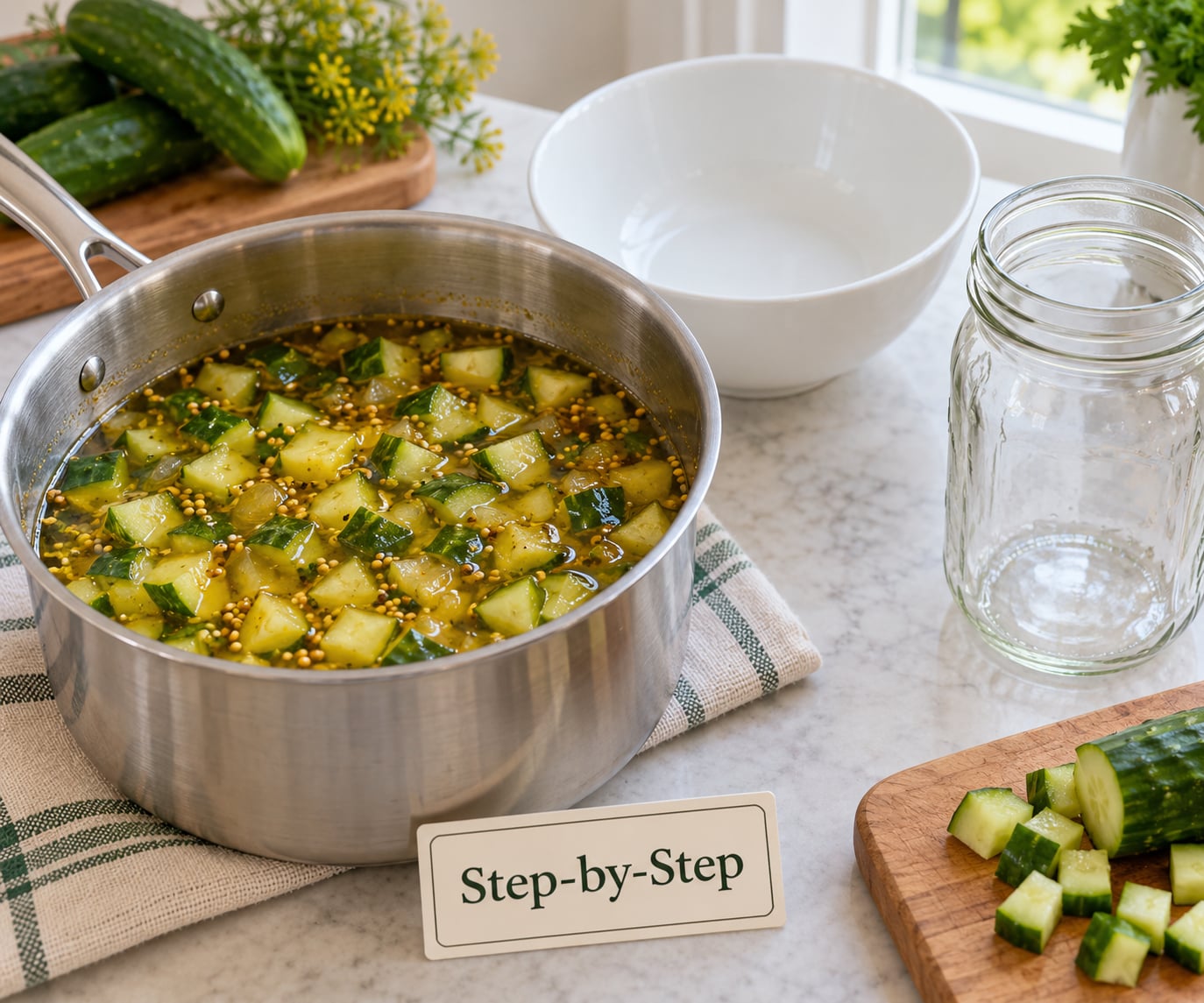
Follow these stages in order. The salt cure comes first and nothing else happens until it finishes.
1. Salt the cucumbers
Combine the diced cucumbers, onion and both bell peppers with 1/4 cup (36 g) of the pickling salt in a large nonreactive container. Nonreactive means stainless steel, glass or enamel, never aluminum or copper, which react with vinegar and dull the flavor.
Pack the mixture down, pour in enough ice water to cover it completely, then weigh it down with a plate or a clean weight so everything stays submerged. Cover and refrigerate for 3 hours, or up to 12 hours if you want a stronger pickle flavor.
2. Drain and rinse
Dump the vegetables into a fine-mesh sieve and rinse under cold running water until the salt is gone. Taste one raw cube. It should taste like a pickle, not like a salt block.
Let the vegetables drain for 15 minutes. Do not squeeze them dry, since squeezing releases more water than you remove and leaves you with limp cucumber.
3. Boil the syrup
Pour the vinegar, sugar and remaining 1/4 cup (36 g) of salt into the pot. Add the mustard seed, celery seed and turmeric. Bring to a boil over medium-high heat, then reduce the heat and simmer for 5 minutes so the sugar fully dissolves.
The brine should thicken noticeably and start to smell like candy rather than vinegar.
4. Add the vegetables and simmer
Stir in the drained cucumbers, onion and peppers. Bring back to a boil, then simmer gently for 25 to 30 minutes, stirring every few minutes so nothing catches on the bottom.
The mixture looks thinner than you expect at this stage. It sets as it cools, because the sugar and pectin thicken the liquid when the heat drops. Canners complain about this every year and it is normal.
5. Fill the jars
Bring the jars and lids to a simmer in clean water. Ladle the hot relish into hot jars, leaving 1/2 inch (1.25 cm) of headspace. Wipe each rim with a clean damp cloth, set a hot lid on top and screw a band on just until it stops.
Keep the jars hot while you work. Food safety guidance from the National Center for Home Food Preservation is clear on this point, so read it before a first attempt rather than after.
6. Process or chill
If the jars are going in the pantry, put them in a water bath canner or a deep pot with a lid, add boiling water to cover the jars by 1 to 2 inches, and boil hard for 10 minutes at sea level for pints and smaller jars, or 15 minutes for quarts. Above 1,000 feet (305 m), extend to 15 minutes; above 3,000 feet (915 m), use 20 minutes.
Remove the jars and let them cool undisturbed for 12 to 24 hours. Press each lid in the center. A flat, tight lid means a good seal. Then turn the jar upside down and shake it; liquid moving means it failed.
If the jars are going in the fridge, skip the boiling water entirely, cool the relish first so you are not putting boiling liquid into a warm glass jar, then cover and refrigerate.
The relish lands on burgers, hot dogs and brats, which is why I keep a jar going most of the summer. If you want a full burger build, my guide to double cheeseburgers at home pairs well with it. And for a quick refrigerator version, there is a fast shortcut below.
How to Keep the Cucumbers Crunchy
Crunch comes down to four things, and every mushy batch I have seen broke at least one of them.
Chop with a sharp knife into even 1/4-inch pieces. Uneven dice means the small bits turn to paste before the large ones soften. Keep the cucumber skin on; the peel is a large part of what stays crisp and it holds the bright green color that peeling destroys.
Do not overcook once the vegetables go in. Thirty minutes of gentle simmering is the ceiling, and a low simmer is not the same as a rolling boil. Vigorous heat plus a long simmer turns cucumber to silk.
Time the vinegar right. Adding the drained vegetables to boiling syrup shocks them, which softens the outsides before the middle cooks. Pull the syrup back to a simmer before the vegetables go in.
Cool things separately when you are making a refrigerator batch. Hot relish covered and refrigerated traps steam against the surface, and that trapped moisture is the single most common reason homemade relish turns watery within a day.
If cucumbers have already gone limp in your brine, an ice-water soak for 15 minutes buys back some snap. Canners on r/Canning use that trick on soft pickles with decent results.
How to Make the Relish More or Less Sweet
Treat sugar as a range, not a number. Start with 3 cups (680 g) for a balanced result and go up to 3 1/2 cups only if you want the thick, syrupy profile that sits like candy on a hot dog.
The vinegar does the opposite work. More vinegar sharpens the flavor, cuts the sweetness and thins the finished relish, so if you add 1/4 cup extra, expect a looser jam and a brighter bite.
Taste too early. The brine sharpens as it sits in the fridge, so relish that tastes flat at hour one often lands right around day seven. Canners on r/food generally suggest tasting at 48 hours before you add more sugar.
To rescue a batch that is too sweet, dilute it rather than adding more vinegar. Mix in equal parts finely diced fresh cucumber and a splash of the pickling liquid, then refrigerate it. Two or three days of rest flattens the sugar without erasing the cucumber.
To fix a relish that tastes flat, it is almost always missing acid or salt, not spice. A tablespoon of cider vinegar and a teaspoon of pickling salt usually solves it.
Canning and Storage
Decide fridge or pantry before you start, because the two paths diverge at the very last step.
Refrigerator relish has no processing step, so it is not shelf stable and it never becomes so. Treat it like any other homemade pickle. It keeps its best flavor for 3 to 4 weeks and is generally considered safe for 2 to 3 months when kept consistently cold.
Water-bath canned relish is shelf stable, provided you used a tested recipe, 5 percent acidity vinegar, and a full processing time for your jar size at your altitude. Expect about 12 months of good color and flavor, with the seal holding a year or longer in a cool dark pantry.
Here is how the jar sizes and sea-level processing times line up for this batch:
- 8 oz (240 ml) jar: 10 minutes water bath at sea level, about one serving-sized jar per batch.
- 12 oz (350 ml) jar: 10 minutes at sea level, about one appetizer jar per batch.
- 16 oz pint (470 ml): 10 minutes at sea level, about 4 pints per batch.
- 32 oz quart (950 ml): 15 minutes at sea level, about 2 quarts per batch.
Treat those figures as a starting point and confirm them against the tested recipe you are following, since tested recipes are the authority rather than any single page on the internet. Never improvise ratios on a canning recipe.
Check the seal 12 to 24 hours after processing. Any jar with a lifted, leaking or soft lid goes straight into the fridge and gets used first, and it never goes back into the pantry.
Discard relish that has mold on top, a fizzy or swollen lid, an off smell, or a slimy liquid. When in doubt, throw it out. Botulism is not worth the gamble over a batch of condiments.
If you want to hand jars out as gifts, canning is not optional, since a shelf-stable seal is the whole point. For the batch sizes that works well with, see how to make sliders at home for a reason to put a jar on the table.
Common Mistakes
Watery relish at ladling time. This is the big one, and it is usually not a failure. The mixture looks thin while hot and thickens as it cools. Let it sit undisturbed for 24 hours before you judge it, and if it is still loose at packing time, simmer it five more minutes with the heat off at the end.
Mushy cucumber. Almost always a food processor or an over-long boil. Chop by hand, keep the peel on, and cut the simmer short at 30 minutes. If it already happened, the texture will not come back, but the flavor still works as a burger topping.
Relish that tastes too sweet. Give it time, then dilute with fresh diced cucumber and a splash of brine rather than reaching for more vinegar, which makes it thin and sharp at once. Starting at 3 cups of sugar instead of 3 1/2 solves it next time.
Gray or dull cucumbers. Peeling is the usual culprit, and so is a long soak in hot brine. Leave the skin on, cut close to the last minute before simmering, and skip the turmeric unless you want the yellow-gold color of commercial sweet relish.
Bland seasoning. Mustard seed and celery seed need hot liquid to bloom. Add them with the brine rather than at the end, and give the mixture 15 minutes of storage before you decide it needs more salt.
Failed seal. Usually under-filling headspace or wiping the rim properly. Leave a full 1/2 inch, wipe with a vinegar-soaked cloth, and tighten the band with light pressure. Over-tightening is just as common and pushes food into the seal.
Storage mistakes, which include leaving a fridge batch out for hours, stacking jars in the pantry without checking for seal failure, and assuming a processed jar keeps its quality forever. Label each jar with the date, and check it before you use it.
On serving, keep a thin layer rather than a thick one on the burger. Relish that overpowers the patty is a waste, and it is why I mix a little mustard into it. If you want the sauce version instead, my home burger sauce recipe takes about five minutes and does the same job for hot dogs and fries.
For the quick refrigerator version, chop 2 cups of drained sweet pickles from a jar, 1/2 cup of finely diced onion and 1/4 cup of diced green pepper, simmer in 1/2 cup of vinegar and 1/3 cup of sugar for 15 minutes, then cool and refrigerate. Twenty-five minutes start to finish, no jars, no heat processing, about two weeks of good eating.
Frequently Asked Questions
Can I just chop up pickles to make relish?
You can, and it is the fastest version there is. Finely chop 2 cups of drained sweet pickles, mix in diced onion and green pepper, then simmer them in a short vinegar and sugar syrup for 15 minutes before cooling and refrigerating. It tastes good and it is not the same as the fresh-cucumber method, which stays crunchier and lets you control the salt.
How long does pickle relish last in the refrigerator?
A refrigerator batch keeps its best flavor for 3 to 4 weeks and is generally considered safe for 2 to 3 months when kept consistently cold. Canned relish lasts far longer, roughly 12 months for peak color and flavor. Taste before serving, and discard anything with mold, a fizzy or swollen lid, a slimy liquid or an off smell.
Does sweet relish have to be refrigerated?
Only if you skipped the boiling water step. Water-bath processed jars that show a complete seal are shelf stable and can sit in a cool dark pantry. Any jar without a good seal, and every refrigerator-only batch, has to stay cold. When in doubt, refrigerate it, since cold is always the safer place for an unprocessed jar.
How many cucumbers do I need for a batch of relish?
About 3 kg of raw pickling cucumbers, roughly 7 cups once diced, fills a large batch that yields about 5 pints. Small slicing cucumbers work too, just make sure they are firm and unwaxed. English cucumbers with the wax coating and heavily seeded slicers both turn soft, so pick firm fruit for a relish you want to stay crunchy.
Why is my homemade pickle relish watery?
Most often it is not watery yet. Hot relish looks thin because the sugar and pectin need time to set, and the mixture thickens noticeably over 24 hours. If it is still loose after cooling, simmer it a few more minutes. Other causes are squeezing the drained cucumber and covering hot relish in the fridge, which traps steam against the surface.
Conclusion
The salt cure decides everything else, so measure the pickling salt, weigh the cucumbers down under ice water and give it the full three hours. From there the recipe is a 5-minute syrup and a 30-minute simmer, and the result is a relish that tastes sharp first and sweet after, with a cucumber crunch that survives the jar.
Before you pack it, drain the vegetables accurately and taste the sweet-and-sour balance once they are hot. Jar only what you like, and refrigerate anything you have not water-bath processed.