
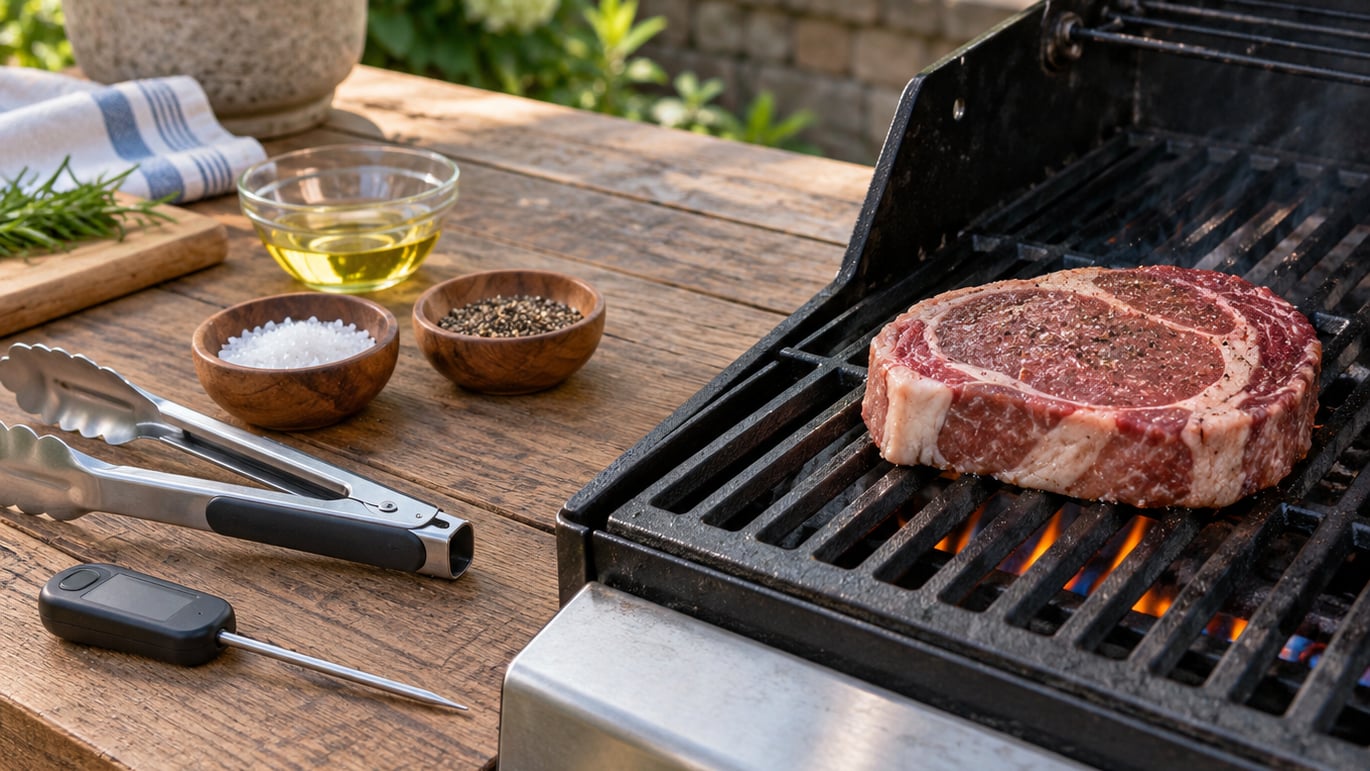
Learning how to grill steak on a gas grill is mostly a matter of setup: two zones, one screaming hot for the sear, one moderate for finishing the steak to temperature. A 1 to 1.5 inch steak needs about 10 to 14 minutes on the grill plus 5 to 10 minutes of rest, and it lands reliably on medium-rare every time. Here is the method I use in my own backyard, written out step by step.
What You Need
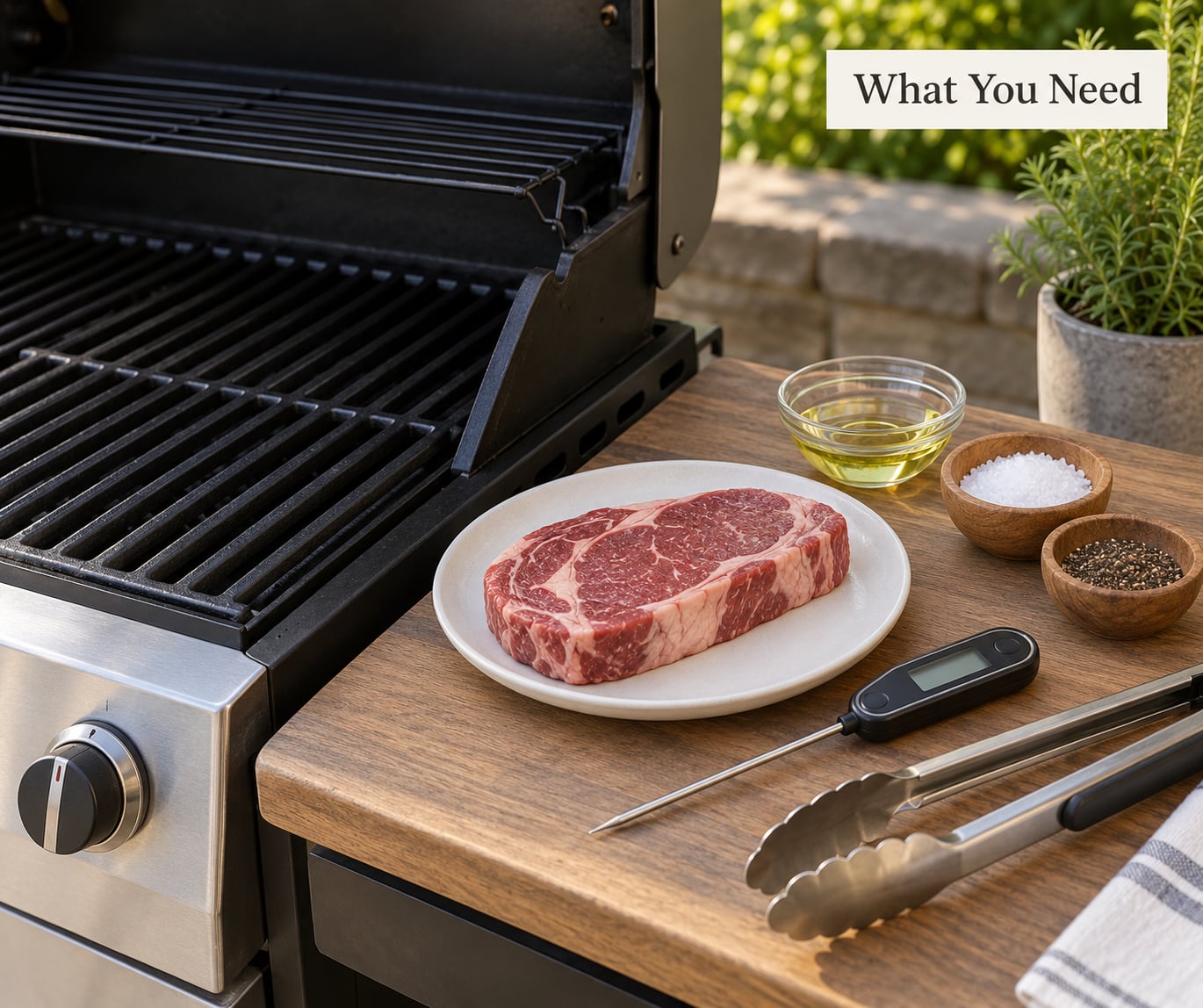
A gas grill, a thermometer, and a steak at least 1 inch thick. Everything else is helpful but not critical.
- A gas grill with at least one main burner and either a second burner or a side burner for the indirect zone.
- An instant-read thermometer. This is the one tool that separates a good steak from a guess. Leave it within arm’s reach of the grate.
- Tongs with scalloped tips for turning, plus a heatproof plate or small tray for resting.
- A neutral oil such as grapeseed, canola, or avocado. Olive oil burns at searing temperatures, so it does not belong on the grill grates.
- Kosher salt and coarsely ground black pepper. Fine salt works, but kosher salt gives you better texture at the same measured volume.
- A 1 to 1.5 inch steak. Ribeye, New York strip, sirloin, or filet all work. Thinner than 1 inch and you will spend most of your time chasing a window between burned and raw.
If you want to go beyond salt and pepper, a dry brine the night before is the single biggest upgrade you can make. Salt the steak on both sides, leave it uncovered in the fridge for 4 to 12 hours, and blot the surface dry before it hits the heat.
Step-by-Step: How to Grill Steak on a Gas Grill
Five steps, in order. Skip ahead and the results get worse.
1. Choose the Steak and Set Up Two-Zone Heat
Pick a steak at least 1 inch thick, and let thick cuts come to room temperature for 20 to 30 minutes before cooking. A cold thick steak spends so long heating through that the outer crust turns gray and leathery before the center gets anywhere near done.
Food safety note: room temperature means room temperature, not all afternoon. Leave raw steak out no more than 2 hours, or 1 hour if the air is above 90°F.
Then split the grill. Light one burner and set it to high, and leave the other side off or on low, with the indirect zone sitting around 375°F. That gives you a searing zone and a gentle zone at the same time. Our guide to setting up two-zone heat walks through the burner math if your grill has three or more burners.
2. Preheat the Gas Grill and Prepare the Steak
Preheat with the lid closed for 15 to 20 minutes on high. Gas grates hold heat differently than charcoal, and the grates themselves need to be fully preheated before anything touches them.
Verify with a laser thermometer if you have one, aiming at the grate surface: 500 to 550°F for searing. If you only have the small dome thermometer on the lid, expect it to read high or low and treat it as a rough guide rather than a fact.
While the grill heats, pat the steak completely dry with paper towels. Moisture is the enemy of browning, because the steak has to spend energy boiling off water before the surface can exceed 350°F and start the Maillard reaction that builds a crust.
Season both sides generously with salt and pepper immediately before it goes on the grill. Oil the grates with a folded paper towel held in tongs, not the steak. For the olive oil question: a light coating on the meat can encourage sticking and burns at high heat, so skip it unless the steak is very lean and dry.
3. Sear the Steak Over Direct Heat
Place the steak on the hot zone with the lid closed and leave it alone. A 1 inch steak needs 2 to 3 minutes per side for a solid sear.
Do not press it, do not flip it every 30 seconds, and do not move it around the grate. Each release and re-place resets the crust that was forming, and you get grill marks without a sear.
You are looking for an even deep brown crust, not black char. Char is burned fat, and it adds bitterness rather than flavor. Once the surface no longer looks wet and translucent and releases from the grate with a light nudge, turn it.
4. Move the Steak to Indirect Heat and Check Doneness
After searing both sides, move the steak to the cooler zone, close the lid, and let it finish there. This is where a two-zone setup earns its keep: the crust stops burning while the center catches up.
Start checking temperature early and check often. Insert the probe into the thickest part of the steak, aiming from the side so the tip stays in the meat rather than touching bone or the grate. Pull the steak 5°F below your target, because carryover cooking will add another 5°F or so while it rests.
| Doneness | Pull at | Final temp after rest | How it looks |
|---|---|---|---|
| Rare | 120°F | 125°F | Deep red center, cool and glossy |
| Medium-rare | 125°F | 130°F | Warm pink center with a red edge |
| Medium | 135°F | 140°F | Pinkish tan center, firm to the touch |
| Medium-well | 145°F | 150°F | Mostly tan with a hint of pink |
| Well-done | 155°F | 160°F | Uniform brown throughout |
Whole cuts of beef should reach at least 145°F internal temperature for safety. That is the floor for rare steak, not a target for every piece, and doneness is a matter of taste on top of it.
5. Rest, Slice, and Serve the Steak
Rest the steak 5 minutes for anything under 1.25 inches and 10 minutes for thicker cuts. Resting is not about “letting the juices settle,” which is a myth. It is about letting the heat move from the hot outer layers toward the cooler center, so slicing it releases less liquid onto the board.
Slice against the grain. Look at the raw steak before cooking and find the direction the muscle fibers run, then cut perpendicular to them at a slight angle. On a ribeye the grain swirls around the eye, which makes the technique more obvious than it is useful. Flank and skirt steak benefit most because the fibers are long and obvious.
Common Mistakes When Grilling Steak
- Grilling a cold steak hard. The outside overcooks before the middle cooks. Let thick cuts warm up first.
- Using one temperature for the whole steak. Sear hot, finish moderate. One burner set on high for the entire cook burns the outside while the center stays cool.
- Pressing or constantly flipping. Both squeeze out moisture and prevent a crust from forming. One turn per side is enough.
- Seasoning too early. Salt applied an hour or more ahead draws moisture to the surface, unless you are deliberately dry brining. Season right before grilling.
- Skipping the thermometer. Color is a poor proxy for doneness. A steak can look medium and read rare, especially in a thick cut.
- Resting too briefly. Cutting straight off the grill dumps the juice on the board. Ten minutes costs nothing.
- Slicing with the grain. Correctly cooked meat will feel noticeably tenderer when cut across the fibers.
The most common complaint I hear from home cooks is a gray ring under the crust with a raw center. That band is muscle that spent too long in the slow zone without enough time in the hot zone to cook through. Fix it by searing longer per side, or by finishing the steak on the direct side for the last minute.
Tips for Juicy Steak on a Gas Grill
- Map your hot spots once. Lay a piece of bread or hold your hand near the grate and find where it heats fastest. Place tough or thin cuts over that area and thicker steaks away from it.
- Keep the lid closed during indirect cooking. Every opening drops the temperature, and you will extend the cook by a minute or more.
- Handle flare-ups instead of fleeing. Move the steak to a cooler spot or let it sear for 20 seconds through the flame. Our flare-up guide has the full technique.
- Trim the fat cap. The thick fat along the edge of a strip steak burns before the meat cooks. Leave a thin layer, no more than a quarter inch.
- Finish with butter if you want. Add a knob of butter to a small pan on the side burner in the last minute for a basting sauce. It is not part of the basic method.
- Adjust to the steak, not the clock. A steak taken from a warm cooler cooks faster than one straight from a fridge. Use the ranges in the table below as a starting point only.
| Thickness | Direct heat per side | Then indirect, lid closed |
|---|---|---|
| 0.5 inch | 1 to 2 minutes | Almost none, check temperature often |
| 1 inch | 2 to 3 minutes | 3 to 5 minutes |
| 1.25 inch | 3 to 4 minutes | 4 to 6 minutes |
| 1.5 inch | 4 to 5 minutes | 5 to 7 minutes |
| 2 inch | 5 to 6 minutes | 8 to 12 minutes |
If you are weighing fuel and flavor, charcoal and gas compared side by side makes the case that gas wins on control and loses on smoke flavor. For steak, control usually matters more.
Frequently Asked Questions
What temperature should a gas grill be for steak?
Preheat to 500 to 550°F measured at the grate surface with the lid closed, which usually takes 15 to 20 minutes. Use high heat only for the sear. Move the steak to a side with a burner off or on low, around 375°F, to finish without burning the crust.
How long do you grill a 1-inch steak on a gas grill?
About 2 to 3 minutes per side over direct heat for the sear, then 3 to 5 minutes on the indirect side with the lid closed. Check with a thermometer and pull 5°F below your target, since the steak keeps cooking as it rests. Timing varies with the cut, the starting temperature, and how hot your actual grates are.
Should I use two-zone heat when grilling steak?
Yes, and it is the single technique that most improves a home-grilled steak. One hot zone gives you a fast sear without burning, and one cooler zone lets the center catch up while the crust stays put. It also gives you a place to put the steak when a flare-up gets out of control.
What internal temperature is safe for steak?
Whole cuts of beef should reach at least 145°F measured at the thickest part with an instant-read thermometer. That is the safety floor for a rare steak, not a prescription for every steak. Ground beef needs 160°F. Many cooks pull steaks 5°F under their target because carryover cooking adds more heat during the rest.
Why is my steak burning outside but raw inside?
Two causes cover most cases: the steak went on cold and too thick, or it spent too long on a moderate zone without enough time over direct heat. Let thick cuts reach room temperature for 20 to 30 minutes, extend the sear by a minute per side, and check the internal temperature with a thermometer instead of guessing from the crust.
How do I stop a steak from sticking to a gas grill?
Pat the steak dry, make sure the grates are clean and fully preheated, and oil the grates with a paper towel held in tongs rather than oiling the meat. A wet steak sticks because it has to boil off moisture before browning. If it still sticks, it is usually because the grate was not hot enough when the steak landed.
Conclusion
Start here: preheat the grill with the lid closed for a full 15 to 20 minutes, light one burner and leave the other off to create two zones, pat the steak dry, and season it right before it hits the grate. Then trust the thermometer instead of the color. Once you get that sequence down, the gas grill stops being the weak link in the kitchen and starts producing the steaks you order at restaurants.