
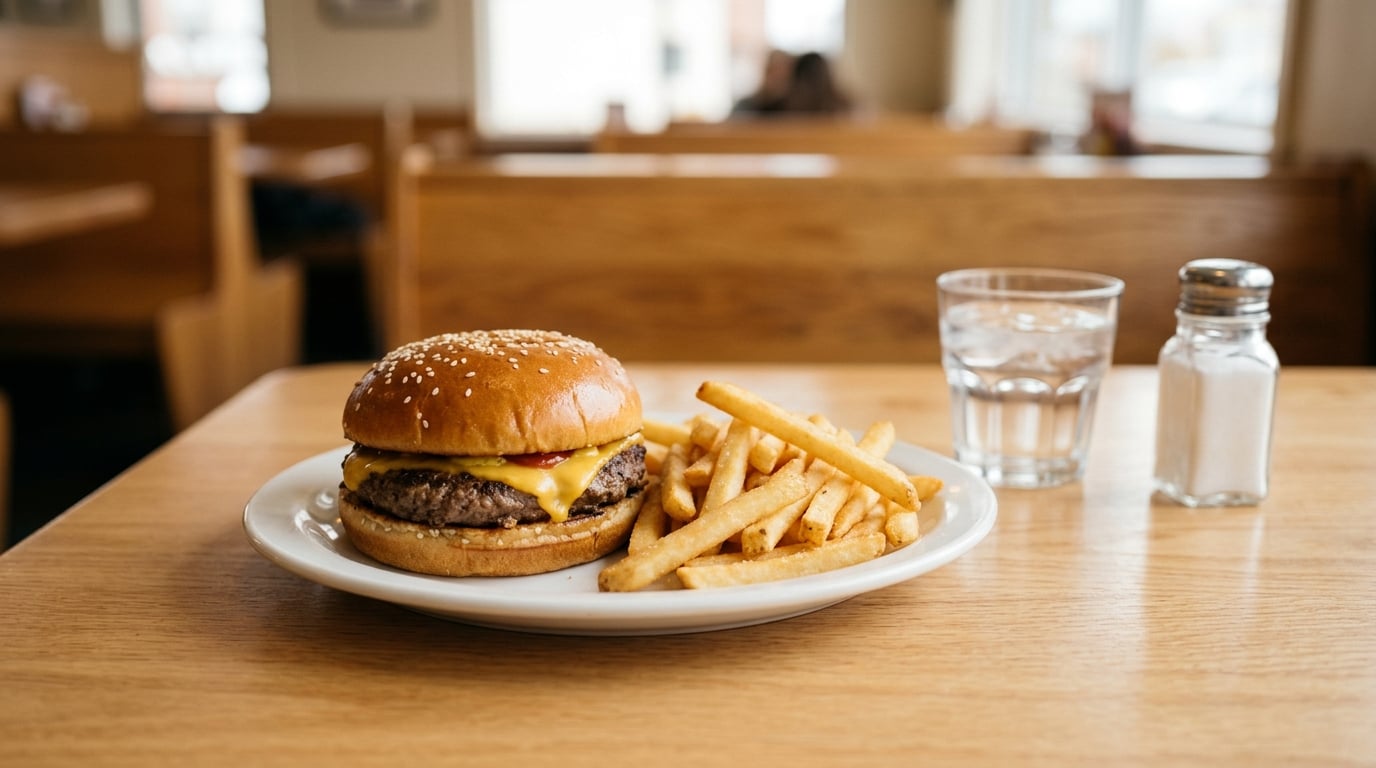
Short answer: how many calories are in a cheeseburger with fries? Roughly 800 to 1,000, before any drink. That is one beef patty, one slice of cheese, a standard bun, and about 45 fries. The catch is that both halves of that plate scale with the restaurant, so the same order can land under 700 calories at a drive-thru or well past 1,300 at a sit-down place.
Below is the working I use when there is no nutrition page to check: what each component costs, which four variables move the number most, how to estimate a burger nobody has published data for, and where the calories come out.
Table of Contents
- How Many Calories Are in a Cheeseburger with Fries?
- Typical Calories by Part of the Meal
- What Changes the Total?
- How Much of a 2,000-Calorie Day Is That?
- How to Estimate a Restaurant Meal
- Ways to Lower the Calories
- Frequently Asked Questions
- How many calories does a fast-food cheeseburger with fries contain?
- Are cheeseburger calories mostly from the fries or the burger?
- How many calories are in a medium serving of fries?
- How can I reduce calories without giving up my cheeseburger and fries?
- Does a cheeseburger with fries count as a high-calorie meal?
- How do restaurant portion sizes affect the calorie total?
How Many Calories Are in a Cheeseburger with Fries?
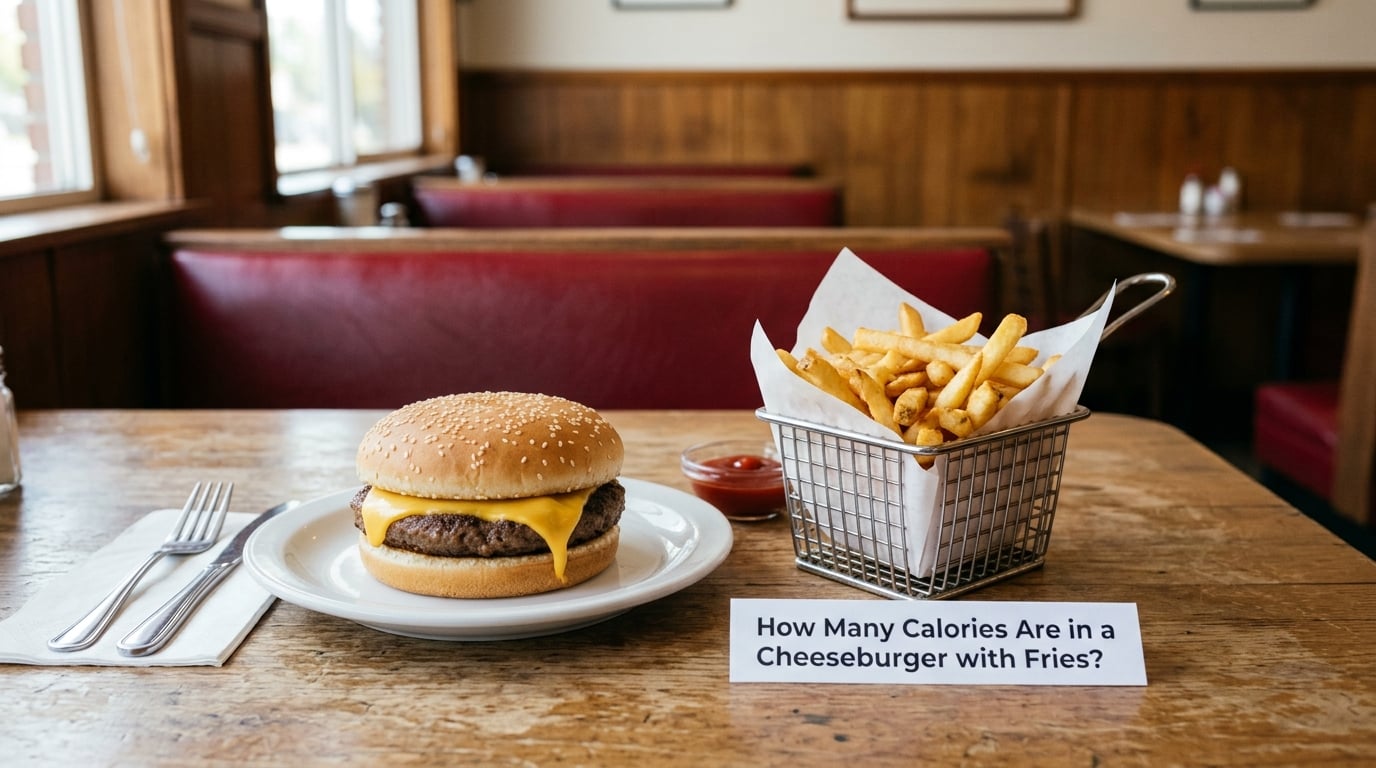
A cheeseburger with fries ranges from about 620 calories for a small fast-food order up to 1,500 or more for a loaded, restaurant-style plate. Most people asking the question are picturing something in the middle, and that middle sits between 800 and 1,000.
Published figures for specific full orders show how far the range stretches. A chili cheeseburger with fries at Original Tommy’s is listed at 1,210 calories, and the double version at 1,390. A bacon cheeseburger and fries order at Friendly’s is listed at 1,220, and the Breakfast Deluxe Cheeseburger with fries at Ben & Florentine comes in at 1,660.
Those numbers all come from nutrition databases rather than the kitchens themselves, and database entries for a named chain item rarely match what the plate in front of you looks like. Treat any single figure as a rough tracking number, not a fact. A plus or minus 10 percent variance is the honest way to read all of them.
Add a drink and everything moves again. A medium fountain soda adds roughly 200 to 250 calories, a milkshake can add 300 to 500, and that is on top of food most people already think of as the whole meal.
Typical Calories by Part of the Meal
Build the total from the parts and it stops being a guess. These are typical per-component figures drawn from restaurant nutrition panels and published menu breakdowns.
| Component | Typical serving | Calories |
|---|---|---|
| Beef patty, fast-food style | About 3 oz | 230 to 280 |
| Beef patty, larger restaurant style | About 6 oz | 400 to 550 |
| American cheese | 1 slice | 50 to 70 |
| Hamburger bun | Standard | 120 to 160 |
| Brioche or buttered bun | Standard | 200 to 280 |
| Mayonnaise or house sauce | 1 to 2 tbsp | 90 to 200 |
| Ketchup, mustard, relish | 1 tbsp total | 15 to 30 |
| Lettuce, tomato, onion, pickles | Standard garnish | 10 to 20 |
| Small fries | About 25 fries | 250 to 320 |
| Medium fries | About 40 to 45 fries | 320 to 400 |
| Large fries | About 55 to 60 fries | 390 to 500 |
| Medium fountain drink | About 16 oz | 200 to 250 |
Now stack those into totals. A fast-food single cheeseburger is usually about 300 to 350 calories on its own, so the same burger pairs with any fry size and stays under 850.
| Fry size | With a fast-food burger | With a larger restaurant burger | Plus a medium drink |
|---|---|---|---|
| Small | 550 to 670 | 700 to 870 | 750 to 1,120 |
| Medium | 620 to 750 | 770 to 1,050 | 820 to 1,300 |
| Large | 690 to 850 | 840 to 1,150 | 890 to 1,400 |
Two cheeseburgers with a large fry, by the way, is one of the most searched variations of this question. Double the burger at roughly 300 calories each and add a large fry near 400, and you are at about 1,000 calories before anything else lands on the tray.
What Changes the Total?
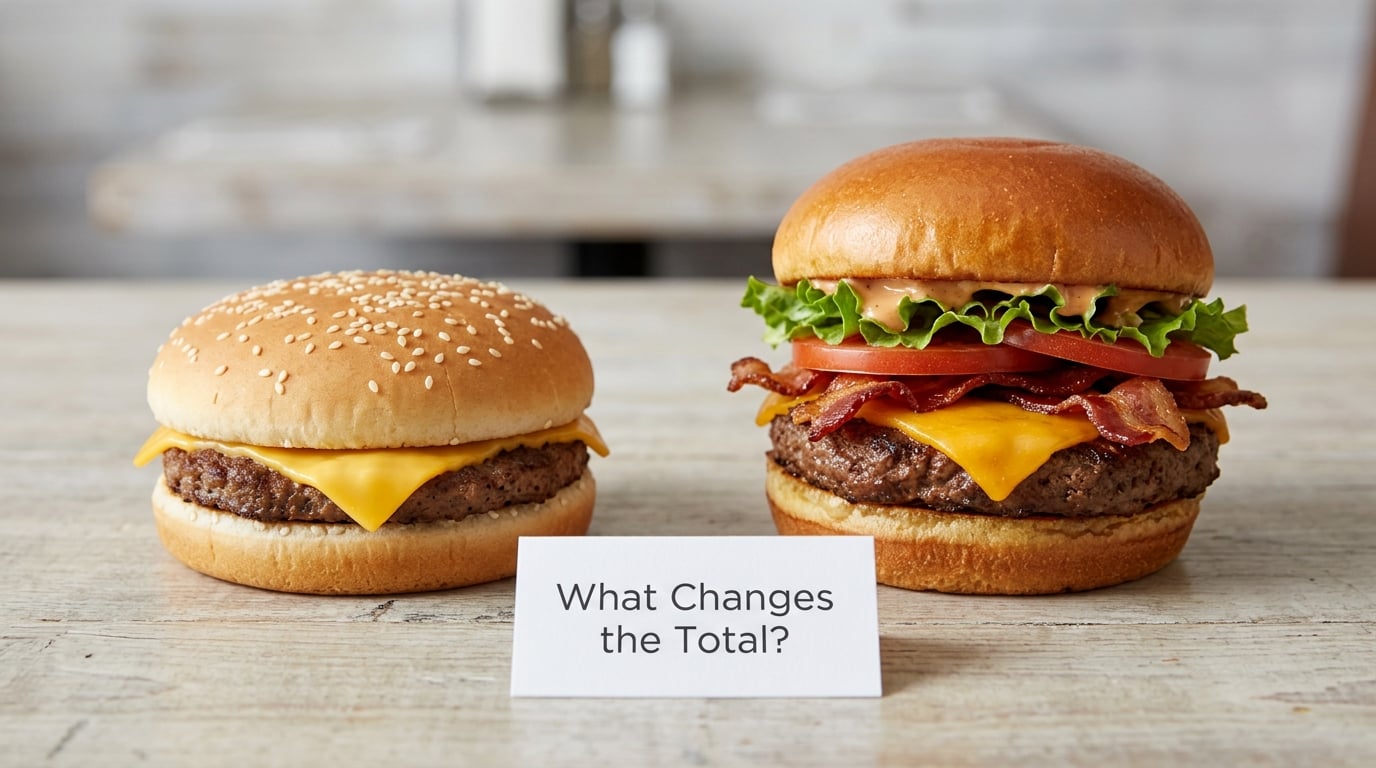
Four things account for almost all the swing between a 650-calorie order and a 1,500-calorie one.
Patty weight and beef fat
Beef fat is the densest calorie source on the plate. A lean patty and a standard 80/20 patty of the same weight can differ by 80 to 120 calories, and doubling the patty weight doubles the gap. A thin fast-food patty and a six-ounce restaurant patty are different meals wearing the same name.
The bun
A standard toasted bun runs 120 to 160 calories. A brioche or buttered-toast bun runs 200 to 280, and a lettuce wrap removes most of that. A plain roll is the cheapest item on the burger, which is why people baking at home underestimate the bread before they underestimate anything else.
Cheese, bacon and fried toppings
Each slice of American cheese adds 50 to 70 calories. Bacon is roughly 40 to 50 per slice, so a bacon cheeseburger quietly doubles both the topping count and the fat. Fried onion rings or jalapenos on the burger add 100 to 200 on their own, and they are fried in the same oil as the fries.
Sauce volume
This is the item people miss most. Ketchup and mustard together are 15 to 30 calories, but mayonnaise and house “secret” sauce run 90 to 200 depending on how generously the kitchen spoons it on. A burger and fries order from a chain that is known for sauce tends to be a worse bet than the menu photo implies.
Fry portion
A small is about 25 fries and a medium is about 40 to 45, so the step up is roughly 70 to 100 calories and a noticeable volume. Restaurant fries are not portion-controlled to any chain standard, which is why the same order number can be off by 150 calories between two locations.
How Much of a 2,000-Calorie Day Is That?
Run the math against a standard 2,000-calorie day and the number stops feeling abstract. An 800-calorie combo is 40 percent of the day. A 1,000-calorie combo is half. A 1,500-calorie loaded order is 75 percent of everything you are supposed to eat in 24 hours, delivered in about 25 minutes.
Macronutrients follow the same pattern. The 1,210-calorie Original Tommy’s order carries 61 grams of total fat, with 550 of those calories coming from fat. Their double is 73 grams of fat and 650 calories from fat. The Ben & Florentine Breakfast Deluxe order lists 97 grams of fat, 137 grams of carbs and 55 grams of protein, and the Friendly’s order lists 26 grams of saturated fat and 150 milligrams of cholesterol on its own.
Sodium follows the salt in the bun, the seasoned fries and the processed cheese, and a burger-and-fry order with a drink regularly approaches or passes the 2,300 milligram daily value on its own. If you are tracking sodium or cholesterol for medical reasons, the chain nutrition page is the number to use rather than any estimate in this article. Your doctor or a registered dietitian can tell you what fits your situation.
For the exercise side, a common rule of thumb puts 1,000 calories at somewhere around 100 to 150 minutes of brisk walking, or roughly an hour of running, for a healthy adult. It is a rough conversion and it changes with body weight, pace and fitness, but it gives the 800-to-1,000 figure a physical size.
How to Estimate a Restaurant Meal
Plenty of burgers have no published nutrition data, especially at local joints and independents. This is the most common question in calorie-counting communities, and the method that gets used there is simple addition rather than an app.
- Start with the patty. Weigh it if you can. A quarter pound of cooked ground beef is roughly 500 calories; a fast-food thin patty is closer to 250.
- Add the cheese. One slice of American is 50 to 70. Two slices, or a thick slab of cheddar, changes the total more than most people expect.
- Add the bun. A standard hamburger roll runs 120 to 160 calories. Brioche and toasted buttered buns add 80 to 120 more than the plain version.
- Add condiments by the spoonful. Ketchup and mustard together are under 30. Mayonnaise and house sauce are 90 to 200.
- Count the fries. Twenty fries is about 240 calories, forty is around 380, sixty pushes past 500. Count ten and double it rather than eyeballing a whole serving.
One calorie-counter worked a local bacon cheeseburger and fries that way, tallying one ounce of cheese, one hamburger roll and twenty fries, and landed at 1,101 calories. Another user logged the same kind of plate with coleslaw and pickles from a local place and estimated about 1,500. Both were accepted in the thread as a rough number to track against, not a measurement.
That gap is the honest limitation of the whole exercise. Log the estimate, note where it came from, and move on. Treating a database entry for a different restaurant as if it described your plate is what produces the false precision people complain about.
Ways to Lower the Calories
You do not have to abandon the order. Most of the fat and calories come from a handful of specific decisions, and each one can be undone without turning the meal into something you will not finish.
| Change | Calories saved |
|---|---|
| Skip the bacon or a second slice of cheese | 40 to 70 each |
| Ask for sauce on the side and use half | 50 to 150 |
| Swap the bun for a lettuce wrap | 120 to 200 |
| Choose a small fry instead of a medium | 70 to 100 |
| Share the fries or take half of them off the plate | 150 to 250 |
| Water or unsweetened tea instead of soda | 200 to 250 |
| Drop fried toppings such as onion rings and jalapenos | 100 to 200 |
Stack three or four of those and the same order lands closer to 550 to 700 calories without changing what the meal feels like. Dropping the drink alone moves the total by more than most people expect, since the drink is usually the least filling part of the tray.
For people who genuinely want a lighter burger and fries, a single patty with no cheese on a regular bun, a small fry and water lands under 500. That is a real option, not a compromise of the meal.
Frequently Asked Questions
How many calories does a fast-food cheeseburger with fries contain?
A single cheeseburger with a medium fry at a fast-food chain usually lands between 620 and 750 calories, counting a thin patty, one slice of cheese and a standard bun. Add a small fry instead and the total drops to roughly 550 to 670. These are the lowest figures in the range because fast-food patties are thin and chain fry portions are set to a standard weight. Published nutrition pages for these items tend to be the most reliable of any restaurant data, since the food is made to a fixed specification.
Are cheeseburger calories mostly from the fries or the burger?
It depends on which version you order. With a fast-food burger at about 300 to 350 calories and a medium fry at 320 to 400, the fries contribute slightly more than half the plate. With a larger restaurant patty at 450 to 650 calories, the burger is the bigger half and the total climbs well past 1,000. So the fries are the swing item in fast food, and the patty is the swing item everywhere else. Whichever version, the fries are the easier half to reduce.
How many calories are in a medium serving of fries?
A medium serving from a fast-food chain runs about 320 to 400 calories, roughly 40 to 45 fries. A small is around 250 to 320 calories and a large is 390 to 500. Sit-down restaurant fries carry no portion standard, so the same order can vary by 150 calories between locations and a large can pass 600. Counting the fries gives a better estimate than judging the carton size, since a full-looking container is not a reliable measure.
How can I reduce calories without giving up my cheeseburger and fries?
Order the sauce on the side and use half of it, skip the bacon or the second slice of cheese, and choose a small fry instead of a medium. Swapping the bun for a lettuce wrap takes off another 120 to 200 calories, and water instead of a fountain drink takes off 200 to 250. Three or four of those changes together move an 800 to 1,000 calorie order down to roughly 550 to 700 without making the meal feel like a different meal.
Does a cheeseburger with fries count as a high-calorie meal?
In the context of a 2,000-calorie day, yes. A typical 800 to 1,000 calorie order uses 40 to 50 percent of the whole day’s budget in a single sitting. A loaded restaurant version at 1,500 calories uses about 75 percent. It is also dense in fat, sodium and saturated fat, which is the part that matters if you are managing cholesterol or blood pressure. If you have a specific medical condition, your doctor or a registered dietitian is the right person to interpret these figures for you.
How do restaurant portion sizes affect the calorie total?
They are the single biggest variable. A fast-food medium fry is weighed to a standard, while a diner or gourmet kitchen serves whatever the plate holds, and a loaded build can add a second patty, a brioche bun, bacon and sauce. That is the gap between a 620-calorie small fast-food order and a 1,660-calorie Breakfast Deluxe with fries. The two ends of the range are the same meal description. When you are estimating, assume the middle of the range unless you know the exact item and size.
Figures last reviewed in 2026. Fast-food and chain numbers come from published restaurant nutrition panels; dine-in numbers and the estimating method above are typical values with a plus or minus 10 percent margin, since portion weights and recipe changes are not published item by item.
If you only change one thing, start with the drink. It is the easiest 200 to 250 calories on the tray, nobody misses it, and the rest of the order stays exactly the way you wanted it.