
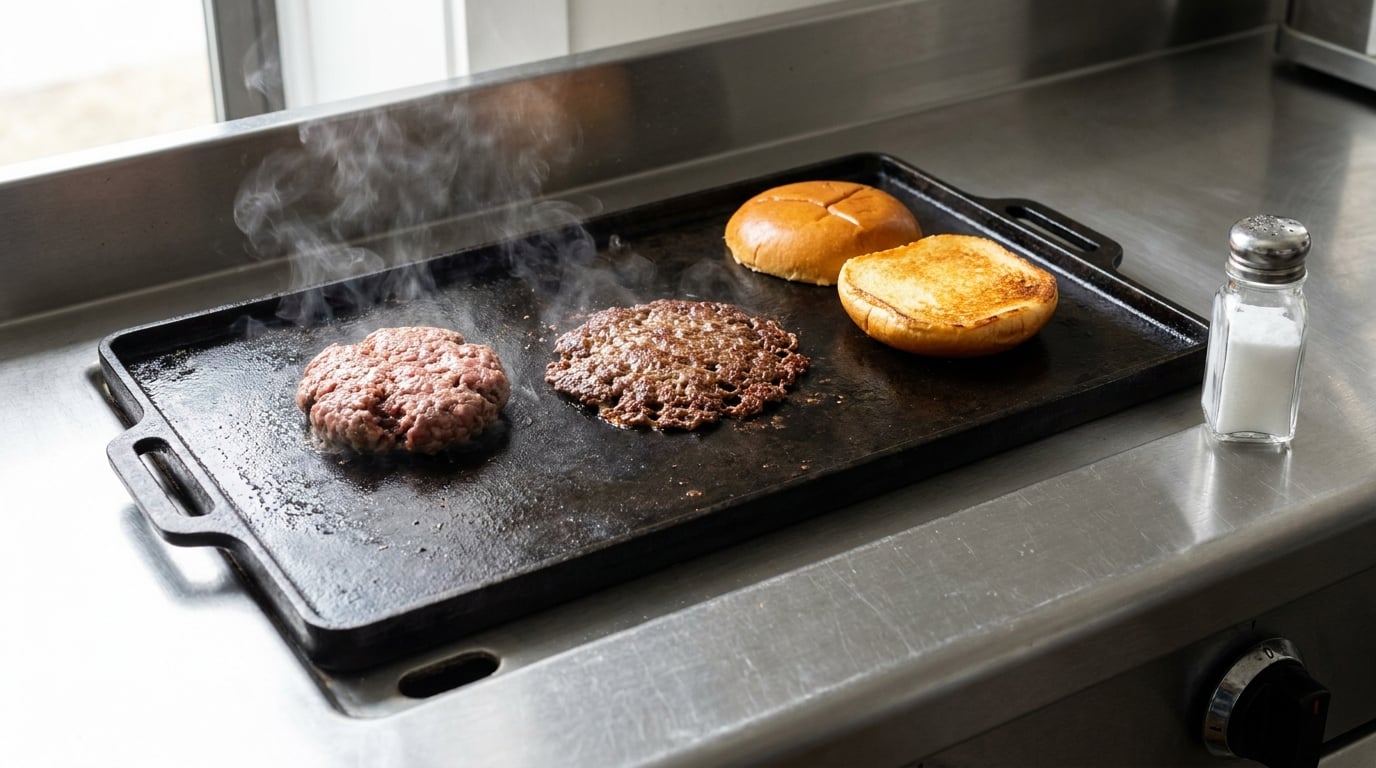
Restaurant burgers taste better because kitchens control four things most home cooks do not: a fattier beef blend, a far hotter cooking surface, seasoning applied in layers, and a better toasted bun. That is the whole answer to why restaurant burgers taste different than homemade. It is technique, not additives, and charcoal smoke has almost nothing to do with it.
I have made burgers the lazy way for years before I stopped and paid attention. Same beef, same bun, wildly different results. Once you understand which four variables a kitchen is managing, you can copy almost all of them on a home griddle.
Table of Contents
- Why Restaurant Burgers Taste Different Than Homemade at a Glance
- What Makes Restaurant Burgers Taste Better?
- How Can You Make Homemade Burgers Taste More Like Restaurant Burgers?
- Does a Cast Iron Griddle or Flat-Top Make Better Burgers?
- How Much Fat Should You Use in Burger Meat?
- Should You Salt Burger Meat Before or After Cooking?
- Why Do Restaurant Buns Taste Better?
- How Do Sauce, Cheese, and Toppings Change Burger Flavor?
- What Temperature Should You Cook a Burger to?
- What Common Mistakes Keep Homemade Burgers From Tasting Restaurant-Quality?
- Frequently Asked Questions
- What does a restaurant put in burger meat to make it taste better?
- Do you season burger meat before or after forming the patties?
- Are smash burgers supposed to taste different from thick homemade burgers?
- Why are my homemade burgers dry but restaurant burgers stay juicy?
- Can store-bought patties taste like a restaurant burger?
- Conclusion: Start With Heat and the Patty
Why Restaurant Burgers Taste Different Than Homemade at a Glance
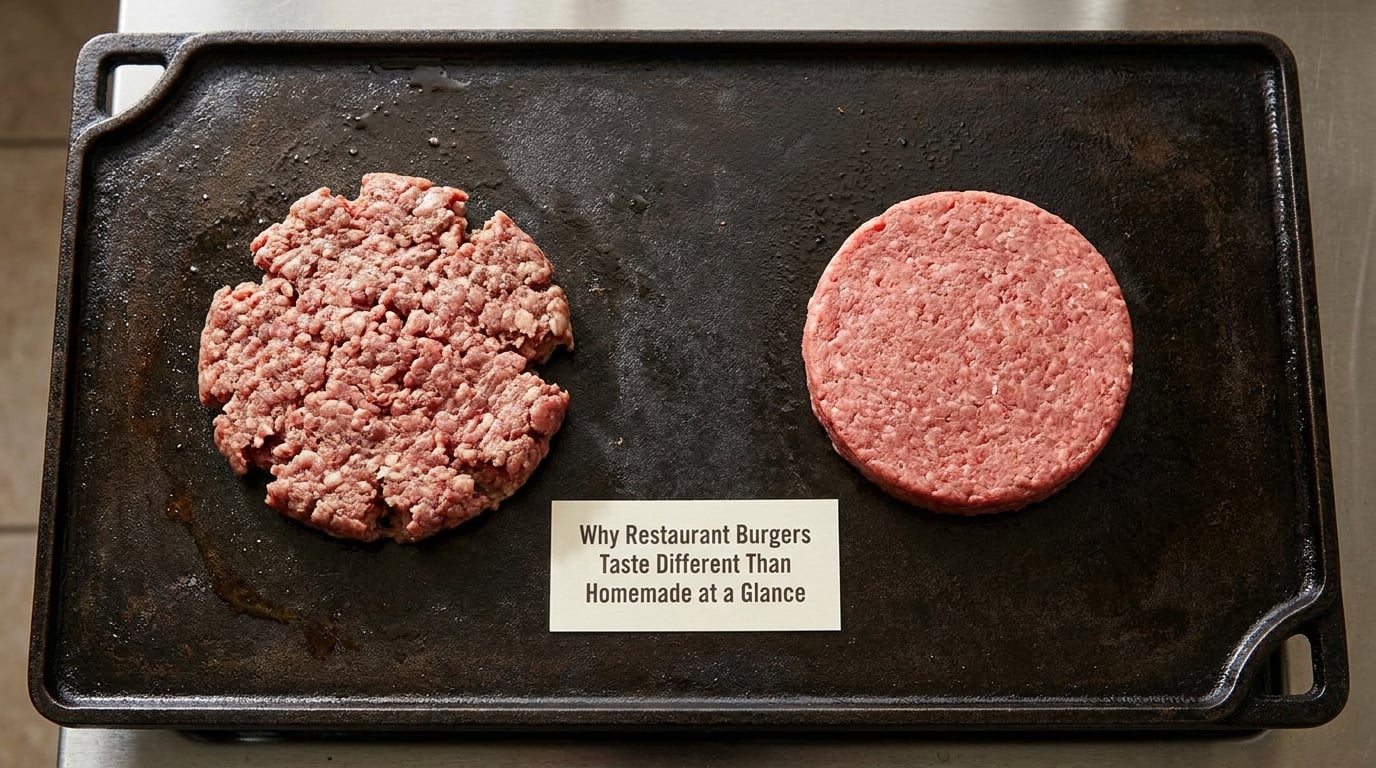
The table below sets a typical restaurant kitchen against a typical home kitchen. Every row is a variable you can change on a Tuesday night.
| Variable | Restaurant kitchen | Typical home kitchen |
|---|---|---|
| Meat blend | Chuck and brisket, ground coarse, roughly 20 percent fat | Supermarket ground round, often 10 to 15 percent fat |
| Patty formation | Loosely packed balls, pressed once on a hot surface | Overworked and packed into a tight ball |
| Cooking surface | Flat-top griddle holding 450 to 500 F | Home grill or skillet at 300 to 350 F |
| Seasoning | Salted in layers, both under and on the surface | Dusted once just before cooking, or not at all |
| Fat behavior | Rendered fat bastes the patty and seasons the flat-top | Rendered fat drips away or smokes and turns acrid |
| Bun handling | Buns buttered and griddled on the same hot plate | Bun used cold, or toasted after assembly |
| Toppings | Thin sauce spread, cheese melted, vegetables drained | Thick sauce, watery pickles, cold cheese |
| Holding | Held in a warming cabinet, cooked to order and assembled in minutes | Meat finished while everything else is still being prepped |
Read it top to bottom and the pattern is obvious. A restaurant is not doing one clever thing. It is doing eight ordinary things at a higher level, and the fat row plus the surface temperature row do most of the work.
What Makes Restaurant Burgers Taste Better?
Restaurant taste is a bundle of five outcomes arriving together, not one secret ingredient. Browned and aromatic crust. Juicy interior. Salt balanced across the whole patty rather than sitting on the surface. A bun that is warm and soft with a cut face that has caramelized. Toppings that add contrast instead of wet weight.
Home cooking often lands two of those five. The patty browns a bit and the bun is warm. What is missing is usually juiciness and a real crust, and those two are chemistry, not talent.
Why Restaurant Burgers Taste Different Than Homemade
The underlying difference is a heat transfer problem. A flat-top grill plate at 450 to 500 F dumps energy into the first millimetre of the patty surface fast enough to drive the Maillard reaction, the browning between amino acids and sugars that produces the smell and taste of cooked meat. A home grill sitting at 300 to 350 F barely starts it before the patty is done inside.
Three other differences stack on top. Restaurants run a fattier blend, so the fat renders and bastes the meat instead of leaving. They keep patties cold and loose, so they cook evenly in two or three minutes. And they season in layers, under the surface and on top, so a bite tastes salted all the way through rather than only at the edges.
Chain burgers differ again, and it is worth naming since the question comes up constantly. A fast food patty is a formed, often frozen, uniformly shaped portion cooked on a conveyor grill, seasoned with a dry seasoning salt, and held in a warming cabinet. A smash-burger shop presses a fresh ball hard onto a very hot plate for a few seconds. A sit-down kitchen griddles a loose 80/20 patty to order. Three completely different processes, three different burgers.
How Can You Make Homemade Burgers Taste More Like Restaurant Burgers?
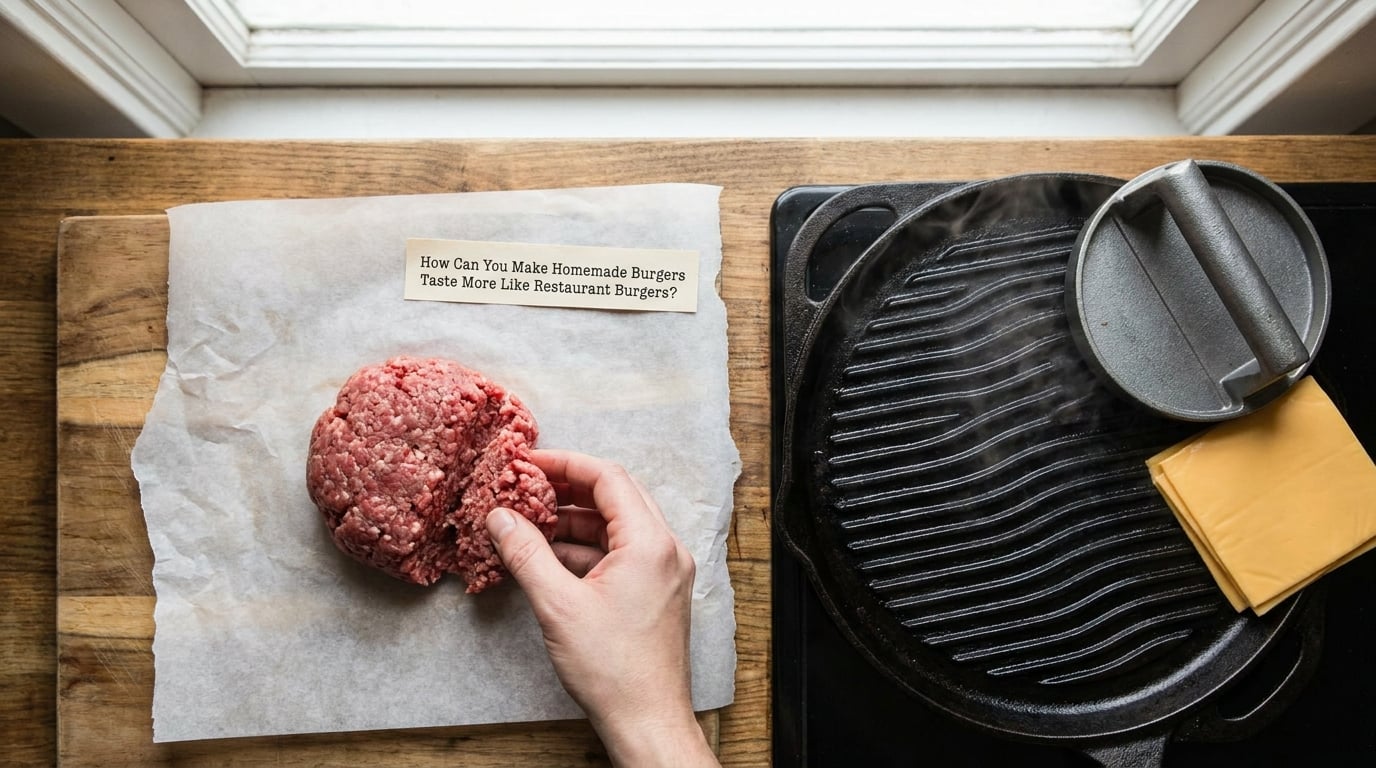
Work down this list in order. Each step builds on the one before it, and the first two fix most of the problem on their own.
- Buy a fatter blend. Ask the butcher for chuck and brisket, or pick a package labeled 80/20 or 85/15. This is the single biggest change most home cooks can make.
- Get a coarse grind. A coarse grind keeps fat in distinct pieces that render slowly. A fine grind turns the whole bowl into a uniform paste, which is why pre-ground supermarket beef dries out.
- Handle the meat gently. Divide into 4 to 6 ounce balls and pat them into shape with light fingertips. Stop squeezing the moment the edges look even. Overworking makes a dense, bouncy patty.
- Refrigerate the balls. Cold meat hits a hot plate harder. Warm patties steam before they brown.
- Preheat the surface properly. A cast iron skillet or griddle needs several minutes on high heat until water flicked on it skitters and vanishes. Cool surface, pale patty.
- Press once, right at contact. For a smash burger, put the ball down and press flat for a few seconds to build a wide contact patch. If you want a thick burger, skip the press entirely.
- Leave it alone. One flip, more for a thick patty. Every extra flip tears the crust you spent 30 seconds building and lets moisture escape.
- Season twice. Salt with the fat in the raw mixture, then salt the raw surface right before the patty hits the plate.
- Rest briefly. Thirty seconds on a rack keeps the juice in the meat instead of running out onto the board.
- Assemble last. Toast and butter the buns while the patties cook, then build and serve within a minute.
Step 6 is the one people get wrong. Pressing a patty that has already formed a crust flattens the browned layer and squeezes out the juice. Press early or not at all.
If you want the full version of that technique, our guide to how to make smash burgers on a griddle goes deeper on press timing and crust development.
Does a Cast Iron Griddle or Flat-Top Make Better Burgers?
Surface matters, but less than people think. What matters is that the surface gets hot, holds heat, and does not drip your fat away.
Cast iron skillet or griddle
Heavy, cheap, and excellent at holding heat. It browns a patty well and takes abuse. It also holds onto fat, so the tenth burger on a home griddle can taste of the first one unless you wipe between batches.
Cast aluminum flat-top or home griddle plate
Heats fast and evenly across a wide surface, closer to a restaurant plate. Aluminum moves heat faster than iron, so it recovers from a cold patty better. The trade-off is that it will not hold a searing temperature as long once the fat is rendering.
Standard home grill
Works, but you are working against the design. Grates expose both sides of the patty to open heat, so you get more evaporation and less contact, and the flare-ups drip fat onto coals instead of basting the meat.
On the charcoal question: a burger cooks in two or three minutes per side, which is not long enough for meaningful smoke penetration. A flat-top at 450 F is the reason restaurant burgers taste better than backyard burgers far more often than fuel type is. The same argument shows up whenever you compare a griddle smash burger against a backyard grill, where the surface does the work rather than the fuel.
If you own nothing special, a heavy skillet on a burner with a thin film of neutral oil, or a sheet pan under the broiler, gets you most of the way there.
How Much Fat Should You Use in Burger Meat?
Fat is where flavor and juiciness both come from. Lean beef has nothing to render, nothing to baste, and nothing to keep the center moist during a hard sear.
| Fat ratio | How it cooks | Best use |
|---|---|---|
| 90/10 | Dries out, tightens, leans chewy | Meatballs and sauce |
| 80/20 | Juicy, balanced, forgiving | Everyday burgers and thick patties |
| 85/15 | Rich and moist, more rendered fat to drain | Smash burgers on a very hot plate |
Start at 80/20 and move up if you like richer flavor. Our breakdown of the best beef to fat ratio for juicy burgers covers what each cut contributes when you blend it yourself.
Sirloin is not the secret ingredient. It is leaner than chuck, so on its own it makes a drier burger. A chuck and brisket blend gives you the flavor people attribute to sirloin without the dryness.
Should You Salt Burger Meat Before or After Cooking?
Season the mixture lightly before forming, and season the raw patty surface right before it hits the heat. Doing both is better than either alone.
Salting the mixture seasons the inside of the burger all the way through, which is something seasoning only the surface can never do. Home cooks on r/burgers and r/Cooking frequently report the opposite problem, adding a heavy salt layer to the raw meat hours ahead and finding the interior sticky and tough.
The surface seasoning happens in the last seconds before cooking. It seasons the crust, helps the Maillard reaction get moving, and gives you a measurable way to season instead of guessing.
Cook immediately after seasoning. Salt sitting on a raw patty for many minutes pulls moisture out of the surface and gives you a wet griddle instead of a dry one, which fights the crust you are trying to build.
Why Do Restaurant Buns Taste Better?
A restaurant bun is built to survive a griddle and a hot patty. A soft sandwich loaf from the grocery store is not, and it turns into a damp piece of bread under a hot patty.
Restaurant buns are more hydrated, so they stay soft for longer. Many contain milk or potato powder, which slows staling and improves browning. They also carry enough fat, whether from added shortening or from an egg wash, to brown rather than dry out. And the cut face is griddled in butter right before assembly, which builds flavor and slows how fast the bun absorbs juice from the meat.
You do not need their exact recipe. Toast a soft potato or brioche bun cut side down in butter for about 30 seconds until the face is golden, and you reproduce most of the effect. Our step-by-step on how to toast burger buns properly covers timing and how far to take the browning.
One rule matters more than the rest: toast the bun before the patty, never after. A bun toasted under assembly has already turned soft by the time it reaches the plate.
How Do Sauce, Cheese, and Toppings Change Burger Flavor?
Toppings change flavor by shifting the balance of salt, fat, acid, sweetness, moisture and temperature. A restaurant build is balanced on purpose, and a home build often is not.
- Moisture is the big destabilizer. Soggy bottom bun, watery pickles and thin tomato all soften the crust you just built.
- Salt on top of an already seasoned patty can push a burger past pleasant into curing territory. Taste the patty before adding salty sauces.
- Fat carries aroma. Mayonnaise or a fatty sauce on a hot bun releases flavor compounds that a watery ketchup does not.
- Acidity cuts fat and makes a rich 85/15 patty taste lighter. Pickles, pickled onion and a little vinegar in the sauce all do this.
- Sweetness balances salt and char. A thin onion jam or a lightly glazed bun works where a heavy sweet sauce overwhelms the meat.
- Temperature is the one most home cooks skip. Cheese melted on the patty, onions warmed in the rendered fat, and a toasted bun all add to the sense of a hot, finished burger.
Practical rules: spread a thin layer of sauce on the toasted bun rather than a thick one, drain anything watery, melt the cheese on the patty, and keep crisp toppings off until the very last second.
What Temperature Should You Cook a Burger to?
Cook ground beef to a safe internal temperature and take it off the heat before it reaches it. Resting and carryover do part of the work for you.
| Point | Patty type | Method | Check |
|---|---|---|---|
| USDA minimum for ground beef | All patties | Cook to this internal temperature or hotter | 160 F (71 C) with a thermometer |
| Carryover | Thick patties | Pull 3 to 5 F early | Rest 30 to 60 seconds |
| Thin smash patties | Under 1/4 inch | Cook fast, 30 to 60 seconds per side | Hard to probe, use color and time |
| Thick pub-style patties | Three quarters inch or more | Cook slowly, 4 to 6 minutes per side | Thermometer required, sides cook unevenly |
Verify any patty thicker than a quarter inch with an instant-read thermometer in the thickest part. Color is not a reliable signal, and a patty that is well done through the middle is still dry at the edges.
USDA guidance for ground beef is 160 F internal, measured in the thickest part of the patty, and it applies to ground meat bought from any source, including a good local butcher. The guidance is reviewed and occasionally revised, so check the current USDA food safety pages rather than trusting a number you read years ago.
What Common Mistakes Keep Homemade Burgers From Tasting Restaurant-Quality?
Each of these is common, each is fixable, and most are quick to change.
- Overmixing the meat. Work it too long and the patty tightens like sausage. Fix: handle it only until the portions are even, then stop.
- Perfectly round patties. The center is thickest, so it cooks last and dries first. Fix: make a shallow dimple in the middle so the patty stays even from edge to center.
- A cold griddle. The patty sits and steams instead of searing. Fix: preheat until a drop of water skitters across the surface and disappears.
- Pressing after the crust forms. You flatten the browned layer and push out juice. Fix: press within the first few seconds, or not at all.
- Flipping constantly. Every flip resets the browning. Fix: one flip for a thin patty, two or three for a thick one.
- Cooking to well done. The edges turn leathery long before the center reaches temperature. Fix: use a thermometer and pull early.
- Stacking the patties. Steam trapped between them softens the crust. Fix: cook in single layers with space between patties.
- Stale or untoasted buns. A cold bun absorbs juice and falls apart. Fix: butter and griddle the cut face for about 30 seconds before assembly.
And the one to stop believing: restaurants are not winning with additives. A burger patty is beef, salt, and heat. The preservatives theory shows up constantly in cooking forums and it does not survive contact with a label.
Frequently Asked Questions
What does a restaurant put in burger meat to make it taste better?
Usually just a fattier beef blend. Most kitchens use chuck and brisket ground coarse at roughly 20 percent fat, sometimes with salt mixed in and a dry seasoning salt on the surface. There is no standard secret additive. What changes the taste is the fat ratio, the coarse grind, and the very hot flat-top surface that renders that fat and forms a browned crust.
Do you season burger meat before or after forming the patties?
Both, in that order. Mix a light amount of salt into the meat before you form the patties so the seasoning reaches the inside of the burger. Then salt the raw patty surface in the last seconds before it hits the heat, which seasons the crust. Do not salt hours ahead, since that pulls moisture to the surface and gives you a wet griddle.
Are smash burgers supposed to taste different from thick homemade burgers?
Yes, and the difference is intentional. A smash patty is pressed hard onto a very hot plate to build a wide contact patch, so it develops a thin, even, crisp crust and cooks in under three minutes total. A thick patty is formed loosely and cooked slowly to a safe internal temperature, so it has more interior meat, a softer exterior, and a juicier center. They are different products, not better and worse versions of the same thing.
Why are my homemade burgers dry but restaurant burgers stay juicy?
Three causes account for most dry home burgers: lean meat, overworking the ground, and overcooking. Restaurants use an 80/20 or fattier blend, pack patties loosely so they cook fast, and pull them off the heat before they look done. Pick a fatter blend, stop squeezing the meat once the edges are even, and use a thermometer instead of color to judge doneness.
Can store-bought patties taste like a restaurant burger?
Sometimes, and the patty is rarely the problem. A store-bought 80/20 patty is fine if you skip the seasoning already in it, press it onto a properly preheated surface, and cook it fast. If it tastes flat or rubbery, it is usually a lean blend packed too tightly. Buy a fatter fresh blend, and the patty stops being the weak link in the burger.
Conclusion: Start With Heat and the Patty
If you change two things this week, change these. Preheat a heavy surface until it is genuinely hot and cook an 80/20 patty shaped without squeezing. That combination alone fixes the crust and the juiciness, which are the two things home burgers usually miss.
Everything after that is refinement. Salt the surface right before cooking, press only in the first seconds if you want a smash burger, butter and griddle the bun, and drain anything watery out of your toppings.
The answer to why restaurant burgers taste different than homemade is that a kitchen runs a hotter surface on a fattier, better-handled piece of meat, then finishes the build on a toasted bun. None of that needs equipment you do not own, and none of it is a secret ingredient.